The University of Texas at Austin Athletics
Can you describe for us your background and your ultimate journey to the Behavioral Health position here at Texas?
I went to UT for my undergrad and graduate degree, both in social work. Right after I got out of grad school, I worked at a community crisis center for about three years and did therapy for domestic violence, sexual assault, and sexual abuse. I also earned my LCSW during that time.
I wasn't particularly looking for a sports job when I kind of fell into this role at Texas. I was browsing the UT job website, seeing if the on campus mental health center was hiring and came across this opportunity. They were looking to hire an expert in the mental health field to help build and implement a more well rounded and adequate behavioral health program for the athletes. I thought to myself, “I'm never gonna get that”, but here I am. I've been here for about six and a half years.
Prior to my hiring, Texas Athletics had limited education and services for behavioral health. Due to limited education for students, coaches, and staff it wasn’t talked about as much as it is now. Since then, the program has grown exponentially and we've basically tripled in numbers of utilization. It's become a highly used resource.
Texas asked you to build the mental health program. Walk us through the process you started six and a half years ago.
We've expanded in all aspects. I was the first full-time staff member that was a mental health clinician to take a role here. It was simply myself and some outside contractors. Much of the work was managing the independent contractors in addition to having my own caseload. We also worked really hard on developing a program to educate coaches and connect their athletes to our services.
The bigger the department became the more I realized it was much more than a one person job. So, over time I started to build an internship program, bringing in clinical social work interns every spring and summer semesters, adding another full time staff member, and increasing the number of contractors we utilize. Including myself, we have two full time staff members, 7 contractors, and 1-2 interns making our team between 9-11. It really showed that we, as a department, were being utilized and our services were helpful. We started off small and had to do a lot of education, relationship building with coaches, and lots of advocating on why mental health is important and decreasing the stigma surrounding behavioral health.
Could you describe the unique opportunity you have in working with Texas’ elite level athletes?
The first thing I like to say is athletes are people. A lot of times people forget that and they don't view the athletic population as vulnerable. On one hand, I do get to do the same things that I did prior to UT. I do have athletes that come in with trauma and that have experienced things like sexual assault. On the other hand, I also get that some of the differences come from the vulnerability aspect specific to being an elite athlete. Vulnerability can look like pressure from coaches, parents, and fans especially at this level. Many times It can look like a lack of control. Student Athlete’s schedules are jam packed and they are expected to show up when they're told to.
At this level, athletes are in the spotlight so everybody has access to them and that's something that also has changed over the years with social media. The general public gets to know all of their business. If one of these kids makes a mistake, it's all over the media and they have thousands upon thousands of comments.
I believe that we forget that athletes are also people with people problems. They're also young adults so they're experiencing the same transition of going to college, leaving home, and being home sick that non-athletes do. People see them on Saturdays on national television and they don't think about the person they are behind the scenes. To many fans, all they are is just their performance, which is sad.
Our student athletes will never be able to perform at the level they could potentially perform at if they're not taking care of their mental health.
What are some key educational factors that coaches and donors alike should know about the behavioral health departments' importance and expertise?
Particularly with coaches, giving them information on different types of mental health issues that they may see in their athletes has been very beneficial. Additionally from a coaching level, educating them on how to manage it appropriately is essential. Our department likes to give them very tangible identifiers around different mental health challenges their athletes face.
Much of the education we provide helps answer questions like: What are these things? How do you identify them? And what do you do about them? At the end of the day, coaches are in charge of their athletes - physically and mentally. We want our coaches to feel comfortable having these conversations with their athletes while also encouraging their athletes to take advantage of the resources provided.
The big question I get asked is “why is mental health important?” A big misconception of being mentally tough is simply toughing things out and getting by. However, people forget that you can't have mental toughness if you're not taking care of your mental health first.
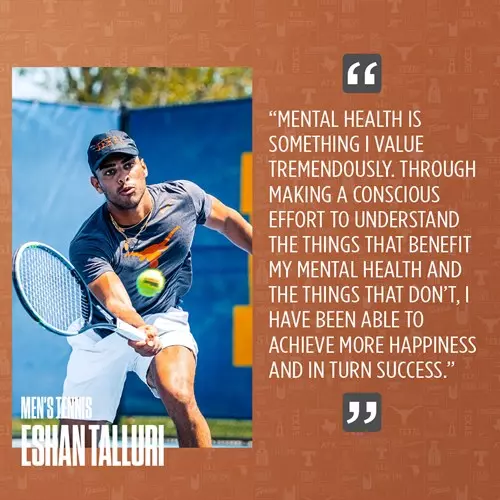
How would you like to see the Behavioral Health department grow?
I definitely see our program continuing the need to grow. Having the ability to work with more contractors would be game changing and we still have a need for more staff. Even a two staff member operation like we have now is sometimes stretched thin to cover about 500 athletes. I would like to see more growth of all kinds within the program. One roadblock we run into is that our department’s importance and influence is not always understood. It’s hard to show the impact our department has on the athletics department as a whole because behavioral health is such an intangible aspect of excellence.
How would you describe the importance of behavioral health for student athletes?
Our student athletes will never be able to perform at the level they could potentially perform at if they're not taking care of their mental health. Everything is intertwined; Our physical health, our mental health, and our emotional health are all together. We can't take care of one and not the other. Our department aims at building well rounded individuals, not just athletes. We want our athletes to perform at the highest level because they care about this university and we care about them too. You have to invest just as much time and energy into mental health that you do physical health to make those things happen.
Can you speak to the gratitude and the appreciation you have for the fact that we work at a university where mental health is a priority?
A lot of my colleagues at other universities don't have the same support that we have the privilege of receiving here at Texas. It's nice being a part of a system that is trying to learn and do better in mental health. Six and a half years ago it looked very different than it does now. I'm super grateful to see the growth in our department. When I first started, that first year we only had about 900 appointments. We average a little over 3,000 now, so we really have grown. I'm grateful for the people who want to understand our area of expertise, even if it's harder. It’s so encouraging for us to know that there are people that are acknowledging that the mental health of the student-athletes is a crucial part of competition and keeping Texas great.
At other institutions, funds are delegated to different departments to simply fulfill obligations. Here at Texas, we have a program that emphasizes filling that need and dedicating money to the mental health of our athletes because we recognize how important it is.