

The University of Texas at Austin Athletics
Describe your background and journey to your career at the University of Texas.
I attended school at San Diego State in the 1990s. I started out pre-physical therapy, but decided it wasn’t for me. My mom talked to me about it and she said, “You know, you were always into nutrition. Why don't you check it out?”. Soon after, I took my first nutrition class and just loved it. I always wanted to work with athletes and active individuals, but at the time, sports nutrition really wasn't a niche in nutrition compared to now. After I finished my dietetic internship and passed my credentialing exam, I moved back to Texas since I'm originally from here. While building my career, I took any opportunity that came my way to be involved in sports nutrition, whether that be writing articles for sports nutrition books or speaking for free at running events or just any opportunity that I could get to talk about sports nutrition, I took advantage of it. I served in several different roles as a dietitian prior to starting my career at UT Athletics. I worked in public health, also worked in a role on campus as a dietitian in the student services building. I also started building a private practice on the side and did that full time for about 10 years. That is when I started consulting with UT Athletics. I served in the consultant role for about 5 years, and during this time, the need for a full time sports dietitian became important for the athletics department. When the job was posted, I wasn’t sure I wanted it, since I felt I was working in my dream job of having my own business. But, I realized that over time, I developed a vision for building out the performance nutrition department at UT. I wasn’t sure I would get the job, because in my mind, I was the least qualified because I didn't have any full-time experience running a collegiate program. However, I had a vision, passion, and relationships that I had built over time, and I let that lead me in the interview process. Thankfully I was awarded the position; that was 10 years ago.
Could you describe the unique opportunity you have in working with Texas’ elite level athletes?
I think that's what intrigued me about taking this position is that fact I get inspired when I drive into work every day because we are working with the best athletes and coaches in the country. The athletes and staff alike push me to practice at the highest level of my credential. There is always a drive to be looking for ways to stay elite and world-class and also to provide the best level of care to our athletes. I also find it very fulfilling in building relationships with the athletes; they are so gifted and so talented. A lot of times, they've never had to think about nutrition before and so if you can give them a little insight to become even a little bit better, to recover better, or to feel better in a workout is incredibly fulfilling. Our department has such a cool opportunity because we help to build life skills over time. Our work is not just about performance nutrition because we care about their health and wellness for long term too, so that guides the work we do with each athlete. We use the TANC (Texas Athletics Nutrition Center), as a learning lab. We're teaching them nutrition education in the office but then the practical application of it is in TANC, in cooking classes, cooking demos, or even grocery store tours which are all really fun. Being able to work with these top-level athletes and help them to learn about their nutrition that's going to help support their performance, health, and wellness is really rewarding.
What are some key educational factors donors and coaches alike should know about your department’s work?
What's important is that we have enough staff so that we can have a presence in all the sports teams. My philosophy is that if you're there, you care. During Covid, we went from seven dietitians to three so we had to change our service model significantly and that meant we couldn't go to as many practices or competitions. We’ve bounced back from that and are back up to 5 full-time sports dietitians. Being fully staffed is important, because it means that we can get to know the athletes that we serve, we can be in their environments, and we can ensure we provide individualized care. In individual nutrition consultations we're providing clinical care that only a credentialed dietitian can provide. Nutrition education is happening pre or post lift or workout, and also up in the TANC doing live plate coaching. We also conduct applied performance nutrition which is directly applicable to practice and competition. Applying that nutrition education in the moment when food is happening is important to the educational aspect of sports performance. There's education going on one-on-one with the athletes, in a team group setting, and then a lot of life skill education.
Food and fueling our athletes is something that's very practical. It's something that donors can help support which has such a positive outcome on their performance, health and wellness.
TANC is an important resource for student-athletes. Can you describe its inner workings and how it evolved to be more conducive to helping student-athletes over the years?
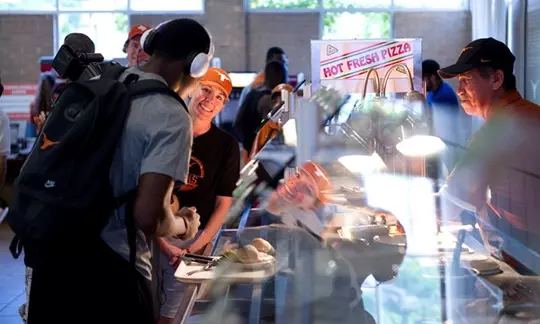
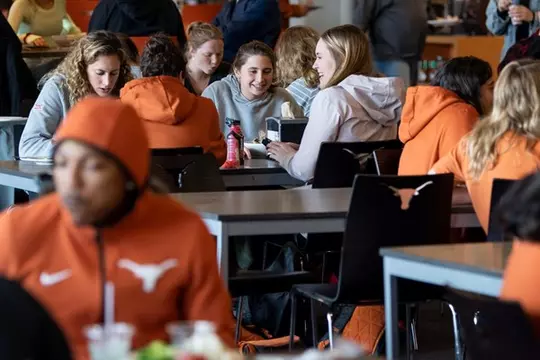
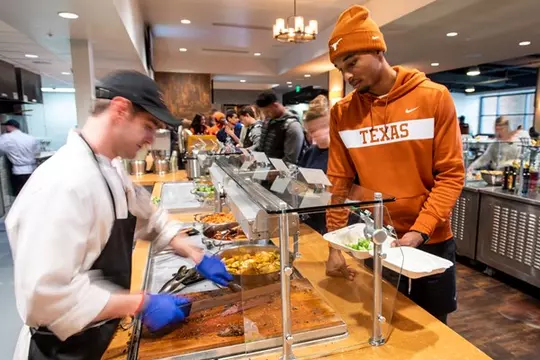
We used to have the Longhorn Dining Hall that was connected to Jester Dorm. I started in my position, I had five strategic goals goals that I wanted to achieve in those first few years, and one was changing Longhorn Dining Hall from really just food we're providing you to true performance fuel. What's important is that performance fuel has to be approachable. If somebody doesn't know anything about nutrition and they go into the TANC and they don't recognize any of the foods or never tasted any of these flavors before, then it's really hard to apply performance nutrition – the fuel has to be approachable. I want nutrition to be delicious and while at the same time you're learning what it's doing for you. I think many times people think that those two things can't exist together. We try at the TANC to make sure that those jointly exist. We were out of space over at the old Longhorn Dining Hall when we were able to begin providing more meals to our student-athletes after deregulation of feeding (NCAA bylaw change), so we took three outdoor concession stands in the North End Zone of the football stadium, and turned it into our Texas Athletics Nutrition Center, or TANC. My goal there is that no matter what your sport is, what your goals are, what your relationship is with nutrition, that you're going be able to find something to eat that you enjoy, and and you're going be able to individualize it for your sport and goals. It's broken up into different stations on purpose so that you can individualize your nutrition as needed. You're eating delicious food and it happens to also be nutritious too.
Can you describe the importance of nutrition and health education for student-athletes?
The biggest thing that I've seen to be true is a quote that I can't take credit for, but it says, “Nutrition can make a good athlete great or a great athlete good”. Whether it's the athlete’s daily choices, not supporting their recovery, not supporting pre-workout fuel, not meeting adequacy for their activity load, or even not getting the right nutrients to help to decrease the inflammatory process, all of these things can contribute to poor performance and overall struggles with general health and wellness. One of the challenging parts of our job is that one has to be ready to make changes – so our job is to build the importance of how nutrition can support optimal performance. That’s why it’s so important for the dietitian to be integrated with teams because they're building relationships and they're building trust with the individual athletes. Hopefully, those athletes will come to us and ask questions, be interested, and want to make those changes. Whenever athletes come to us to discuss potential barriers in their nutrition, we conduct a lot of screening to determine their overall health and wellness. Whether that's lab work for iron levels or checking their vitamin D, we look for a number of things that contribute to nutrition as a whole. When we see our athletes start to make small changes, we see improved sleep, recovery, and workout and competition performances – that’s very rewarding!.
How has Texas nutrition developed over the course of your career here at Texas?
In 2012 it was just me providing as much as I could to as many athletes as I could. The demand definitely changed over time to where we now have a staff of five, with three full time dietitians to cover our Olympic sports and one solely for our Football team, and my role is to lead the department, while also covering sports. It became very evident that if I was going to be a director and a leader of this department, that I needed to have all hands-on deck. The food service operational side of our department is often overlooked, but it takes a lot of hands to ensure we have pre/post workout nutrition available at all of our fueling stations/facilities. So, when it was just me, I was having to do all of that in addition to the clinical care and the education. Now, We have three paid fuel station managers who are our part-time undergrad or graduate students who lead our 30-person intern program. They assess inventory and day-to-day operations so that the dietitians can focus on the clinical work and the nutrition education. We wouldn't be able to do the work we do with our student-athletes without our volunteers and part-time nutrition operation managers.
Can you speak to the gratitude and the appreciation you have for the fact that you work at a university where student-athlete health and nutrition is deemed important?
I do feel very fortunate, I've been supported in so many ways. I have a lot of colleagues at other schools without the resources and the number of sports dietitians that we have. We wouldn't be able to have this depth with all of our teams if we didn't have the support and staff that we do. I'm very appreciative because we're able to do this kind of work and we're able to have that individualized reach with our student-athletes. We were able to do over 850 individual consultation, and 175 team talks this past year and that just in itself is a lot. I'm especially grateful for the TANC because it’s a very valuable resource for our student-athletes. The athletic department is very supportive and that is so important for the student-athletes.
How can donors help contribute to the health and wellness of our Texas student-athletes?
We would really like to get the sports nutrition residency position back within our department. We would also like to continue to pursue opportunities for growth and have our dietitians stay connected and involved with our athletes. The growth of sports science and the ability to monitor and individualize things for our athletes has been critical. The emphasis on individualization is really where things are headed, and you just have to have the staffing to be able to support that. A dream of mine is to have a teaching kitchen connected to the TANC, so that hands-on education is convenient and practical. Food and fueling our athletes is something that's very practical. It's something that donors can help support which has such a positive outcome on their performance, health and wellness.