

The University of Texas at Austin Athletics

Can you describe your background and journey to your career here at UT?
I grew up in Tennessee and played football my whole life. The weight room became this vehicle that helped me become a better football player and led to me getting a full scholarship to play football at the University of Georgia. I had a great experience at Georgia, but went through some very hard times too, as I hurt my knee in my senior year. Thus, the weight room not only made me a better football player but also helped me get healthy, and led to my career and coaching profession. I was always trying to figure out what I was going to do after football, and the weight room has always been that piece that’s made a difference for me. This led me to coach at the University of Colorado as an intern, and I haven't looked back since.

Can you describe the unique opportunity that you have working with the elite athletes at Texas?
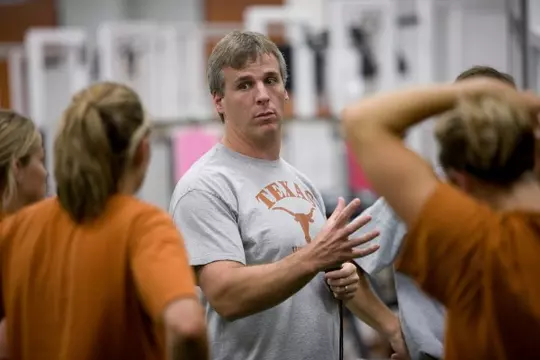
When I drive to campus every morning I get to see the Tower, which is always a reminder that every day is an opportunity. I've always felt that my calling is to mentor, influence, and shape the lives, minds, hearts, and souls of these young student-athletes. Now, my tools are the weight room– a barbell, dumbbell, recovery, conditioning, a difficult moment, a conversation, a question, an encouragement, or challenge. At the end of the day, if you sum it up, I'm teaching kids to win in life. And that's kind of my motto as a coach.
Walk me through a day in your life here – What time are you here? What time do you head home?
First and foremost, I have a family. I’m coming up on 27 years of marriage to my beautiful wife Karen, with whom I have four daughters. Everything I do in life stems from me being a family man. If I'm a better husband, I'm a better dad, I'm a better coach. I don’t believe in compartmentalizing my life, I see it as all one thing.
I'll leave early – 6:30 a.m., and I’ll get here at 7:15 a.m. to get ready for my first group. I've learned over the years that if I can get my morning routine down, meaning: coffee, little quiet time and self-reflection – then I know I’ll be in a good place and be more suited to help my student-athletes, because that’s what I’m here to do – I’m here to serve. Then, at the end of the day, I want to make sure I'm at home and I'm present with my family. Those pieces of my life are so important. There are certainly times and seasons as a coach where you spend more time at work than you do at home. But then there's going to be seasons where I've got more time, I can spend at home than I do at work. I'm always trying to figure out how to navigate that balance, because I spell love T-I-M-E.
The money donated now not only helps our athletes succeed on the field, but also creates a strong and loyal base of people for our university for years to come.Donnie Maib
How have you seen our athletic department grow during your time at Texas?
On a micro level down in my world, everything's becoming very specialized. 20 years ago, when I first got into this field, not everybody used the strength coach. Now everybody does– golf, rowing, tennis. Nowadays, everybody's realizing the benefits it gives you to train and be in great shape. You're seeing a trend towards a specialization of services. I need to be a golf swing coach to better train our golfers, I need to know how to train a tennis player, a soccer player, a volleyball player– everybody. When I first started your football strength coach trained everybody, and everyone trained like a football player. Not anymore. Now the head coach's philosophy sets the tone for the whole team – you need to work in lockstep with him and her. It also depends on your student athletes. Most kids haven't trained like this prior to arriving on the Forty Acres, whereas in a sport like football, you’ve got guys who have trained for several years. A lot of education about this stuff goes on behind the scenes, which is why I like to call my department the team behind the team.
This support staff has really grown through the years as well. Obviously my world of strength & conditioning and athletic training, but now you also have things like sports nutrition, sports science, and mental health or behavioral health professionals.It’s become much more complex, and different departments have different needs. If you want to compete at the level we expect to at Texas, it’s not free and it’s not cheap. We’re constantly trying to improve what we can offer our student athletes, whether that means buying new equipment, our coaches taking a trip to learn from certain experts, creating more meeting and training spaces, or building better facilities.
What's the team environment like with the athletic performance coaches? How much do y’all collaborate and work together?
We have 20 teams at Texas, and they have 20 unique, completely different cultures. As a result, our strength coaches need to be intimately involved in that team culture. For example, I have a small group meeting later today with some of my players. It’s not just about seeing them in the weight room– you need to be in a lot of these other meetings and communication lines, so that you're helping move that needle for that team. Each strength coach has the freedom to work in a way that best fits each team, but we all guide how we do things on the same principles. For example, if the team's running a lot, I know I don't need to run them even more– I need to do more soft tissue work or mobility/stability work with them. But if they're not running much, I need to fill that bucket. There's going to be some guiding principles that we all follow. I think rule number one for us is just to do no harm. We're always mitigating and managing risk.

What are some of the highlights you've had working with these incredible student-athletes during your 25 years at Texas?
I'm always trying to figure out how I can have an impact on our athletes. When they leave here there should be something that we talked about in a conversation, or something experienced in a workout or a difficult season where I was able to shape and mold how they think and view life, how they carry themselves as an adult and as a community leader. One of the highlights for me is whenever I see an athlete five or ten years from now and they say “the lessons I learned from you really changed my life; my time at Texas made me a better leader, a better sibling, a better mom.” And then secondly, the fact that I’ve been able to be a part of four national championship teams. One with football, two with volleyball, and one with tennis. It’s a goal we all strive towards, but is so difficult to achieve, so to be a part of those wins and to carry on the standard of excellence we expect at Texas when we light the tower– nothing else compares.
What are some challenges you face?
I think number one is education– not just ensuring that our athletes know what I’m asking them to do, but also our coaching staff. Just making sure that everyone knows what we’re doing and why we’re doing it, so that they can see the value and impact what we do will have on the field. Secondly, we’re constantly fighting for time. The NCAA is always fighting (understandably) to protect athletes' time, so we do everything we can to maximize what time we do have and try and squeeze out as much as we can.
You mentioned trying to educate people to see what it is you do and how that improves our teams, can you expand on that?
The biggest thing is that 1% difference. It’s very easy to do that first 99%, but the level that Texas competes on, we need to get 1% better. And that 1% is a lot harder and more expensive to achieve than that 99%, but that’s why we’re here at Texas. Because when we step on the field with Stanford, with Michigan, with Alabama, what is our edge? Our edge is our incredible donors, who give us the time, the resources, and the facilities to provide support to our athletes that is unmatched by any university. When you give us that 1%, we’re going to be a difference maker.
Can you speak on your gratitude for the level of service we’re able to provide our student athletes?
When I blew out my knee in college, my mental health program was someone kicking me in the rear and telling me to suck it up. So to see how far we’ve come is really impressive. I have an appreciation for the attention and care we’re able to give to our student athletes. Are we perfect? No. But we are always trying to figure out how we can be better, whether it’s providing counseling, or more conditioning, or nutrition education. What we are able to do at Texas is just mind blowing. We want to do everything we can to set these kids up for success, so that if they aren’t successful, it won’t be because we failed to give them an opportunity to be. Part of my job is making sure these kids see the opportunity they’ve been given so they don’t take it for granted. With the transfer portal, getting kids coming from other schools, 9 out of 10 of these kids have never seen anything like what we do here before. Much of what we do is under the hood, it’s behind the scenes, it isn’t on social media or on the website… but it’s absolutely making a difference, and no one can match it right now.
You’ve touched on this a little bit, but one more time can you mention to our donors about how they can contribute to our student athletes’ success?
First and foremost, we have to remember that these athletes are still people. They’re human beings who are going through struggles and difficulties, and so what you might not see from the outside is when you donate, you’re helping them get over that hump and be successful. Not only will this help them find success on the field wearing the burnt orange, but it's helping them be successful in life. You’re setting them up to succeed in their 20s, their 30s, their 40s and beyond. And when they’re later in life and they look back on the opportunities given to them here, they’re going to be thankful and loyal and motivated to give back themselves. So the money donated now not only helps our athletes to succeed on the field, but also creates a strong and loyal base of people for our university for years to come.