The University of Texas at Austin Athletics
Longhorns Olympic Trials Q&A: Raasin McIntosh
06.11.2012 | Track & Field / Cross Country w, Track & Field / Cross Country
June 11, 2012
Longhorns in London 2012
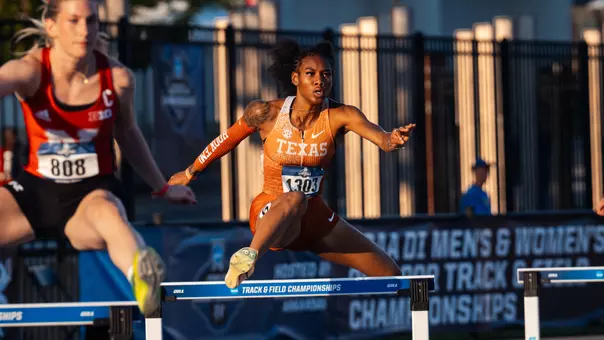
AUSTIN, Texas -- Raasin McIntosh made her mark as a hurdler for Texas Women's Track and Field during the 2003 NCAA Outdoor Championships.
That year, McIntosh placed second in the 400-meter hurdlers, third in the 100 hurdles and also ran the third leg of UT's championship 4x400 relay team.
McIntosh also won eight Big 12 championships and in 2004, she placed fifth at the Olympic Trials in the 400 hurdles with a personal best time. Now, after some time away from competitive running, McIntosh is focused on qualifying for the London Olympics later this summer.
She recently spent some time with TexasSports.com to discuss her outlook and training journey.
What memories do you have of watching the Olympics when you were younger? Carl Lewis, Marion Jones, and Miles Clark - I have great memories of US runners in the 400 and 4x400. It was the Atlanta Olympics that I particularly remember. I watched the swimming and diving that year. I do not remember anything in particular but watching the sprints and the 4X400. They were always memorable
When did it become a dream to represent the USA in the Olympics? I always knew that I would be great when I was younger, I just did not know what I would be great at. I thought I would be this great basketball player, but I ended up being a great track runner in high school. Once I was introduced to track by Rose (Brimmer), who is the assistant coach here, I developed great expectations for myself. I figured as a runner the greatest thing that you can accomplish is the Olympics. So I developed a goal of becoming an Olympian and represent the country.
When did it become a goal to represent the United States in the Olympics this year? I always had the goal when I was in high school and college. I ended up falling a little short in 2004 with placing fourth. I missed it by one and decided to take some time off to learn about myself and grow. I took almost eight years off. God kept my body and my health in great shape, so all I had to do was fix spiritually and mentally. Once I grew in those areas, I thought now I know what am I supposed to do. I am to return to track with one goal in mind, to get an Olympic medal and run a couple years after.
Was there a particular moment when you came to the decision to return to track? Somebody said I was through. They said I had a career, and I decided to walk away from it. They said I had opportunity and did not take advantage of it, basically saying that I could not do it anymore. I thought to myself, "I am the only one who can say I cannot do something." I am not saying, I am here and back to prove something to anyone, but I am back to finish what I started. I needed time off and there was nothing wrong with me taking that time off long as I can come back. That window of opportunity is still definitely open for me, and I am gong to take advantage of it now that I have grown. I have spiritually grown and mentally I can enjoy it. I am a different person. I think I am a better person. I am more dedicated. It is a matter of time before things come together for me.
You have always had the speed and ability, but now that you have the mental aspect, are you better prepared? Yeah, I think I was a bit hot headed when I was younger. As strong as I was outwardly, inwardly, I struggled with myself. I had a few fears that I had to face. One of those fears was the fear of failure. Now growing through experience, I understand that failure is not an option to me, failure is something that I give energy to. Losing is not a failure; it depends on how you look at it. Bev (Kearney) said today in practice that losing can be a win depending on how you look at it. Any loss that you take is making you better for the greatness that is ahead for you. I had to understand that. Instead of taking a loss and coming back even harder, I decided to take a loss and run away when I was younger because I was not accustomed to losing. But now, I know how to lose now. I am more dangerous than I ever was because I have been down and back. I am not afraid of anything. I love competition. I am not afraid to lose, but when it comes that time to take my wins I will stand up and take my wins like a champion.
What do you take away from Bev? The intensity and understanding that spiritually you been to be in a place to be successful and not just physically. Working on an athlete's mental and spiritual part is extremely important. You can have all the talent in the word but no work ethic, and you go nowhere. There is an understanding that I have to train myself in every opportunity to choose to be a champion, to choose the gold medal and that is whatever I eat, who I hang out with, train with and everything else. Making a decision to take the gold medal is a spiritual training with intensity.
Does your understanding of track possessing a physical and spiritual aspect, give you an advantage? It gives me a better vision, a better understanding. You can come at something in one way but never see that there is another side to it, this time around I am coming at it from different angles. I can understand things that are going on with me that I could not when I was younger because I was able to coach and help athletes do that. That does give me an advantage of the sport and how I understand it. I have taught it.
UT is very well represented at the Olympics, does that provided additional pressure? Pressure is good. If you are not feeling any pressure you are not where you are suppose to be at that time. I embrace pressure. There are plenty of people that come from UT, swimmers particularly. There is respect, but everyone has to get out there line up, get on the swimming or track line and perform at the time they have to perform. With that there is a respect of every athlete that we share in common.