Coaches Corner: Q&A with Track & Field Head Coach Edrick Floréal
9/22/2023

What has been one of the most memorable and valuable parts of coaching at The University of Texas?
I think winning. That’s probably the only thing that you’re chasing on a consistent basis. Obviously, you’re developing young people and getting them to graduate and become better versions of themselves. But ultimately as a coach, I would be a hypocrite to say that winning championships, developing winners and investing in young people who can go to the next level of their life after their best in the business isn’t probably the coolest feeling.
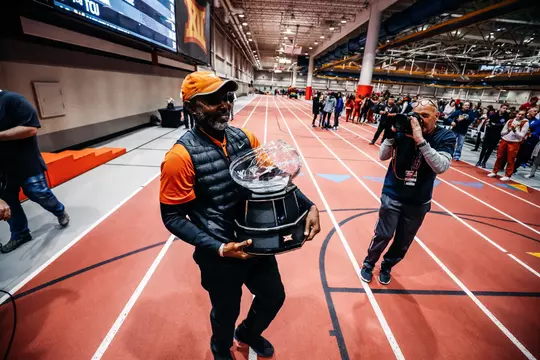
You ran in the Olympics as a Canadian in 1988 and 1992. You’ve produced eight Olympians in your track and field program. Can you describe what that experience is like and what that means to you to be producing Olympic talent?
The Olympic movement is obviously the birthplace of all athletics, so any time a kid can add the letters “OLY” next to their name, which is now anybody who goes to the Olympics, is incredible to be a part of… It’s not just the actual running fast and performing well, it basically puts you in a fraternity where you’re looking at the top 1 percent … It’s the crème de la crème of the elite level, and that’s the aspiration that everybody has … For any athlete, getting to make and compete at the Olympics, is probably the Mount Rushmore of athletic success … When an athlete makes it to the Olympics, I know how they feel because I’ve had that feeling as well.
What is the hallmark of your coaching philosophy?
To me, it’s all about the “ah-ha” moment. Taking somebody who has low confidence in themselves and infusing a vision about how great they can be and pounding it in until they take hold, that’s the thing that excites me the most. Having a superstar become a superstar, that’s common, that’s supposed to happen, but having the one kid that is not tagged to be a superstar or anything and having them put a mark on history, that’s probably the thing that excites me the most.
You were a triple jumper and five-time national champion at The University of Arkansas. How does the state of college athletics, and the opportunities allotted to Texas student-athletes through the Longhorn Foundation compare to that of the late ‘80s and early ‘90s?
Oh gosh (laughs), there’s no comparison. If I have to compare, I don’t even know if I can find a word. It’s like human beings right now compared to Neanderthals, there’s nothing that can even connect to it. Back then, we just ran track and competed. The layers of resources provided to these young people is unparalleled. When a kid leaves Texas as a grad student and goes elsewhere, I’ve had multiple former Longhorns who have contacted me and told me, “It’s nowhere near the same.” The level that we operate at here at Texas is so much different than everybody else … The kids who transfer are just flabbergasted by the level of involvement and support that they got here in comparison to other schools. I don’t think they would know it unless they have something else. It’s almost like if you’re always eating chicken, you don’t know what steak tastes like until you have it.
How vital have donors been to the success of your program?
Oh man, I think it’s invaluable. If you think about the current days of track and sports in general, it’s close to a semi-pro model with NIL. All this stuff added to it that coaching ability, albeit great, and success, albeit great, but there’s so much more being offered by other schools. Having a foundation that can support that vision and give you the resources to level the playing field – if somebody is getting XYZ from another school, and if you don’t have XYZ, you can’t be competitive. If I have to spend days and nights fundraising trying to get to that level and playing field, it’s going to impact my ability to be a good coach. If I have to do that, then I’m lesser of a coach because I have to spend half of my time doing that. Having that group of people who are responsible for making sure that I have the same stuff that other schools have, that I can recruit and provide these student-athletes with the exact same thing that another school provides is important. Having people do that behind the scenes – like the Longhorn Foundation – who understand what I have to fight against and provide me the things that I need to have a fair fight with other schools is important.
People don’t understand that that scholarship I gave to that kid, gave that kid a chance to go to college and get a degree in their entire family – it’s not just about athletic scholarships, it’s about the opportunity to change lives down the road and change the course of somebody’s life.
What is the value of a scholarship for an athlete in your program?
There are different layers when you talk about the value of a scholarship. Some people just can’t afford college and a scholarship is the only avenue that allows them to do that. Their opportunity to go to college, it’s live or die by whether they have a scholarship available or not. I think the word “scholarship,” when you refer to it, is giving someone an opportunity to do something they couldn’t afford to do. I’ve had probably about 15 to 20 first-generation college graduates in my life as a coach. That is a course of your life, life-changing phenomenon. That entire student-athlete’s family understands that, from now on, everybody in that family will be expected to get a college degree because that is now the expectation. People don’t understand that that scholarship I gave to that kid, gave that kid a chance to go to college and get a degree in their entire family – it’s not just about athletic scholarships, it’s about the opportunity to change lives down the road and change the course of somebody’s life.
Where do you envision the track and field program going in the next few years and how will donors continue to play a vital part in that?
We don’t know where the NCAA is heading with legal ramifications of NIL and Congress. Rules and laws can completely change. I’m not sure what’s going to be needed, especially going to the SEC. I’m confident that whatever that requirement is, that these guys will continue to do their jobs at the highest level … I just think what’s important is having people that can adapt. I’m very confident that whatever the challenge is going forward next year, that the Foundation will get the coaches the help they need to be competitive at the highest level. Hopefully we can continue business enhancement, and I’m hoping that we can continue to provide the highest level of mentorship, teaching and training to young people and giving them the best chance to succeed in life.
What is something you try to instill within your players for when their time on the Forty Acres comes to an end?
Texas has this connection and attachment that Longhorns will retain for the rest of their lives. Whatever it is that they become, they retain their love for Texas. I have Longhorns still telling me that “Texas saved my life. If I didn’t come to Texas and get that degree and win those championships, I wouldn’t be who I am today if it were not for the person I became between the walls of Texas.” I think that’s the “it” effect, you come to a place however you are and walk out something else. For me, I just want the kids to know to appreciate that. It’s so easy to look at next door. I tell the kids that comparison is the killer of all joy. When you just don’t take what you have and appreciate that, you take it for granted. It’s hard when you have the very best, which is Texas. I just want them to appreciate how good they have it here. Nothing is owed to you, and this is a special opportunity and you just need to cherish it, and I just hope they appreciate it.