The University of Texas at Austin Athletics
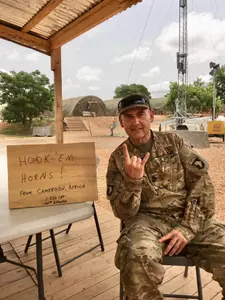
Texas Lottery Veteran Recognition: Jim Daigle
10.16.2026 | Longhorn Sports Properties / Learfield
The retired U.S. Army first sergeant will be honored when Texas Football hosts Florida on Oct. 17.
Jim Daigle was a student at The University of Texas in the 1980s, served in the Navy, and coached football at the high school and professional levels. When his son deployed to Iraq with the Marines and was wounded in 2006, Daigle was lit up with a new call to serve.
"Why is my son fighting a war, and I'm still young enough to contribute?," Daigle said. "I joined the Army and became a medic."
Daigle was 41 when he enlisted in 2007. He deployed to Afghanistan as a platoon medic with an infantry unit and was wounded while on patrol. "So, I got my own Purple Heart," Daigle said. "We're one of the few father-son Purple Heart teams from the same conflict."
Initially considering the Army National Guard, Daigle did so well on his vocational test that the Army recruiter encouraged Daigle to make a new career with the Army and serve on active duty. The Army's medical department motto is "to conserve the fighting strength," and Daigle understood what he was signing up for because of the care his son received when injured in battle.
"That's what I wanted to do, and that's why I became a medic," Daigle said. "My job was to keep as many guys in the fight as I could. With an infantry unit, you're an infantry soldier until somebody gets hurt. You're right there with them. You take care of everybody who has gotten wounded. We took care of all coalition forces."
Daigle deployed to Afghanistan, Africa and Korea; he served in nearly every enlisted position within a medical platoon, including platoon medic, senior line medic, treatment noncommissioned officer in charge, senior medical advisor and medical platoon sergeant.
"I held every job, and as medical platoon sergeant that made me a way more valuable leader, because I knew what everybody was going through. I knew what they did all day, every day – I had done it," Daigle said. "It made me a more compassionate leader, more understanding."
His experience in the field, and particularly in combat, also translated to Daigle's stateside service, which included administration, training, and policy advisor roles. Daigle served as a subject matter expert during the redesign and implementation of a new program of instruction and cadre course material for the Warrior Transition Unit (WTU).
During the conflicts in Iraq and Afghanistan, WTU services supported soldiers who were wounded and unable to continue serving, including those who were medically retired or medically discharged, as they returned to civilian life. Wounded warriors in the unit received medical care, job training, and counseling – "anything they needed to make them successful in the civilian world," Daigle said.
"For people who were no longer able to serve – and the military is all they knew – the Army owed them that service to make them successful and be a productive member of society when they left the military. We owed them that, and that was my total focus," Daigle said.
In recognition of his courage, dedication, and professionalism, Daigle was awarded the Combat Medical Badge, a Bronze Star Medal with a "V" device for valor, two Purple Heart Medals, three Army Commendation Medals, the NATO Medal and two Meritorious Service Medals.
On the ground, in the trenches, and day to day, Daigle embraced the opportunity to lead wherever he was with selfless adaptability. For example, having already learned from his basic training experience in the Navy, Daigle helped peers half his age recognize the game and purpose of boot camp – everything must be done as a team.
"If not me, then who? That hits the nail on the head as to why I joined the Army," said Daigle, who was medically retired as a first sergeant in 2020 due to wounds received in Afghanistan.
Daigle's son Alan continues to serve as a sergeant major in the Marine Corps. Daigle's wife, Tina, and daughters, Lindsey and Julie, also shared in the sacrifice and service of his Army career. They uprooted and moved on multiple occasions, and they persevered through the stress and strain of having loved ones deployed into hostile combat zones. But life happens according to perspective, and the Daigles viewed challenges as opportunities to learn from new places, build relationships, and contribute to the welfare of others.
When Daigle retired, he transferred his education benefit to Julie, who went on to receive two degrees from Texas State at no personal cost.
"The Army has done so much for me. I could never repay the Army for everything it's done for me and the experiences it's provided for my family," Daigle said.
Thanks to the Texas Lottery, great things are happening all across Texas. The Texas Lottery consistently contributes nearly $2 billion of lottery revenue each year to good causes like public education and veterans' assistance programs. Beginning with the first veterans' dedicated scratch ticket game in 2009, the Texas Lottery has now contributed over $311 million to the Fund for Veterans' Assistance.
Since 1992, the Texas Lottery has generated more than $43 billion in revenue for the state of Texas. Through strict adherence to its vision, mission and core values, the Texas Lottery is dedicated to ensuring that this support continues. The Texas Lottery's functions and activities are administered by the Texas Department of Licensing and Regulation (TDLR), the state agency responsible for licensing and regulating a broad range of professions, occupations and industries in Texas.