The University of Texas at Austin Athletics
Cotton Bowl Hall of Fame ceremonies honor Appleton, Speyrer, Syracuse's Davis
07.01.2005 | Football
DALLAS -- For Cotton Speyrer, it was a story of a little boy who sat in front of the television set and dreamed.
For Scott Appleton's family, it was the memory of Friday night lights and Saturday heroes. And for Darrell Royal and Cleve Bryant--and the mother and uncle of the late Ernie Davis of Syracuse--it was a special kind of closure.
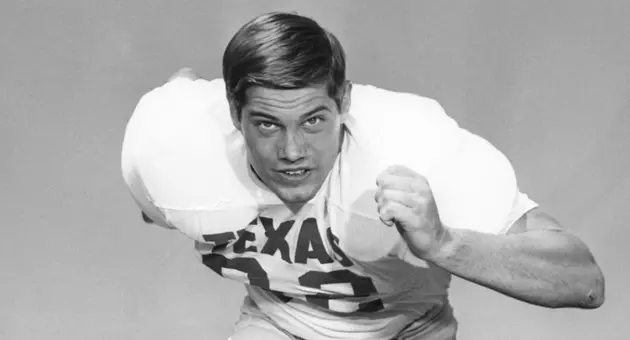
Speyrer, who played in two Cotton Bowl games and missed another with injury, and Appleton, who was a dominating lineman on Texas teams which played in three bowls in the early 60s, Tuesday became the fifth and sixth Longhorn inductees in the Southwestern Bell Cotton Bowl Hall of Fame.
Davis, the first African-American to win the Heisman trophy, was a sophomore in 1959 when the national champion Syracuse team defeated a young Darrell Royal's SWC tri-champions, 23-14, in the 1960 Cotton Bowl. In the game, a confrontation between Texas' Larry Stephens and Syracuse's John Brown--two significantly big linemen--almost led to brawl before cooler heads prevailed. In the Dallas of the late 1950s, the racial overtones of a team from the East playing in a Southern segregated city created a tension that went far beyond the football field.
Cleve Bryant, who is Texas' Associate Athletics Director for football operations and Mack Brown's right-hand man, was a kid in high school in Ohio when he first heard of Ernie Davis. Bryant was a Syracuse fan because of a junior high teacher, and he knew the story of Ernie Davis well. As the head coach of his alma mater, Ohio University, Cleve was one of two men to become the first African American head coaches in NCAA Division I football.
So it was not without irony, and entirely fitting, that Bryant joined Darrell Royal in representing the Texas football program at the ceremonies. The school that once was labeled "racist" in the East was represented by its top football administrator, a Black man.
For Royal, the poignancy of the moment came when John Brown, who had roomed with Davis before he died of leukemia at age 23, came up to Royal and visited about the game, and the time.
"He was great," said Royal. "He said he had crossed paths with Larry Stephens in the NFL, and he understood what happened was a heat of the battle kind of thing. They became friends, and he was aware that Larry had died a few years ago. That visit, and watching Cotton and remembering Scott made the trip for me."
Bryant said it best: "That was a different time. What I prefer to do is to think of the Texas of today, and look at the attitude and composition of our staff and team. I am proud of where we are, and how we treat people. And what I know is that Coach Royal treats people with respect today, and I guarantee you he did it then, too.
Appleton, who had 12 tackles and two sacks as the defensive star of the 1964 Longhorn victory over Roger Staubach and Navy, died awaiting a heart transplant at age 50, nine years ago.
This brings back memories of so many years ago," said Appleton's sister as she accepted the award. "Memories of a time when our lives consisted of Friday night football, and later Saturday football at The University of Texas. It was a special time, and I know that if Scott were here, he would thank God for the chance he had, and he would thank all of you for making this possible."
Speyrer spoke with humor and eloquence as he joined his former teammate James Street, who was inducted in the class of 1999, as members of the hall. It was Speyrer who caught Street's fourth down pass that set up the winning touchdown against Notre Dame in the 1970 Cotton Bowl, and he also had a record-setting receiving performance against Tennessee the year before in the 1969 victory.
"As a kid," said Speyrer as he stood on the sun splashed plaza in front of the Cotton Bowl Stadium's main gates, "I used to sit in front of the television and dream, and a lot of those dreams concerned this stadium behind me. Then as a grew up, I turned out to be a skinny kid who looked more like he should be marching in the band than playing. But I remember well that day so many years ago when I walked down that tunnel on a cold New Year's Day and we were about to play Notre Dame. I remember thinking 'this is it. This is really it."
The other inductees in the class of 2001 included Miami defensive tackle Russell Maryland, who jokingly apologized to all Texas fans for Miami'a 46-3 thrashing of the Longhorns in the 1991 Cotton Bowl, the late Jess Neely, who had a 3-1 record in the bowl as head coach at Clemson and later at Rice, Arkansas defensive tackle Loyd Phillips, and former Houston head coach Bill Yeoman.
Royal and the late Bobby Layne were inducted in the first class in 1998, Street was chosen in 1999, and Appleton's teammate, quarterback Duke Carlisle, was enshrined in 2000.
The criteria for selection is based on performance in the actual Cotton Bowl game itself, not on a player's overall career or specific season. A 35-member panel chooses the recipients.
Bryant, Royal, Athletics Director DeLoss Dodds, UT vice president Patricia Ohlendorf, former head coach and Appleton teammate David McWilliams and Longhorn legend Rooster Andrews headed the Texas delegation at the ceremonies.