The University of Texas at Austin Athletics
Catching up with: Cotton Speyrer
02.09.2012 | Football
Feb. 9, 2012
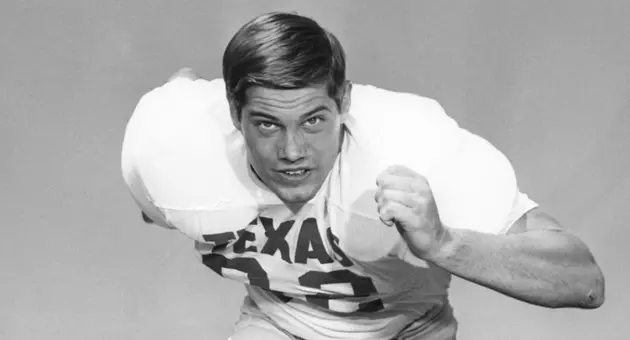
Charles Wayne "Cotton" Speyrer from Port Arthur, Texas, played split end from 1968-1970 and led UT to National Championships in 1969 and 1970 and SWC titles from 1968-70. He was an All-American in 1969 and 1970 and All-SWC in 1969 and led the team in receiving in 1968 and 1969. In the 1969 Cotton Bowl versus Notre Dame, he had 161 yards receiving and caught two touchdowns in a 21-17 win. Speyrer was a second round draft pick of Washington Redskins in 1971 and played with the Baltimore Colts (1972-74) and Miami Dolphins (1975). He as inducted into the Longhorn Hall of Honor in 1984.
How did you get to be called "Cotton?"
When I was born I had white hair, and I grew up in Brownsville. My mothers' family, who was from Illinois, wanted to name me "Frosty." Being in the valley, it stuck as "Cotton." Again, thank God it wasn't "Frosty." That's really how I got it. I had white hair when I was young.
Do you still get nostalgic feelings when you think about your playing days?
Those are memories that will be with me forever. Those are times that I cherish, and I cherish with my teammates and my coaches, and everyone that was involved in those great efforts.
Do you keep up with any of your former teammates?
There are quite a few that live in Austin, and we get together on occasion, and during football season, when people come in from out of town. We do that on occasion, and we have had several reunions.
Do you feel a sense of pride about the time you spent as a Texas football player?
I am very proud of yesterday's wine, so to speak. I will say though, it's been so long. I came to Texas way back in 1967. I doubt if I would have even known who played in 1927. The players nowadays probably don't know about our past teams, but they do know we are in the record books. We acquitted ourselves very well.
What made those teams you played on so special?
Obviously we had to work hard. We had the upmost respect for Coach [Darrell] Royal and all of the assistant coaches. We had respect for our teammates. I never heard a teammate complain about anything. I believe that we felt like that we had something special working, and we weren't going to let that slip through our fingers. We worked extra hard at achieving our goal of winning every game.
Tell us about your role as a WR in the wishbone offense.
My first comment was, "Oops," thinking that I would be more likely to catch a cold than a pass in most games. It was fun to watch, even from my perspective being out on the end. And on occasion the running game didn't work, and we threw the ball and it worked out.
What do you feel is your legacy as a team player?
I felt like I contributed every game. Maybe most of my contributions weren't focused on because it was more or less blocking or something like that. I am very pleased with the role that I was allowed to play. I feel very fortunate, and again I feel like I did other things than the couple for what I am known for. However anyone chooses to remember me that's fine.
What was your experience like playing professional football?
It was like night and day. Our facilities here at the University of Texas were so much better than the pro teams I was playing on, which includes the Miami Dolphins who were world champions. The fans, just the overall atmosphere was totally different. As a matter of fact, I was somewhat disappointed in the professional game. I know it's probably changed a lot now.
What keeps you busy these days?
I do a lot of things when I am not working. I work for Susan Combs, the state comptroller. I enjoy my job. I like it very much. I hike. I do a lot of reading, and I keep myself very busy when I am not at the office.
How would you liked to be remembered?
I would prefer that folks remember me as part of a National Championship team who won thirty games in a row, and who excelled and achieved excellence.
Do you think your experiences here at UT made you a better man?
There is no doubt that spending time with my teammates, with Darrell Royal, Emory Bellard, some of the other coaches, just being around the student body, I learned so much. I was somewhat immature when I got here. I was seventeen years old, and I grew up a lot here at the University of Texas. Those lessons I have carried with me throughout my life.