The University of Texas at Austin Athletics
Bill Little commentary: The meddle of the metal - Ricky gets a statue
04.06.2012 | Football, Bill Little Commentary
April 6, 2012
Bill Little, Texas Media Relations
The sun-splashed day capped a perfect weekend for Texas football. It was April 1, but there were no tricks. It was as if God were smiling on all things Longhorn - smiling most of all on the area in the southwest corner of the stadium.
The Spring Game would be a moment for the future, featuring the Longhorns of 2012. The football letterman's weekend reunion had been a tribute to the past. But the bronze statue of Ricky Williams was a monument to a dream.
And in the dedication ceremony and the video presentation, it was as if time stood still. In 1995, Ricky Williams had come from California - another of a long line of Texas running backs who proved early he could be good. Nobody knew how good, except maybe Ricky himself.
Dreams are funny that way. First, you have to believe - even if you are the only one who does. Then, you have to act to make the dream come true. And on a December night in 1998, Ricky Williams had done just that. It was the eve of the presentation of the nation's most coveted football honor. As he waited in anticipation for the night he had dreamed of, quietly to himself, almost as a kid giddy with a smile, he said, "I'm going to win the Heisman Trophy tomorrow."
|
|
Rare is the moment, and rarer still the person, who can live his dream. In a lot of ways, it seems only yesterday that an assistant coach brought a young recruit into our sports information office and asked me to talk with him about what we did for all-star candidates. "'This kid," he said, "wants to win the Heisman Trophy."
Right, and I want to be president. How many times they dream...and never come close. But I did talk with him, and I told him the Heisman Trophy should be won on the field...and that if he came to Texas and did his job, we would do our job. It is great when things work like they are supposed to, and with good fortune and a lot of hard work from John Bianco, the assistant athletics director for media relations, and the media relations office; Ricky Williams did what he came to do. With the guidance of Mack Brown, former offensive coordinator Greg Davis and then running backs coach Bruce Chambers, he became the lynchpin of Brown's first team at Texas. Together, they set a standard which few have equaled in college football.
But it would be folly to speak of Ricky Williams and all that he did only in terms of yards and records and trophies. Ricky was more than that.
He was a young man who cared and dared to be different...not to set an example, but because that's just how it was. He didn't start out to teach us a lesson that it is okay to look a little different, but that was the message we learned.
He return for his senior season just to win a trophy or set a record...he did it because enjoyed moments like those in New York, where he could share that award with his teammates, and where he could be a kid himself...for all the kids that he loves. And it left a message to countless kids because of it.
He came back because he wanted his team to win...not because he wanted to win himself, but because he wanted to be a part of success.
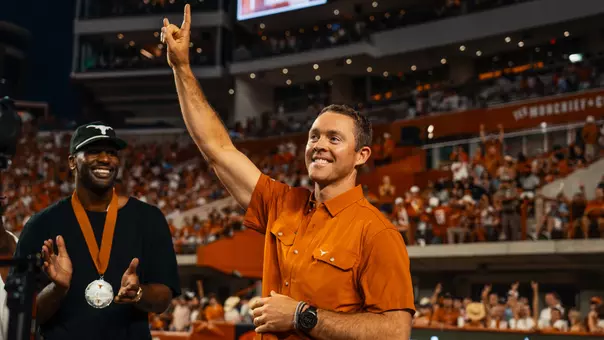
At the ceremony dedicating Ricky's statue, which was created beautifully by former UT professor David Deming, Mack Brown remembered the moments with Ricky. Benefactor Joe Jamail kidded Ricky about his sometimes quirky style, teammate Wane McGarity remembered the camaraderie of that 1998 team, and broadcasting legend Brent Musburger celebrated a highlights video which included his famous call of Ricky's NCAA record setting run.
A crowd bordering on 50,000 stood and cheered as Ricky walked into the stadium where his number has been retired, into the arena where it all had happened - a special place where memories hang like portraits in the hallways of the mind.
Ricky's journey - his odyssey of life - since he left Texas has been well-chronicled. His is a travel plan not drawn up by your typical Mapquest of life. Ricky has marched to his own drumbeat at times. But the truth is, he has always searched for meaning, and for truth, aided by a brilliant mind and a gentle spirit.
At the moment, he is officially retired from the NFL (after gaining 10,000 yards and earning All-Pro honors). He plans to return to Texas and finish his undergraduate degree. The current thrust of his efforts to help kids is with his foundation, "Ricky's Kids," which helps youngsters in need of after-school supervision.
The inscription at the base of his statue reads:
With remarkable determination, a rare combination of strength and speed and a flair for the dramatic, Ricky Williams ran his way into the record books - and into the hearts of Longhorns everywhere.
In a career that spanned the end of the Southwest Conference and the beginning of the Big 12, the San Diego, Calif., native helped lead Texas to three league titles in his four seasons from 1995 through 1998.
When he decided to return to school for his senior year rather than join the professional ranks, he formed a bond with new head coach Mack Brown that would serve as a model for what college athletics should be all about.
In his final regular season game, with a packed stadium and a national TV audience watching, he became the school and NCAA record holder in both rushing and all-purpose yardage. He won every national player of the year award for which he was eligible - including the Heisman Trophy, the Maxwell Award, and the Walter Camp Foundation Player of the Year. A two-time winner of the Doak Walker Award as the nation's best running back, he led the NCAA in rushing in both 1997 and 1998.
He would follow his Texas career with a successful stint in the NFL, earning All-Pro honors and leading the league in rushing.
When I was working on the book "What It Means To Be A Longhorn," I asked Ricky what that meant to him, and he said this:
"It's like a family that can never be separated, never be broken up, and something that never, ever can be taken away from you...."
In the southwest corner of the stadium grounds there now stands a monument to Ricky Williams - a time traveler who redefined the work "unique" as he passed our way.