The University of Texas at Austin Athletics
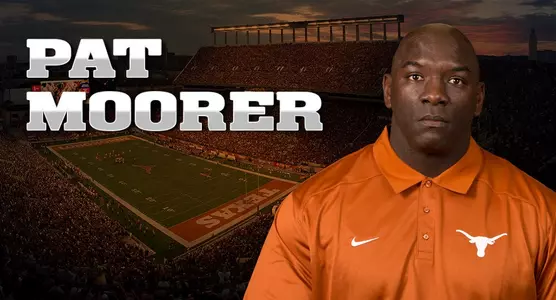
Q&A with Head Strength and Conditioning Coach for Football Pat Moorer
01.24.2014 | Football
Moorer worked under head coach Charlie Strong at Louisville
A long-time protégé of head coach Charlie Strong, Pat Moorer is in his first season as the head strength and conditioning coach for football at Texas.
Moorer spent the last four seasons in the same role under Strong at Louisville, helping mold the Cardinals into one of the top programs in the nation.
Prior to that stint, the native of Pensacola, Fla., served as the director of strength and conditioning at South Carolina for 11 years (1999-2009). Strong and Moorer worked together at South Carolina from 1999-2002.
Here is a Q&A with Moorer:
What does it mean to you to be able to come to Texas?
There's so much tradition here. Growing up and hearing everything you do about this program in the media, following it through the news, you understand the rich tradition, all of the great things surrounding the program and the state. It means a lot to me to join this program and it's an unbelievable opportunity, one that I think coaches dream about. I'm most excited about making an impact here. I'm a result-oriented coach, just like our head coach. We have very high expectations and if you know anything about football here, you'll understand that.
Having worked on a number of staffs with Coach Strong, what makes you two work so well together?
I think number one you have to have unbelievable passion. You have to have unbelievable passion for the football players, for the students, because ultimately they're the ones that have to go play the game. So you have to have passion for what you do as a coach. It will be a student-athlete driven program. He's a big-time player's coach. The energy that you're going to bring, the intensity you're going to play with, and more than that the genuine care for the student-athlete. And I think that's the thing that says the most about Coach and how we do things. Really, really genuine interest in developing the kids not only as football players but as people. Because some day this game is going to end for everybody, and our thing is we want to make sure we've done everything we can to set that young man up for nothing but success once he's done playing the game.
Coach Strong talked a lot about having toughness in the team. Just how important is it to you?
That's going to be the staple of the program. There's no question about that. I think it's almost impossible to play the game if you don't have that. I think the game has turned a little bit, but there are some things about this game that will never change. If you are not tough, not willing to be tough, not willing to train tough, then this is probably not going to be the game for you. I tell people that if you're not willing to work hard, do the little things, pay attention to detail, then it's going to be hard for you to play for Coach Strong.
How important is it to develop mental toughness, in addition to physical toughness?
The two go hand-in-hand. We're going to be in such great shape that you'll be able to play the game the way it's supposed to be played: with great physical and mental toughness. You play with great intensity. And we expect you to play like that every single down. So for me, what I'm going to do in the weight room is I'm going to train you to do that. You don't ask anybody to play like that if you haven't trained them to do it.
Do you feel it's important to not only tell players what to do, but to be able to show them?
Absolutely. I think that's one of the unique things about how we do things. We're always on the floor, we're very hands on, the head coach isn't just going to talk to you about working hard; he's going to come down and work out with you, and show you, just like I am, how it's supposed to be done. Believe it or not in all that, it really just helps strengthen the bond between the players and coaches, and the one thing you're going to have, you're really going to develop a big trust for everyone in the program. There won't be any hidden agendas; everything is out in the open. If you're lacking in an area we're going to figure out what that weakness is and it has to become a strength. That's how it's going to be across the board.
Having trained athletes like Emmitt Smith and so many great players that have achieved at the highest level, is there anything you've learned from them?
Those guys have a passion for being great. When a guy has a passion for being great, they're willing to work and willing to do the things that other people aren't willing to do. I also worked with a guy by the name of Duce Staley who was also a great running back in the NFL. I always tell people there's one thing consistent in those guys, they're never afraid of hard work. So whatever it is that you put them through, as long as you understood you were doing it to make them better players, they would do that. My thing is I'm going to convince you of a couple things. I'm going to work you harder than you've ever been worked in your life. You're going to believe you've worked harder than anyone you'll compete against. I want you to be uncomfortable in the offseason. It's important for things to be difficult and things to be uncomfortable, because when you get out there on Saturday to play the game, the game has to be easy for you. I can't have you get to the game and have it be difficult. So that's part of the process – and it is a process we're going to have to go through to get you there. We're not going to be there today or tomorrow, but with work and time, we will.