The University of Texas at Austin Athletics
05.28.2015 | Men's Tennis
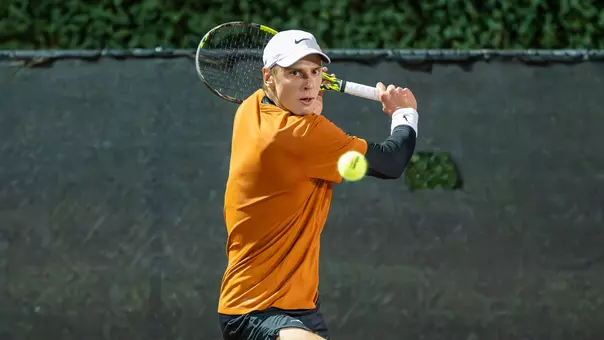
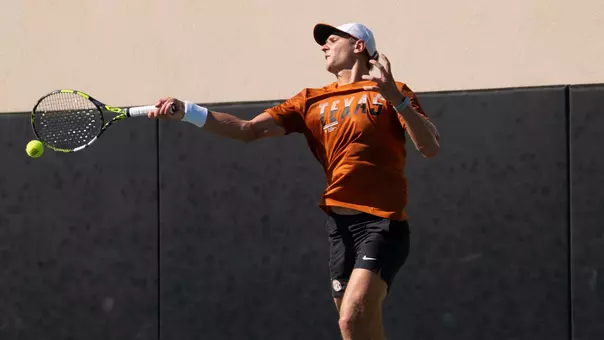
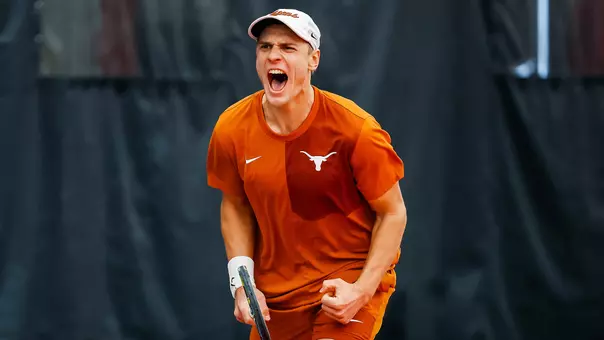
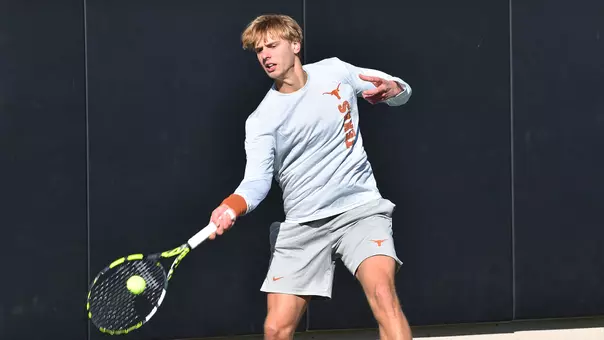
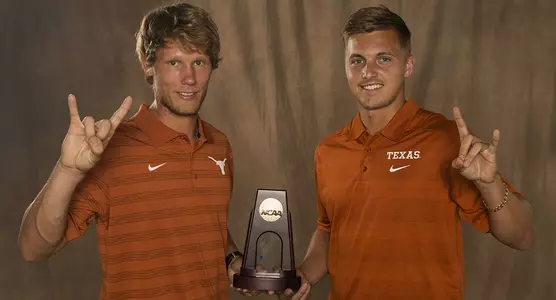
Seniors Lloyd Glasspool and Søren Hess-Olesen end their Texas careers as NCAA Doubles national champions.
Photo Gallery | LHN studio interview | 'Double Trouble' with LHN | Highlights
Moments like these can make believers out of us all, because the proof is in the outcome.
Texas Men's Tennis coach Michael Center stood courtside, inside Waco's Hawkins Tennis Center, ball in hand, savoring the situation. His senior All-American duo of Lloyd Glasspool and Søren Hess-Olesen was a game away from history. Hold serve and they become Texas' first NCAA Doubles national champions in 71 years.
Center handed over the ball to Glasspool, the senior from England with the cannon serve, and said, "There's nobody I'd rather have serve this out than you right now. Go do it."
Glasspool held at love, defeating Texas Tech's Hugo Dojas and Felip Soares 6-1, 3-6, 6-3, to capture UT's first doubles title since 1944.
And Center had to stop and soak in the moment, because, in reality, Glasspool and Hess-Olesen are the unlikeliest winners of a NCAA Doubles title.
Hess-Olesen arrived on the Forty Acres as a singles specialist from Denmark. Glasspool came to Texas set on paving his path to a professional career, and that didn't leave much room for doubles play.
During Glasspool's freshman and sophomore years, Center appreciated a skillset that was perfect for doubles – big serve, instincts for the ball – but Glasspool didn't have a mindset for doubles.
"I think I was just being stubborn," Glasspool said.
Hess-Olesen had never even played doubles.
"It was something I had to get used to," Hess-Olesen said.
Ultimately, they were drawn together by friendship, work ethic and competitive natures. They practiced together every single day, and as hitting partners, it was only natural they started to pick up each other's games.
As Glasspool and Hess-Olesen grew into best friends off the court, Center finally paired them together on the court during the ITA All-American Championships in October of their junior years. The new doubles team reeled off five-straight wins in that tournament, and won nine of their first 10 matches, to begin the spring 2014 season ranked among the top 5 in the country.
They earned All-America honors for advancing to the quarterfinals of last year's NCAA Doubles Championship, defeating 14 nationally ranked opponents along the way.
"You talk about one guy who didn't want to play doubles, and one guy who didn't even know how to play doubles, and they become NCAA champions. That's pretty remarkable," Center said. "These guys just became a great team. They earned it. They worked for it."
Success on the doubles court is as much about communication as execution. Teammates have to know where the other will be, and what they're likely to do with the ball when they get there.
So, it's no real surprise that Hess-Olesen knew exactly where Glasspool would be around noon every day for the past two weeks.
"Eating a bread bowl full of broccoli cheese soup," Hess-Olesen said. "He's full of cheese right now."
It's the mark of a championship team. They know each other's tendencies. And it played to their favor during this year's NCAA Doubles tournament. With the match format extended to best-of-three sets, Glasspool and Hess-Olesen were able to work their way into matches, and not feel the need to rush or overplay points.
They also took advantage of their individual skills to change their formations. For instance, when Hess-Olesen was serving, he would often stay on the baseline and let Glasspool get into the net. Hess-Olesen's strength as a singles player gives him confidence that he can get to balls anywhere on the baseline and also rely on his power.
"He was just pounding that ball," Glasspool said. "And I could just pick the balls off at the net."
Glasspool and Hess-Olesen defeated No. 2 seed Yannick Hanfmann and Roberto Quiroz of USC in three sets in the first round of NCAA doubles play. In the third set, USC held a 40-love lead on their serve, but Glasspool and Hess-Olesen battled back to break that game.
"It turned the momentum in our favor," Center said. "At that point, I felt like, 'Ok, this team has a chance,' when they started to take control of that third set."
They won their next two matches in straight sets, and then out-willed a Baylor team on its home court during the semifinal match for a 2-6, 6-3, 7-6 (3) victory that saw Glasspool and Hess-Olesen serving from behind the whole match.
"Every match we won, the better we played," Glasspool said. "We were so confident going out each day."
In the semifinal win against Baylor, in a raucous environment, against a fiery team, Glasspool and Hess-Olesen revealed their championship tactics – their personalities. They never appear rattled.
"We play with energy, but it's a different kind of energy," Hess-Olesen said. "We're very competitive and determined, but not loud. We know each other and how to talk to each other."
And, when it came to crunch time in Monday's championship final, Center knew how to talk to his team. Just give the ball to Glasspool and tell him to go serve for the trophy. The fact that Center was even saying those words made him emotional, considering a few years back, Glasspool only wanted to use that powerful serve to set up his own winners.
"That was one of the most special moments I've ever had as a coach," Center said. "I know where he's come from, and I know where he took us. It was a great, great moment."