The University of Texas at Austin Athletics
06.12.2015 | Rowing
Rhodes Scholar Jessica Glennie and her family emerged triumphantly from years of personal hardship and sacrifice.
Walter Glennie took comfort in the familiar.
"It was important to me to see my little girl happy."
And even the unfamiliar.
"I didn't know much about it. We knew nothing about Texas."
And even more of the unfamiliar.
"I walked into this stadium of yours. I had no words. I'm a construction engineer, okay? I don't have words."
In August of 2010, Walter and his only daughter, Jessica, logged nearly a full day of air travel from New Zealand to Jessica's new home away from home in the United States. He didn't know his daughter would help The University of Texas win Big 12 rowing championships or help UT advance to the NCAA Championships.
He didn't know she would one day win a Rhodes Scholarship and pursue two postgraduate degrees at The University of Oxford.
But, Walter did know his daughter was in good hands, and nothing was more important than that. An ocean had separated Walter from his family many years before. He had been down this road. The circumstances were different this time, but separation was inevitable once again.

parents with Indian oil and acrylic.
Walter and Rene Glennie are children of South Africa. They were proud to bring their children into the world off Africa's southern cape.
"My heart is there," Walter says. "Still is."
His heart was there, but it was a conflicted heart. He and Rene were not alone in that regard.
Around the middle of the 20th Century, South Africa's National Party rose to power and implemented racial segregation legislation, better known as apartheid. Turbulent times were not unlike the parallels experienced in other corners of the world, including the United States.
Walter and Rene saw the effects of apartheid for decades, and they, like scores of other countrymen and women, pondered new lives elsewhere. Rene's twin sister, Jessica's aunt, fled from South Africa in the early 1980s and relocated with her husband to Australia before finding work in New Zealand.
The reports from New Zealand over an eight-year span piqued Walter's interest. He liked what he heard about New Zealand, but home was home. Immigration papers lay on his desk for two years, but Walter was not yet prepared to uproot his family.
"There was an epidemic of migration out of South Africa, and then we got to a situation," Walter explained. "Jess was born. That, and the political aspect of Africa, initiated my feelings toward leaving."
Walter and Rene took their family – their two sons and two-year-old Jessica, for a holiday in New Zealand to visit Rene's sister and husband. They returned to South Africa encouraged by what they saw on the other side of the Indian Ocean.
"I went back to South Africa and told people, 'If you don't want to have the desire to go to New Zealand, don't go visit it.' It was just simple. No fences around houses. No locked garages. We weren't used to normality because of the political side (of South Africa).
"I didn't want to leave," Walter added. "My (civil construction) business was starting to become successful. I just didn't want to go at all. I didn't want to leave the country. But, the job I had been in was very disruptive and didn't make me a good father."
Walter's oversight of various construction projects in South Africa forced him to spend much of his workweek in vehicles traveling as much as 1000 km on the busiest days. His career created a void of family time and kept him away from his wife and two sons through much of any given week. With the addition of a new daughter to the family, Walter had no interest in repeating the cycle.
"Jess was born and I decided to try to make something of it," Walter said. "Her addition made the family even more important, I suppose. I hardly saw my sons and I missed a little of her growing up. And then you get home and you're stressed. It wasn't very conducive to a family life. All of those factors changed everything for us."

(Jessica Glennie, 2009)
In the fall of 1994, Rene and the three young children made the move to New Zealand where Rene found work as a schoolteacher. Walter tended to his civil construction work in the interim back in South Africa with plans to join the family in New Zealand.
Rene and the three children settled into their new home without incident, but in the spring of 1995, Rene suffered a seizure. It brought to light a larger issue. A cyst had developed in Rene's brain. If it didn't grow, it was a benign cyst. If it grew, it was something else. Cancer.
Rene's physicians diagnosed a stage three malignant brain tumor. Surgery, chemotherapy and radiation were not merely options. They were musts.
"It was hard for my little children, but I think they all grew out of it," Rene said. "Mommy was sick, and Daddy was away, but my sister stepped in and helped out."
Walter had kissed his wife and children a temporary goodbye and then faced the prospect of his wife ailing thousands of miles away.
"This whole thing cause total upheaval in our lives," Walter admitted. "I traveled back and forth about three times that year. The first time I came over, I was in New Zealand for six weeks. That meant six weeks of nothing happening on my job. But that helped. It helped me to cope."
Rene underwent a successful operation to remove the tumor and underwent chemotherapy and radiation treatments throughout the middle and latter months of 1995. From there, an all-around family effort carried Rene and the children through chemo and radiation.
"I remember a lot of love from my aunties and a lot of leadership and care from my brothers," Jessica recalled. "I actually remember a lot of happy times from that. I remember my mom's wig. We would all wear it."
"The wig got more use by the kids!," Rene laughed. "But the doctors drew the line – they couldn't touch the radiation mask! They all did a really good job of protecting me from all of that pain."
Walter made the move to New Zealand in 1995, and Rene's body rid itself of cancer in 1996 though doctors would not officially declare her cancer-free for several years.
"They said, 'If you're clear after five years, it probably won't come back. If you live for five years, we consider you cured.' But, I knew in my mind I was healed from God. I was at peace, and I was healed. That took away a lot of angst about it."
The years to come yielded welcome stability for the Glennies, not to mention a budding artist and athlete in Jessica. Children will scribble in coloring books, rip out a page and then hold it up like it's a Picasso portrait. Jessica wasn't like most children. She was already painting those portraits.
"I loved art," she said. "I loved painting, drawing, graphics, design, everything. I was good at problem solving. I didn't want to choose one or the other."
Enter architecture.

(Jessica Glennie, 2009)
"Architecture seems to be a really good bridge between those sides of your brain. I love buildings and spaces. My auntie is an interior decorator, and I grew up with that understanding and appreciation for spaces."
Like most children growing into their teenage years, Jessica was full of energy, and she used it. She fit long limbs into a six-foot frame that made her an attractive prospect in any number of sports. Jessica did everything from captaining her basketball team to running track to rowing.
"She had just come along with rowing at 14," Walter said, "but I thought her school didn't row. That was how much I knew. She came back from school and wanted to apply for a rowing scholarship in the United States. She had the heart and the brains. And she got it into her head that she should do rowing."
Jessica contacted American universities who had both an architecture program and a varsity women's rowing team. She visited west coast schools on one trip and east coast schools on another.
"I was having trouble picking a school and figuring out how architecture could be a part of it," Jessica said. "I had some schools tell me they wouldn't let me study architecture as a rower. 'We just won't let you try,' they told me. But I continued to look up the top-10 schools of architecture in the United States and saw which ones had rowing programs. The University of Texas had the best school, and the rowing program was better here than the other schools with top-10 architecture programs."
Later on, Texas entered the equation, by Jessica's doing. She engaged former UT assistant coach Melissa Perrone who eventually arranged an official visit to campus. Examinations back home kept Jessica from taking the official visit, but her mind was made up.
"I told Melissa, 'Don't worry, I'll just come.' I signed early with Texas, sight unseen."
"Texas was Jess' choice completely out of the blue, and she often does that to us," Walter laughed. "I knew nothing about UT."
"It's so huge to send your daughter away," Rene said, "but I put it in God's care. Jessie is a confident girl, successful in school. I just thought she could do it. A mother knows. Little me, I just had to grin and bear it because I loved her so much."
Jessica appreciated the flat water of Lady Bird Lake and the buildings and spaces at UT, but perhaps not the spaces she had just placed between herself and her family.

Austin's Lady Bird Lake (Jessica Glennie, spring 2013)
"There was a little bit of homesickness, but that first semester my teammates and I were just so caught up in this new routine and making it our lives that we didn't have much time to really be so sad," she said. "We focused on this new schoolwork, classes, rowing and training. It was just a whirlwind."
The whirlwind following Jessica was more of a dust devil than a hurricane. She kept it that way. Jessica already had balanced multiple sports and activities with academics in high school. She was adept at managing the chaos.
The rowing went well – she helped Texas win Big 12 and Conference USA titles as a freshman – and the academics went well – she made the Big 12 Commissioner's Honor Roll and received a Conference USA Academic Medal.
"I made lots of lists, slept when I should have been sleeping and prioritized my activities. We were in this very secure bubble, and no external factor could throw it off. We lived right by the (football) stadium, had carpools to get to Lady Bird Lake. It was organized, cushioned and well prepared."
Jessica's regimen continued to pay off. She'd roll out of bed in the morning and make the Big 12 Commissioner's Honor Roll. It wasn't that easy. It just seemed that way. The rigorous demands of the architecture curriculum and the expectations of being a NCAA Division I student-athlete were all challenging, but not insurmountable
In the fall of 2013, Dr. Stephen Sonnenberg of UT's School of Architecture planted a seed in Jessica's mind.
"Dr. Sonnenberg is involved with the Plan II program and pushing candidates for scholarships," she said. "He said, 'Jess, you have to go for the Rhodes Scholarship.' He kept badgering me and pushing me over the next little while. When the time came to start preparing, he gave me a call and told me to get the show on the road."
Jessica began an internship with Tod Williams Billie Tsien Architects in New York City last spring. She wrapped up work near Manhattan's Central Park last December, but not before conducting interviews for her Rhodes Scholarship candidacy, with an assist from Dr. Larry Carver of UT's College of Liberal Arts, in her adopted homeland of New Zealand.
The protocol called for a pair of interviews to be conducted in New Zealand, but the committee granted Jessica the opportunity to initiate her first interview via Skype. Last November, Jessica flew from one corner of the world to another – New York City to Wellington, New Zealand – to undergo the final interview of her Rhodes Scholarship candidacy.
Shortly after her final interview, the committee announced Jessica as a Rhodes Scholar. She was destined to study in England at The University of Oxford.
"I didn't realize until that moment how my subconscious was so ready for that, and how much I really had let this dream fester inside my heart," Jessica said. "It was just complete elation. It was a really cool moment."

in Montevideo, Uruguay (Spring 2014)
Jessica Glennie has completed her collegiate rowing career for the Longhorns, whom she helped reach the NCAA Championships last month. She has earned an undergraduate degree from the nation's premier architecture program at The University of Texas. And she found what she was looking for.

(Jessica Glennie, fall 2013)
"Studying architecture at UT was so much more than it was advertised. I can see why it's one of the top programs in the country. There's optimism and encouragement. The school has a really healthy competitiveness within the studios where everyone wants to be the best. There is so much collaboration and peer reviewing. That synergy is what makes it such a productive learning environment."
Jessica will relocate to England this fall and begin her studies at Oxford in October. She will pursue a master of science in environmental change and management in year one before taking on a one-year MBA program in the fall of 2016. Jessica hopes to own her an architectural firm one day and incorporate sustainability with designs that have the environment in mind.
"As an architect, you have the responsibility to make socially and environmentally responsible decisions. It's easy to think you can't make a difference. But, I've been at UT for five years, and we know that what starts here changes the world. I want to study environmental change and management to help me be the most responsible and optimistic architect. I want to learn how to create that way forward."
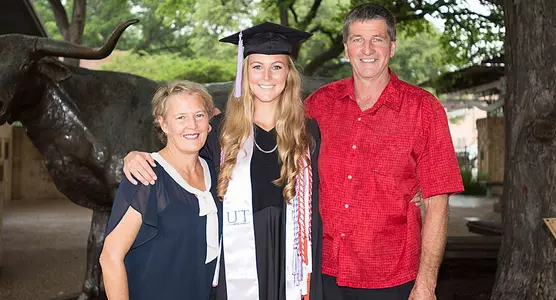
Intermittent rain on campus did nothing to dampen the spirits of Walter and Rene Glennie on their daughter's Commencement Day. The unfamiliar was no more. No longer was UT the big campus with Spanish-tiled roofs, an iconic tower and a massive American football stadium. It was home. It was like the next-door neighbor whom you could trust with your children.
"I'm just so grateful to all of you guys for looking after her and taking on the job that I should have been doing," Rene said. "I'm so grateful that she's done so well."
"I'm overawed by the place," Walter admitted. "I'm so happy that this happened here. I don't think we could have offered her anything like what she got here at Texas. It's incalculable, honestly. The adoption of Jess by this organization was just so relieving. We don't know what we're getting when we get a kid. If you're a reasonable parent, you do what you can. We've been rewarded beyond measure just by the fact that things worked out. It's been so nice."
Related Content
Jessica Glennie's Design Portfolio
Photo Gallery
May 23, 2015: Texas Athletics celebrates 2015 Spring Commencement
Nov. 6, 2014: Rowing's Jessica Glennie wins Rhodes Scholarship