The University of Texas at Austin Athletics
Isn't it grand? Women's Basketball earns program's 1,000th victory
01.27.2016 | Women's Basketball
The Longhorns become just the fifth program in NCAA Division I history to reach the milestone, joining Tennessee, Louisiana Tech, James Madison and Old Dominion.
• Photo gallery: Women's Basketball milestone moments
• Photo gallery: No. 6 Women's Basketball defeats Kansas, 70-46, picks up 1,000th program win
Texas celebrated the legacy and lure of its women's basketball program last weekend. Four decades worth of former letterwinners were there to witness the sixth-ranked Longhorns' victory against rival Oklahoma, and what was intended to be a day of honoring the past also included moments of recognizing the present.
Just as there may not be a bigger critic of effort and outcome than someone who previously and proudly competed in burnt orange, there is also none more appreciative of drive and determination. Little things, seemingly simple things, like rebounding and diving for loose balls resonate with those who laid a foundation, who literally rebounded and slid across the floor for attention and recognition.
Four years ago, when today's seniors were freshmen, two-time national player of the year Clarissa Davis-Wrightsil addressed the team, and she implored them to play with pride -- to play "Texas Basketball." When she returned with another pregame message prior to the win against OU, her intention was different. Davis-Wrightsil spoke on behalf of all the letterwinners as she told the current team, "We're proud of you."
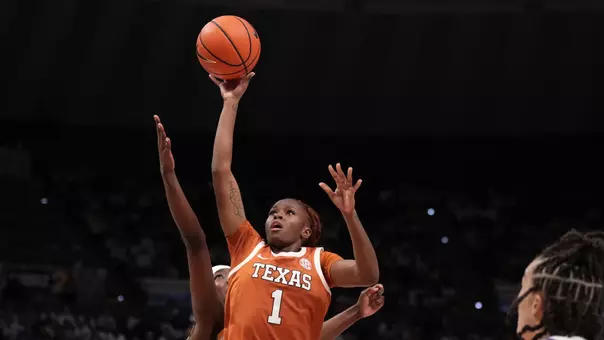
On Wednesday night, the Longhorns defeated Kansas for the program's 1,000th victory. Texas becomes just the fifth program in NCAA Division I history to reach the milestone, joining Tennessee, Louisiana Tech, James Madison and Old Dominion. The 70-46 win provides a tangible connection of the past and present and also forges a promising future for the Longhorns.
"It's not a surprise that this particular team is (reaching) that 1,000-win mark, because they resemble those championship teams that were a collective group," says Davis-Wrightsil, a freshman on Texas' 1986 NCAA Championship team. "They go hard. They're supportive of each other. That is what resonates."
In 1986, then-head coach Jody Conradt and the Longhorns grabbed the attention of the local community, the state, and even the country. With a 34-0 record, Texas won the NCAA Championship and became the first team in NCAA history to go unbeaten.
Perfection had a way of attracting attention. The next year, Texas hosted the first-ever sold-out women's Final Four at the Frank Erwin Center. For both the semifinals and finals, 15,615 fans filled the arena. The attendance for last year's national final in Tampa Bay was 19,810.
"One of my goals early on was to make it fun for the players and exciting for the fans," Conradt says.
Conradt always said that people wouldn't clamor to come watch teams play keep away. She modeled her teams in Dean Smith's "run and jump" style. Players' athleticism and speed were showcased in a fast-breaking, run-and-shoot attack.
Some of the toughest games of the 1986 season were conceivably contested on the Longhorns' practice floor. Davis-Wrightsil was voted that year's most outstanding player at the Final Four, but she was a third-string option on Conradt's bench.
"You look at how talented they were. You understand what got the attention of the country," Texas head coach Karen Aston says. "That's what we're striving for -- to have a team that gets everyone's attention."
The unblemished championship season remains the crown jewel in a decade of dominance that asserted the Longhorns among the elites in women's basketball. Texas won its first 117 Southwest Conference regular season games, a streak that stretches from 1982-90. Seven of the Longhorns' eight appearances in the Elite Eight occurred between 1983 and 1990, with Texas advancing to at least the Final Four in 1986 and 1987.
In those days, Texas was chasing premier programs like Tennessee and Louisiana Tech. Now, they all exist together in a peer group of programs who can count their victories to a thousand.
"You always set goals in athletics. We can measure ourselves against other outstanding programs and say 'Yes, Texas has a place among the elite in women's basketball,'" Conradt says.
Conradt came to Texas in 1976, four years after the enactment of Title IX, the federal law that called for gender equity in higher education. She was hired to coach women's basketball and volleyball, and though both were varsity sports, they were glorified club teams. The squads shared uniforms.
"We traveled in cars and vans to our games. We didn't have a lot," recalls Cathy Self-Morgan, a basketball senior during Conradt's first year as coach. "But we were so thrilled because women were finally being treated better. Not equal, but better."
In the early days, Conradt couldn't recruit with scholarships. Athletic scholarships weren't offered. Instead, she pitched the idea of extending their athletic careers and competing for a collective vision of success.
"For those players to bring their outstanding skills, and become a team, and put on the uniform that said Texas, was a thrill for them and a thrill for me," Conradt says. "It's always about the players, always about providing an opportunity for them. The University of Texas did that."
Nell Fortner, who competed from 1977-81 and went on to become the 2000 Olympic coach, moved to nearby New Braunfels when she was in middle school. For the first time, she was able to play organized girls sports, which weren't offered in her native Mississippi. In Texas, Fortner was exposed to a whole new world and the horizon brightened when she became a student-athlete for the Longhorns.
"There had to be buy-in from the administration, because you need money to support facilities, uniforms, all that," Fortner says. "The University of Texas did it in a big way."
UT's biggest step, perhaps, was hiring visionary leader Donna Lopiano as women's athletics director in 1975. Lopiano is described as "ahead of her time," insisting on full-time publicity and marketing officials for women's sports and targeting head coaches that she called "master teachers."
During Lopiano's Texas tenure from 1975-92, the women's teams won 18 national championships in six different sports.
"It was a fight. We weren't just fighting to win, we were fighting for recognition," Self-Morgan says.
The Erwin Center opened the season after Self-Morgan graduated. It was a world-class basketball facility, and one that Conradt and the Longhorns would eventually fill with fans, hosting that sold-out Final Four a decade later. Still, there were no original plans for women to inhabit the building.
"For years, we were in a locker room with urinals," Conradt says. "Things were quite different. Thankfully, we've moved forward."
Just before tipoff last weekend against the Sooners, Aston and Conradt invited OU head coach Sherri Coale to midcourt. Together, they presented her with a surprise Scotty Cameron putter honoring Coale's recent induction into the Women's Basketball Hall of Fame.
"You don't have a column big enough to write about the amount of respect, admiration and gratitude I have to Jody Conradt for everything she has meant to the sport that we are all fortunate enough to participate in now," Coale said after the game. "They are just very professional, first-class -- as I would assume Texas always will be."
The purpose for Texas was always bigger than Texas. It was to provide opportunity, develop young women leaders, and grow the game. When Austin hosted its first Final Four in 1985, Conradt and her top-ranked team were upset in the round of 16 by Western Kentucky; still they returned home and served as more-than-gracious hosts.
Conradt, Lopiano and the women's athletics staff organized a Women's Basketball Coaches Association party in Centennial Park that Connecticut coach Geno Auriemma still talks about today. Coaches and administrators returned to their campuses with eyes opened to the possibility of women's basketball. Yes, people will come watch it. Yes, they will also pay to see it.
"Texas set a standard for how to treat women and invest in women's athletics," Aston says. "That's why you feel so responsible, because there was such a large investment."
Current women's athletics director Chris Plonsky originally served at Texas as the lead women's sports information director. She was with Conradt and Lopiano for basketball's perfect season in 1986. The Longhorns victorious inside Kentucky's Rupp Arena, Plonsky pondered aloud that championships would only come harder now. The expectation was set, and everybody else was chasing.
Lopiano's response moves Plonsky to this day.
"To tell you the truth, Donna turned and looked at us and said, 'That's the whole point.'"