The University of Texas at Austin Athletics
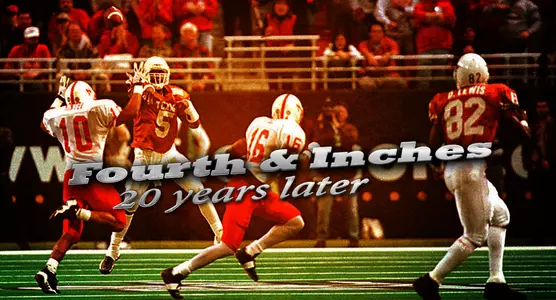
Meet Me in St. Louie, 20 years later
08.22.2016 | Football
As he came to the line of scrimmage and surveyed the Nebraska defense in the first-ever Big 12 Championship Game, James Brown stood at the edge of history.
To put this in perspective, it is important to grasp that elusive entity called time. For example: former Longhorns quarterback Colt McCoy was just ten years old. Former Texas head coach Mack Brown was still coaching at North Carolina, two seasons removed from his first year at Texas. Current head coach Charlie Strong was in his second year as defensive line coach at Notre Dame; ironically, the Fighting Irish had played Texas earlier that season. And most of the current Longhorn players had not even been born.
All of that said, here is our story, twenty years later. . .
As he came to the line of scrimmage and surveyed the Nebraska defense in the first-ever Big 12 Championship Game, James Brown stood at the edge of history.
Or maybe, better said, he was right smack in the middle of it.
To understand the moment, it helps to understand the situation.
The story begins long before that December afternoon in 1996 in the TransWorld Dome in St. Louis. Less than three years before, there was no league championship game, because there was no league. Texas was the linchpin of the Southwest Conference, and Nebraska had become the dominant team in the Big Eight. But the college football world had been undergoing a metamorphosis that had actually been evolving since the summer of 1984, when the universities of Oklahoma and Georgia won a television rights suit against the NCAA.
As the college football world watched, major players jockeyed for position on the national collegiate scene. The result of that, for Texas and Oklahoma, was a marriage of the teams of the dissolved Big Eight, and four teams (Texas, Texas A&M, Texas Tech and Baylor) from the now defunct Southwest Conference. The collection of these dozen schools became known as "The Big 12."
As with any blended family, there were immediate issues, and they all were never more obvious than at the first-ever Big 12 Championship Game that early December day in St. Louis.
James Brown had already been a significant figure for the Longhorns in the mid-1990s. When the Big 12 officially was formed in February of 1994, it was broken into two divisions. The North was made up of Nebraska, Kansas, Kansas State, Iowa State, Missouri and Colorado. In the South Division were the four former Southwest Conference schools as well as Oklahoma and Oklahoma State. And despite opposition from the coaches at all Big 12 schools, their presidents voted to have a championship game matching the division winners and sold the package to ABC-TV.
That is how James Brown came to stand with his team on the field of the TWA Dome, with less than three minutes remaining and Texas nursing an improbable lead of 30-27.
Since the league's formation, the South Division had been viewed as simply cannon fodder for the powerful North Division. There was open resentment among some media, fans and officials in the old Big Eight toward the interlopers from the four Texas schools. So it was with a degree of irony that Texas and Nebraska, two of the winningest programs in college football, would be the first representatives of the divisions to decide the first-ever championship.
Nebraska, which along with Florida State, would be the most dominant team in college football in the 1990s, was 10-1 and within striking distance of playing for a national championship. All the No. 3 ranked Cornhuskers had to do was eliminate the Longhorns, who were twenty-one point underdogs after winning the South Division with a 7-4 overall record.
James Brown had emerged as a Longhorn hero when he got his first start and beat Oklahoma, 17-10, as a redshirt freshman in 1994. He went on to lead the Longhorns to a Sun Bowl victory that season, becoming the first African-American quarterback at Texas to start and win a bowl game.
In that 1994 season, a year that was tenuous at best for the Longhorns' head coach John Mackovic, it was Brown who effectively turned the year--and Mackovic's tenure at Texas--around, as he led Texas to a 48-13 win over Houston and a 63-35 victory over Baylor. In 1995, he had piloted Texas to the final Southwest Conference Championship, including a gutsy performance despite a severe ankle sprain in a 16-6 victory over Texas A&M in the league's last game ever. In leading Texas to a 10-1-1 record, he helped the Longhorns earn an appearance in the Bowl Alliance at the Sugar Bowl.
The Monday before the Nebraska game, Brown had walked into a press conference in Austin and stunned the media. When he arrived, he was confronted by an Associated Press reporter named Chip Brown about the fact that Texas was a 21-point underdog and "How do you feel about that?" The reporter, an SMU grad who had arrived in Austin a few years earlier from Lubbock, was a harbinger of "fan website" reporting before there were fan websites. After repeated questioning, James Brown finally responded, "I don't know...we might win by twenty-one points."
In less than five minutes, it was on the national wire.
"Brown predicts Texas victory."
John Mackovic, who was in his fifth season at Texas, told his quarterback in a meeting that afternoon, "Now that you've said it, you better be ready to back it up."
The TWA Dome was packed, with a decided Nebraska flavor for that game which would decide the first Big 12 Championship. James Brown had led his team on the field in warm-ups, and was out-cheering the cheerleaders in the pre-game drills.
Mackovic, who was known for creatively scripting his offense at the beginning of games, put the Cornhuskers on their heels immediately with an 11 play, 80-yard drive for a touchdown to open the game. Texas had led 20-17 at half, but when Nebraska took its first lead of the game at 24-23 in the third quarter and then made it 27-23 with ten minutes remaining in the fourth quarter, things looked bleak for Texas.
The representatives from the Holiday Bowl in San Diego, who had come poised to invite Texas after the `Horns were dispatched by Nebraska, had marveled at the Longhorn Band at halftime and had delivered to the Texas representatives material advertising the attractiveness of San Diego as a bowl destination site.
But four plays later, Brown hit receiver Wane McGarity for a 66-yard touchdown pass, and Texas was back in front, 30-27.
Nebraska's ensuing drive stalled at the Longhorn forty-three, and with 4:41 remaining in the game, Texas got the ball at its own six. A penalty on the first play pushed the ball back to the three. Five plays later, Texas had moved the ball to their own twenty-eight yard line.
It was fourth down, with inches to go.
Mackovic called time-out and summoned Brown to the sidelines.
"Steelers roll left," he said. "Look to run."
Mackovic had used his weapons well in the game. He had taken Ricky Williams, who would win the Heisman Trophy two years later, and used him primarily as a decoy. Priest Holmes, who had been the third back after coming off of a knee surgery earlier in his career, had been the workhorse.
Both players, of course, would go on to fame in the NFL, with Holmes becoming the league's top rusher at Kansas City in 2001. Holmes finished the game with 120 yards on 11 carries, and Williams carried only eight times for seven yards. Everybody had seen the pictures of Holmes as he perfected a leap over the middle of the line for short yardage. He had scored four touchdowns that way against North Carolina in the Sun Bowl alone.
Nebraska geared to stop Holmes.
And now, there was James Brown, right where you left him at the start of this story.
"Look to run," Mackovic had said. But as the team broke the huddle, Brown looked at his tight end, Derek Lewis, and said, "Be ready."
"For what?" Lewis responded, as he turned to look at his quarterback as he walked out to his position.
"I just might throw it," Brown replied.
Brown took the snap, headed to his left, and saw a Nebraska linebacker coming to fill the gap. He also saw something else. There all alone, seven yards behind the closest defender, stood Derek Lewis.
Seventy-thousand fans and a national television audience collectively gasped as Brown suddenly stopped, squared and flipped the ball to Lewis, who caught it at the Texas 35, turned and headed toward the goal. Sixty-one yards later, he was caught from behind at the Cornhusker 11-yard line. Holmes scored his third touchdown of the game to ice it at 37-27 with 1:53 left.
The next morning, Mackovic was on a plane to New York to attend the National Football Hall of Fame dinner, and to accept on national television the Fiesta Bowl bid to play Penn State. The reaction and reception he received was amazing. In choosing not to punt from his own 28-yard line, thus leaving the game in the hands of his defense with three minutes left, Mackovic had swashbuckled his way into a significant amount of fame. Had it failed, he would have been second-guessed forever, because the Cornhuskers would have had the ball only 28 yards from the goal, where a very makeable field goal attempt would have tied the game, and a touchdown would have won it.
There is an old Texas proverb that says it is only a short distance from the parlor to the outhouse, and there was John Mackovic, sitting on a stuffed sofa in a studio at CBS-TV, accepting a bid as the Big 12 representative to the Fiesta Bowl, as Nebraska dropped from national title contention and went to the Orange Bowl.
"The call" seemingly had been seen by everybody in America. Ushers at the David Letterman show were high-fiving the Texas coach, and managers of leading restaurants were sending him complimentary bottles of wine.
James Brown had made good on his promise, even if he didn't quite get the 21 points margin of victory. He passed for 353 yards, hitting 19 of 28 passes, including the touchdown pass to McGarity. He had led Texas to a stunning victory. The mystique of the North Division of the Big 12 had been shattered, and the guys from the South had proved they belonged.
In the 14 years that followed the inaugural game, Big 12 schools played in the BCS National Championship Game seven times, as the young league quickly solidified itself as a true power in college football. Now, of course, it is a focal point of lots of stirring and rumors across the college football landscape.
The league as it was originally formed has already undergone significant transition. Nebraska departed for the Big Ten, Colorado for the Pac-10 (now Pac-12) and Missouri and Texas A&M to the SEC. In their place came West Virginia and TCU, as the twelve became ten. The new look in the second decade of the 21st century will include the return of an end-of-season championship game, as conversations continue about other changes.
The victory marked the high water mark for Mackovic, who was able to enjoy the popularity of "the call" for a short spring and summer. When Brown sprained his ankle in the season opener of 1997 and couldn't play the next week against UCLA, disaster struck. Texas came apart as the Bruins beat the `Horns, 66-3. Brown never really got well, and neither did his coach. When the Texas season ended at 4-7, Mackovic was removed from the head coaching position and reassigned within the athletics department.
After leaving Texas following the 1997 season, John Mackovic spent a couple of years as a commentator at ESPN before serving as head coach at Arizona from 2001-03. He also spent a few years coaching for USA Football overseas and wrote a bi-weekly newspaper column for the Palm Springs (Calif.) Desert Sun.
In his time at Texas, James Brown earned a special place. He graduated in 2000 and spent years playing in the NFL Europe, the CFL and Arena Football League. He continued winning championships and after six years of professional football retired and went on to coach at the high school and collegiate level. He's also served as a high school athletic director. Brown was inducted into the Longhorn Hall of Honor in 2009.
As a trailblazer, he destroyed the myth that an African-American couldn't play quarterback at Texas, and secondly, he had taken "fourth and inches," and made it into a euphoria that will forever rank as one of the greatest moments in the storied history of Longhorn football.
EDITOR'S NOTE: Excerpts from this commentary came from the book "Stadium Stories--Texas Longhorns," by Bill Little.