The University of Texas at Austin Athletics
09.27.2016 | Women's Basketball
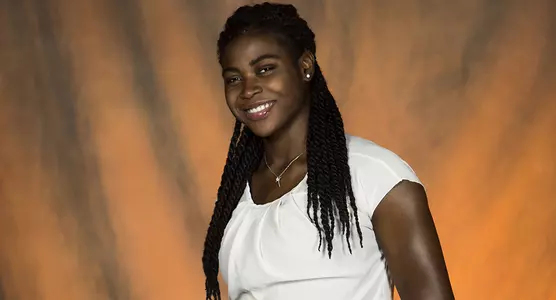
Texas sophomore forward has journeyed nearly 7,000 miles from home and persevered through much adversity.
Olamide Aborowa arrived in Austin with nothing more than a duffel bag and a backpack.
It was a tangible reminder of how far she had come despite having so little.
There's no denying the dearth of material items she has possessed over the years. But Aborowa has never been short on opportunities, which she has fearlessly seized no matter how far they took her away from her home in Lagos, Nigeria.
Accustomed to solitude, Aborowa embarked on what has become a nearly 7,000-mile journey from her home. She first made her way to Philadelphia and Saints John Neumann and Maria Goretti Catholic High School where she won a state championship, and then on to Austin, where she begins the 2016-17 season as a sophomore on The University of Texas women's basketball team.
"I'm happy to be at Texas because I never really thought it would happen to me," said Aborowa, who goes by the nickname Mide (pronounced mee-day). "What makes me happy is the fact that I know I'm making progress and life is all about growth."
TWO CHANCE ENCOUNTERS
"Hey, do you play basketball?" inquired a stranger on the street.
Aborowa, walking down the street in her native Nigeria, was surprised. Not only did she not play basketball, at the time, she wasn't exactly sure what it was.
"Call me," the man said. "I'll give you my number."
Aborowa continued home where she recounted the occurrence to the guardian with whom she had stayed since the age of eight.
Her father had never been in the picture. Her mother, Olaitan Elizabeth, was often away for work. She lived, most of the time, with a family friend.
"Don't talk to strangers," her guardian instructed, tearing up the slip of paper with the stranger's phone number on it.
Aborowa gave little further thought to the events of that day until the circumstances repeated themselves. Joel Ige, the man she would come to know as Coach Joel, stopped her once again on the same street.
"Hey, you didn't call me that time," he said.
"My guardian said I shouldn't speak to you," she responded.
But Ige was persistent. He followed Aborowa home and spoke with her guardian. He thought it would be beneficial for Aborowa to begin playing basketball.
Her guardian reluctantly relented.
"I started out with Converse and a little pair of tights and a shirt," Aborowa said. "It was a run-down outdoor court and they had a rubber ball. The court had potholes in it that were really bad. That's how I started."
The game didn't come easy to Aborowa.
"I didn't understand it at first," she said. "I was just doing what he told me to do."
But, for Aborowa, the personal achievements that she made through basketball weren't necessarily about what happened on the court. The sport provided an outlet from a life that proved challenging for a 14-year-old and one that had never been easy.
"As time went on, basketball took my mind off a lot of stuff that was happening to me personally," Aborowa said. "I started understanding things better – understanding that it's not just about me. I met more people and I got out of my shell more. Before basketball, I was just in the house. I didn't play any sports growing up."
She would get to the rickety old court as often as she could to play with the all-male group of older players. Aborowa's living arrangement, however, made it difficult for her to make the team's regular 8 a.m. Saturday morning practices.
"I was playing off and on because the lady I was staying with would always say, 'You have to do all of the house chores before you can go out," Aborowa recounted. "Before I would get done, it would be like 12 and it would be too late to go. I tried to tell her that basketball and school went together, but she would say, 'oh, no.'
"She didn't like the fact that I was playing basketball, so she didn't let me play."
Early in her basketball career, Aborowa went with Ige to a camp run by Mobolaji Akiode, the founder of Hope 4 Girls Africa, a 501(c)(3) nonprofit organization dedicated to the increased participation and empowerment of disadvantaged young African women in sports and education.
When she returned a year later, she hadn't improved. Her limited opportunities to practice basketball were mostly to blame.
"She saw me a year later and I hadn't gotten any better," Aborowa said. "She was mad. I told her that I didn't get to practice because they wouldn't let me."
Aborowa stood at the station waiting for the bus to take her home following one of Akiode's 3-on-3 tournaments. Akiode was driving by the bus station on her way out of town, when she stopped her car and rolled down the window.
"I can help you," Akiode said, giving Aborowa her business card. "Come to the United States and get a better education."
Aborowa talked it over with her mother, who agreed to let her explore the opportunity.
For many, the thought of leaving home and moving more than 5,000 miles away would be daunting.
Not for Aborowa.
"I wasn't scared, just for the fact that I was basically alone in my life because I didn't stay with any family members," she said. "I was used to being alone, so I wasn't scared of coming here, but I did lack the confidence that I should have had."
FINDING HER WAY
Aborowa moved to Philadelphia where she lived with a host family and attended Neumann-Goretti. She steadily developed into one of the nation's top prep basketball players, but it was her personal development that Aborowa found most beneficial.
"I had a great support system," Aborowa said. "My coach was amazing and she helped me through a lot of things. When I came to Philadelphia, I had a lot of mental struggles based on things I had gone through as a kid. She helped me get out of myself. I wasn't a perfect kid, but my coach and my host family really helped me, and I'm very appreciative of them."
Under the direction of Coach Letty Santarelli, Aborowa became one of the nation's top-80 players, according to ESPN.com and was the 15th-ranked power forward in her class. She led Neumann-Goretti to a 29-1 record and the Philadelphia Catholic League title as a junior. As a senior, her team captured the PIAA Class AA girls' state championship with a perfect 30-0 record.
Playing basketball at the highest level had become a reality for Aborowa, but it wasn't something she had always been able to envision.
"I was just happy to be here," she said. "I was getting a better education and getting a chance to go to college. High school players now talk about what schools they dream of going to. I didn't really have that or know what school I wanted to go to. I was just going to school and playing basketball because I got to."
It was through participating on the Philadelphia Belles Nike Travel Team that Aborowa first caught the eye of the Texas coaching staff. In April 2014, head coach Karen Aston and her staff attended the Boo Williams Tournament in Hampton, Va., and caught a glimpse of Aborowa.
"We were sitting there and we had a break between games watching other recruits," said assistant coach George Washington. "Karen watched the Philly Belles play and she immediately came over and said, 'You guys have to see this kid from the Philly Belles. She is a rebounding machine.'"
There's no question that Aborowa's talent was raw. She had only been playing basketball for a few years and was even newer to organized basketball. But Aston was intrigued by Aborowa's potential.
"She hadn't been playing long, but we saw her potential and we needed a post player," Aston said. "You could look at her length and her athleticism and we just saw flashes of things. I saw the potential in her. The way we develop players here, she was someone that we believed we could develop."
As the Texas coaches got to know Aborowa better during the summer of 2014, they quickly realized that she would be a great fit with the program they were re-energizing in Austin.
It was Washington with whom Aborowa was instantly able to relate.
Washington's daughter Lashann Higgs – Aborowa's age and also now a sophomore on the Texas team – had come from a similar environment in The Bahamas. Higgs immigrated to the United States on her own with hopes for a better life through basketball and school, and was later adopted by Washington and his wife Jackie.
"Because of Lashann, I understood Mide's story and what she had been through," Washington said. "We bonded really fast. She wasn't extremely talkative, but the things we talked about had a lot of substance. We got along really well."
Aborowa's character was appealing to Aston. In the 6-foot-3 forward, she found someone who epitomized what she looks for in potential student-athletes.
"When I did more delving into her as a person, her willingness to stretch herself was intriguing to me," Aston said. "She was willing to come to a place like Texas where she could challenge herself academically, socially and athletically. It would be quite a challenge for her and a lot of kids are not interested in that. She is really gifted academically and that fits well with being at Texas. When we put all of the pieces together, we thought we could really help her reach her potential here."
Aborowa left her official visit to UT with the same feeling.
"I came here for my visit – the girls were cool and the coaches were great," she said. "It seemed like they were going to make me better and they understood where I was coming from. I wasn't in any way a good player. They understood the fact that they could get me better. I got home from my visit and told my host family, 'Yeah, I'm ready to commit."
GROWING PAINS
The transition from high school to college is a difficult one for any freshman. For Aborowa, it was more trying than for most.
Once again, she was in a city that resembled nothing like her hometown where she knew no one. As compared to her past experiences, the expectations were off the chart both on the basketball court and in the classroom. There was a rigid schedule and time management would be a necessity. She was also struggling with a handful of psychological issues stemming from her past.
"The thing about being a freshman in college is that you're learning new stuff at a very fast pace," Aborowa said. "It was hard for me because I was used to just doing things my own way. Now I had people saying, do this or do that. It was difficult for me to get everything and just be level-headed, not going from high-to-low, low-to-high."
The practices were intense and nothing like Aborowa had seen. She struggled with the feedback she was regularly receiving from her coaches in practice. In her mind, it felt like she was the only one who couldn't do things properly.
"There were times that I just cried and said 'I don't want to do this anymore. Why is it just me?'" Aborowa said. "They knew I could do better, so they were just helping me. The coaches yell at every other player, but because of the fact that I had problems of my own, it made it worse."
Aborowa's coaches worked with her off the court to provide regular encouragement. They stressed that they were trying to help her reach the potential that they saw in her.
"The biggest thing was helping her understand that everybody messes up," Washington said. "We weren't upset at you for messing up. We expect you to mess up because our job is to coach you. What probably made the biggest improvement in her overall outlook was the extra time we spent in skill training.
"Mide wants to make the most of her opportunity, so she puts a lot of pressure on herself. It was in the big groups that she had problems. She didn't want to mess up because she didn't want to let the team down."
Aborowa saw action in 18 games last season, averaging 3.4 minutes per game. Her time in games was limited, but her confidence continued to grow with every practice.
"I could see that she was overwhelmed both socially and with how difficult basketball was," Aston said. "We threw her into an environment with a lot of talent. She was initially overwhelmed with how competitive it was and that translated into a loss of confidence. We had to teach her how to put work in, and work creates confidence. We've seen the benefits of that."
MOTIVATING FACTOR
Aborowa takes a lot of pride in her native Nigeria. She also takes great satisfaction in hard work. Work-ethic, she says, is an ethos that is widely embraced in her home country.
She plays with a purpose and enters the classroom with that same determination. Aborowa aspires to return home one day, armed with a great education and all of the tools necessary to help advance the country of Nigeria.
"I am a big believer of home," Aborowa said. "I am a proud Nigerian. I feel like my country can be better. There are a lot of natural resources and things my country has that can be tapped into. There is a lot of corruption going on. I just think there's something I can do and add to it, even if it's a little bit."
She is well-versed in her country's history and references Malcolm X's Letter from Accra as evidence of Nigeria's potential. Malcolm X penned the letter in April 1964 following a visit to Lagos, Nigeria, Aborowa's hometown. He spoke of the country's vast resources and his belief that Nigeria could become the "breadbasket of the world."
"Malcolm X called Nigeria the fastest-growing country in Africa," she said. "We were supposed to be the center. I don't know when it all went to the ground. I want my country to be better. I don't like the fact that people want to go to other countries to get better. I feel like Nigeria has a lot to offer."
Aborowa's passion for Nigeria is evident on a daily basis and the Texas coaching staff realized early on that it was an impetus for her success.
"She has a lot of pride for where she's from, what she's been through and the sacrifices that have been made for her," Washington said. "That was expressed early on in the recruiting process. She carries that weight on her shoulders and I respect her greatly for her. She always talks about how proud she is making her mom by what she is doing. I think it's absolutely amazing."
Aborowa liked the fact that there is a higher-than-average percentage of Nigerians in the Austin metro area, including former Texas player Nneka Enemkpali, a Pflugerville, Texas, native who is the daughter of two Nigerian-born parents. The Austin weather was also a plus for Aborowa.
Aborowa is contemplating a major in international relations and global studies. Whatever struggles she encountered in her first season in Austin, academics was not one of them. She was named to the Academic All-Big 12 Rookie Team in June and is motivated by the fact that her mother did not advance past the 10th grade.
"The thing is, you've got to be good at something, right?" Aborowa joked. "I am thinking of international relations and global studies because I have high hopes for going back home and helping my country. When I got here, I knew that it was a new beginning and a new chapter in life. I knew that I really wanted to do this. And to get somewhere in life, you have to have a good education and good mindset of where you want to be."
NOTHING PERMANENT EXCEPT CHANGE
Anyone who regularly spends time with Aborowa has noticed a definite change since the end of the 2015-16 season. She has had time to work through her struggles, both on the basketball court and personally. Her confidence is continuing to grow.
"It's a lot better now," Aborowa said. "I have counselors and therapists who are helping me work through some stuff. The coaches are very helpful too. I still get down on myself sometimes. It makes me happy that I am making progress."
Aborowa stayed on the Forty Acres the entire summer and the added time in skill development and in the weight room with strength and conditioning coach Shaun McPherson helped contribute to her progress.
"It has been brick-by-brick," Aston said. "Most of it was built over the summer with Shaun and the other players. In the spring and summer, we were able to slow down with her, get in individual workouts, work on fundamental things and build her confidence. She has continued to build her confidence on the floor and Shaun has helped her with her conditioning and getting stronger. She's in better shape and she's able to do the workouts and sustain her effort."
As she enters her sophomore campaign, Aborowa can take pride in the fact that she has reached the other side of a difficult upbringing and is one of the team's top academic performers. These are both traits that will serve her well in the future when she returns to Nigeria to make a difference.
As for basketball, Aborowa – who has a running vertical reach of nearly 11 feet and moves with an ease that is rare for most post players – has only scratched the surface of her capabilities.
"It's really one of the biggest changes I've seen in a kid in one year," Aston said. "She's not there yet, but it has been a remarkable turnaround."