The University of Texas at Austin Athletics
A Heisman Surprise
10.20.2017 | Football
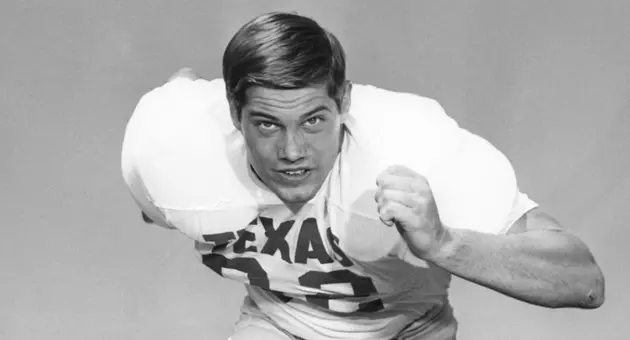
Texas Athletics celebrates the 40th Anniversary of Earl Campbell's 1977 Heisman Trophy campaign.
By Bill Little
It was, at best, a long shot.
The season of 1977 had brought a lot of changes to Texas football. Darrell Royal, who had built a dynasty in his 20 years as head football coach, had surprisingly retired at the age of 52 at the end of 1976. Fred Akers, a relatively untested head coach who had only two years at Wyoming under his belt, had been hired, even though he was not Royal's choice to succeed him.
The Texas Longhorns, who had finished Royal's last season at 5-5-1, were coming off their worst season since 1956. And while Akers inherited a powerhouse team from Royal and brought new energy and enthusiasm, it was still a stretch to think UT would be back in the National Title hunt immediately.
In the middle of all of that was the questionable status of arguably Texas' best player, Earl Campbell. Campbell had come to Texas as the most heralded recruit from the state of Texas in the fall of 1974. His high school career at Tyler was the stuff of which legends were made in a state fraught with legends. His decision to come to UT and shun Oklahoma—which had won more than its share of recruiting battles in the recent past back then—had made national news.
But by 1977, his was a dream too oft unfulfilled. In 1974, he arrived to a program which had been shocked by a spring injury that had short-circuited the career of Roosevelt Leaks, who likely would have been the leading candidate for the Heisman Trophy had he been well. Earl stepped into Leaks' role at fullback, and made all-Southwest Conference.
In 1975, with Leaks' college career over, Earl flourished as he helped lead Texas to a share of the SWC title. In the final game of the year, Royal moved him to running back in the Wishbone formation, and he earned game offensive MVP honors in a victory over Colorado in the Bluebonnet Bowl.
But as 1976 approached, something just didn't seem right.
"We looked like a very average 5-5 team today," Royal had said after the team's final practice before making the trip to Boston College to open the season. Campbell had developed a nagging leg injury over the summer, and in the game in New England, he gained only 23 yards on five carries in a stunning 14-13 loss to BC.
The opening game was an omen. Unable to work because of a hamstring pull tucked deep inside his 30-inch thigh, Campbell played most of the season at 242 pounds—20 pounds more than his best playing weight. He missed four games entirely, and played sparingly in others. He didn't make all-conference and wasn't even mentioned for all-America honors.
Still, as we were preparing for the 1977 season, I got my dad's old camera, and put Earl and Coach Akers in suits, and took them to the stadium deck, and shot their picture with the new Astroturf field far below them.
We slapped it on the cover of the media guide, and I wrote a cutline which read: "New head coach Fred Akers, and Heisman Trophy Candidate Earl Campbell."
No campaign. No bells and whistles or even a handful of post cards.
Fact was, he had little chance of actually winning.
Gifford Nielsen, the quarterback at BYU, was the odds-on favorite. He was heading into his senior year with rave reviews, and a coach who loved to throw the football. Oklahoma State was equally proud of running back Terry Miller. Notre Dame had two solid candidates in tight end Ken MacAfee and defensive lineman Ross Browner. Grambling's Doug Williams was a popular choice who was about to throw for over 3,000 yards for legendary coach Eddie Robinson.
Texas had never had a Heisman winner. Leaks, had he not been injured in the spring, would have been the leading candidate for that honor in 1974. Steve Worster, Chris Gilbert, James Saxton—the list even included linebacker Tommy Nobis and tackle Scott Appleton—all had been in the mix through the years. So to say my cutline was a pipe-dream kind of stretch would be an understatement. But a good sports information director never lets logic get in the way. So with the reluctant approval of my boss, Jones Ramsey, I just rode emotion all the way to the UT printing division and a color cover of a 4-by-9-inch fact book that would be more right than even I could have dreamed.
That was only the beginning of a series of circumstances that would take a humble son of a marvelous lady who raised roses in Tyler all the way to the Downtown Athletic Club of New York just a few months later.
First, Earl came back to campus that fall a sleek 220 pounds. Second, Akers and his staff discarded the Wishbone which had carved Texas' dynasty over the past nine years. Royal and his choice for the coaching job, Mike Campbell, had long discussed going to the "I" formation with Campbell as the featured back, and that is exactly what Akers did.
In those days, Heisman winners usually came from highly successful teams, and the new staff took the returning players and built a powerhouse on both sides of the ball. The 'Horns started the season on the far north side of the top 20, ranking No. 18 (primarily on tradition) as they entered their first game against Boston College in Austin. Campbell rushed for only 87 yards on 17 carries, but the UT defense shut out the Eagles in a 44-0 win.
Texas jumped all the way to No. 9. Earl burst into the headlines in a 68-0 victory over Virginia, rushing for 156 yards on 19 carries and scoring two touchdowns. Texas moved to No. 8 in the polls as it opened Southwest Conference play against Rice. This time Earl tied a then-UT record with four touchdowns, carrying 13 times for 131 yards as Texas plucked the Owls, 72-15.
Now, Texas moved to No. 5 nationally, and was unbeaten as it headed to Dallas to play No. 2 Oklahoma. In a series that had grown more and more contentious over recent years, the Longhorns had not beaten the Sooners since 1970.
It was October 8, 1977. And for Earl Campbell and the Longhorns, "Destiny" was about to become a surprising new traveling companion. The Longhorns, with Earl scoring on a play where he leapt over a Sooner would-be tackler, won, 13-6. Over 2,000 miles away, in Corvallis, Oregon, Gifford Nielsen suffered a college-career ending injury in a game against Oregon State.
Suddenly, the Heisman Trophy race was wide open, and Earl Campbell of Texas was one of the favorites.
In the movie "Gypsy," the girl sings that to be a star, "you gotta' have a gimmick." And Earl was blessed with more than his share of "gimmicks."
The story of his recruiting had included tales of his mother fending off other recruiters because of her loyalty to Ken Dabbs, the Texas assistant who was recruiting Earl. When Earl was offered illegal extra benefits, he looked the coaches in the eye and said, "My people have been bought long enough. I am not for sale."
As a freshman at Texas, he said the reason he played was so he could "buy my momma a house so she doesn't have to look at the stars through the roof at night."
As Texas' success grew, so did his legend. Red Lane, a country songwriter friend of Coach Royal, wrote a song called "Momma's Roses." So the legend of the rose fields of East Texas, where Ann Campbell worked in the soil of the land to support her family, grew larger than life.
Meanwhile, on the field, the Longhorns and Earl were reeling off victories. They were No. 2 in the nation after the OU win when they knocked off No. 3 Arkansas in Fayetteville, 13-9. They crushed SMU, 30-14. The week after, they moved to No. 1, and ran off victories over Texas Tech, Houston and TCU.
Jones Ramsey, who was the best in the business as an SID, got with the Longhorn coaches and created a statistic that would change the dynamic of every running back who would follow. They went through the films and came up with the figure of "YAC." Yards After Contact. Where other schools were trying to mount "Heisman campaigns," Jones helped Earl win it by simply doing his job: providing the media with solid facts to make a logical choice of who was the best football player in America.
Earl had run for 188 yards against Arkansas, 213 against SMU, 116 against Texas Tech, 173 at Houston, and 153 against TCU. He was eight games into what would be a string of 10 straight 100-yard rushing games to end the regular season.
And then the phone rang in the SID office.
"This is Kent Demaret of 'People' magazine," said the voice on the other end of the phone. "Somebody has been telling me about a guy you have playing football whose mother raises roses. Sounds like there might be a story there."
"Let me tell you," I said, "about Earl Campbell.
The next week, as Texas was preparing to play Baylor and the final votes for the Heisman Trophy were due, Ann Campbell's picture was on the front of a magazine at the checkout stand of every grocery store in America.
The Baylor game, which was the next to last game of the regular season and the final game before the Heisman vote, was on national TV. Early in the game, they flashed a graphic which said, "Earl Campbell, two carries for 10 yards."
Rick Ingraham, who was a mainstay of one of the best offensive lines in Longhorn history, came back to the huddle after the play that prompted the graphic.
"Heisman my a--," he said as he looked at Earl.
On the next play, Campbell broke for 20, and when the game was over, he had run 30 times for 181 yards. Texas won 29-7. The voting was over by the time Texas crushed Texas A&M, 57-28. Earl put the final punctuation mark on the Heisman race with 222 yards rushing on 27 carries, three rushing touchdowns, and a 60-yard scoring reception.
He finished the regular season with a school record 1,744 yards rushing and eighteen TDs on the ground.
Years later, an Oklahoma State assistant who had labored in vain to tell the story of Terry Miller, lamented, "We thought we had a chance, but when you guys came up with the YAC stat, it blew everybody away."
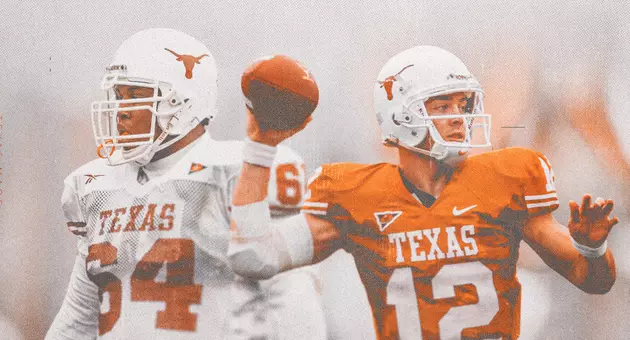
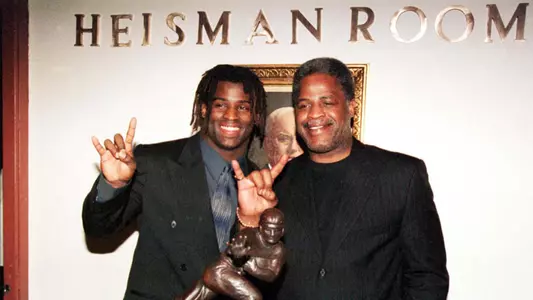
Saturday, the Longhorns' other Heisman winner, Ricky Williams, will join Earl as UT celebrates the 40th anniversary of that storybook season.
It will be a remembrance of a season of accomplishment, earned not through some high-powered publicity campaign or media blitz. It will always be particularly special because Earl and his teammates in that season of 1977 earned the award where it should have been won—on the field.
In that window, the Heisman Trophy was about all the right things. Earl was the best football player in America that season, just as Ricky was in 1998. As for me, and Jones Ramsey, and current Texas SID John Bianco who would follow with Ricky, it was our job to tell the story.
And that is why we are honored to do what we do.