The University of Texas at Austin Athletics
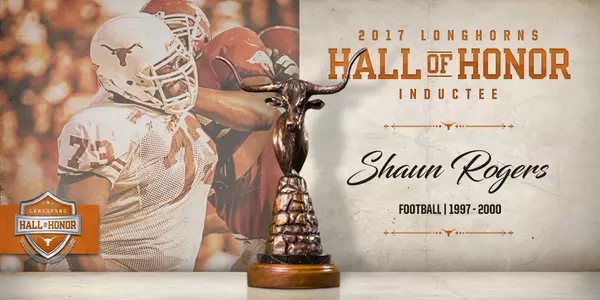
Defining Moments: Hall of Honor inductee Shaun Rogers
10.06.2017 | Football
After making history at Texas, Rogers bounced back from an injury his senior year to become a mainstay in the NFL for 13 years.
By James Rodriguez
Football came naturally to Shaun Rogers, whose stocky build as a kid hinted at the 6-foot-4, 350-pound frame he would one day fill. The game was in his blood — his father played both professional and semi-pro ball.
"It always felt right," Rogers said. "I can't ever really just put my finger on that moment that said hey, you're going to take this to college. It just felt like that's where I was supposed to be and that's what I was supposed to be doing."
Rogers' natural ability morphed into serious talent in high school, and soon schools began courting him. Texas coaches deserve plenty of credit for selling Rogers on becoming a Longhorn, to be sure. But the most valuable recruiter may have been his older brother, Ambrose. Eight years Shaun's elder, Ambrose attended UT on academic scholarship and guided Shaun around campus on frequent visits during the summers.
"Going to the gym, just enjoying being a teen around a college environment — that really was the biggest draw to Texas," Rogers said. "When I finally got the call from them, it was a no-brainer."
Rogers initially expected to redshirt his freshman year, but those plans were scrapped when defensive linemen and future NFL draft picks Casey Hampton and Chris Akins both went down with ACL injuries. Rogers vividly remembers his first matchup against Oklahoma that year in the Red River Rivalry, as well as the first-year nerves that accompanied that game.
"Just imagine as a freshman walking into that," Rogers said. "You hear in the stories, you're walking into a stadium half orange, half red, and it's just an electric, electric environment. At that point, it's just on. Just hoping you don't mess up. That sparked the flame."
Rogers and Hampton later combined to form one of the most formidable defensive tackle duos in Texas history. Both earned first-team All-Big 12 honors in 1999, and Rogers' 27 tackles for a loss that year are the second most for a season in school history.
As his career at Texas progressed, Rogers began to harbor dreams of going pro. Then, in a September matchup against Houston his senior season, Rogers went down with a high ankle sprain that would plague him for the rest of the season.
"That was a huge challenge, going down on that field at the beginning of my senior year, knowing that I had a good career up until that point and there was a possibility of going on to the next level," Rogers said.
Rogers leaned on the advice of his mother, who taught him to meet all challenges and would pull him out of high school football practice if his grades didn't meet her expectations. He recorded 14 tackles for loss and 3.5 sacks in his final year at Texas, but the injury lingered. He required surgery after the season concluded, and arrived at the NFL combine in a wheelchair. It was hardly the kind of introduction Rogers had hoped to make to the swarm of coaches and GMs in attendance.
"I most definitely was red flagged at the combine," Rogers said. "Somebody saw enough in me to still draft me. I was really blessed to be able to be drafted that high after going into the combine in a wheelchair."
In a testament to Roger's talent in college, the Detroit Lions selected him in the second round of the draft with the 61st pick. What followed was a 13-year career in the NFL, one of the longest of any player to come out of UT. He made three Pro Bowl appearances and finished with 130 starts in 163 games.
For Rogers, the greatest praise often came from the offensive linemen he went against on Sundays, some of whom would later tell him he was among the most difficult opponents they faced all season.
"Really, I'm most proud of the longevity and the respect of my peers," Rogers said. "That's just something I've always played for and always appreciated and longed for. I'm the ultimate competitor, and that goes back to my mother and trying to meet all challenges."
Rogers will be inducted into the Hall of Honor alongside his high school coach, Forrest Wiegand, a Texas football alumnus who won a national championship with the team in 1969. At the time, Rogers didn't make too much of those accomplishments — he was just happy to have a coach who knew the game. Now, Rogers said he feels blessed to accept the award alongside his former coach.
"As an athlete, you come across certain coaches that help mold you, and he was one of those figures," Rogers said. "For me, it's just a great honor and a great privilege to be able to go into the ceremony knowing that I'm going in with somebody that I really appreciate and owe a lot to."
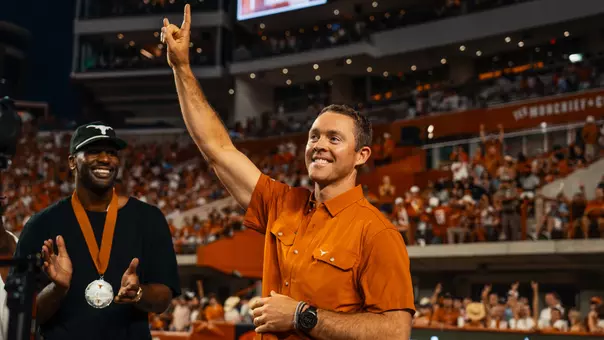
When Rogers steps onto the field on Saturday to be recognized for his induction, Darrell K Royal - Texas Memorial Stadium will look much different than it did when he first arrived on campus. Back then, seating capacity hovered around 75,000, and there was no "Godzillatron" to be heard of.
"The only thing that looks familiar is the grass, and that's not even the same," Rogers said wryly.
The area around campus has changed, too. Several of Rogers' favorite haunts, including Players, a restaurant on Martin Luther King Jr. Boulevard, and the Jack in the Box on Guadalupe Street, are no more. Still, Rogers said, there's a feeling on campus that always reminds him of why he came in the first place.
"It's different, but it's the same," Rogers said. "It's one of those things where you feel the essence, you remember these certain places."