The University of Texas at Austin Athletics
04.10.2017 | Football
The first Thursday of each month, they have gathered at the Mexican food place out on Highway 71, nestled in the trees between the stop light and the Pedernales River. The faces, and the résumés vary, but the reason for the gathering has never changed.
At first, it was simply Darrell Royal and men who had coached with him in the Golden Age of Texas football that spanned the 20-year era between 1957 and 1976. The group has had infusion of others from that time - players like Doug English, Bob McKay, Ted Koy and Randy Peschel.
Others too have dropped in; from celebrity guests such as Mack Brown and DeLoss Dodds, Charles Breithaupt of the UIL and leaders of the Texas Coaches Association, to former Longhorn coaches from other sports and longtime staff members.
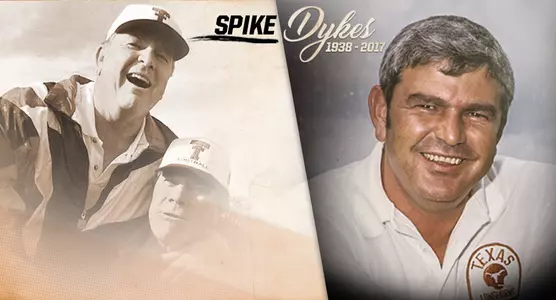
One by one, they have left us. Leon Manley, R. M. Patterson, Willie Zapalac, and of course, Coach Royal himself. And now, arguably the glue which held the whole thing together, is gone. Spike Dykes died early Monday morning, apparently of a heart attack.
Bunny Andrews, the younger brother of the late Texas icon Rooster, who had played in the early 1950s, has assumed the role of the wagon master. Each Wednesday he would call the regulars of the Coach Royal Lunch Bunch to remind them to be at Rosie's at 11:30 sharp. Next month, he will have one less phone call to make. The answering machine at Horseshoe Bay has not changed in the years since Sharon Dykes died.
"Sharon and I aren't here right now," Spike Dykes would say in his gravely West Texas accent. "Leave a message."
And Monday morning, they both were gone. When they sing that song about waiting on the far side banks of Jordan, that's Spike and Sharon, running through the water toward each other. Age is both a proud and insidious traveling companion. Spike had battled heart disease since he coached at Texas Tech, and between that and a bout with pneumonia which took away part of his lung strength awhile back, it had been a long, long time since he had felt good.
The several-times-a-week golf games dwindled until it was hard for him to make nine holes. Trips to Lubbock to see family and friends included appointments with doctors. Yet he never complained, and he worried way more about you than he let on worrying about himself.
If the mark of a man will be judged by those who commit their lives "to be a friend to man," then Spike Dykes gets to sit on the front row.
People all over the state, young and old, knew him and loved him.
Because he loved them.
Many will remember Spike as the head coach of the Texas Tech Red Raiders for 13 years. At The University of Texas, he parlayed deep friendships into a job that ended in the 1970s, but had nurtured relationships that never really died.
In 1971, when Coach Royal was looking to hire a coach who would fit in with a staff which had recently led Texas to thirty straight wins and two national championships, he asked his great friend and assistant Mike Campbell for advice on whom to hire. The profile had been set for Royal. When he went looking for coaches, he sought the most successful he could find, and quite often he brought them out of the Texas high school coaching ranks.
Campbell knew that Alice High School had won a Class AAAA bi-district championship, and the guy who had led them to that title was one of the most respected coaches in Texas high school football. Everywhere he had been—and he had been darn near everywhere—his fellow coaches and his opponents loved him.
"He was," Darrell once said, "…well, he was Spike. He's never changed a bit, and he shouldn't."
Eastland, Ballinger, San Angelo Central; then head coaching jobs at Coahoma, Belton, Big Spring and then Alice all were stops on that road to Austin. Campbell used to kid that Spike kept his office in boxes, waiting for the next move.
When Royal retired in 1976 and Campbell didn't get the job at Texas, Spike was on the move again. To New Mexico. To Mississippi State, and finally back to high school at Midland Lee.
And then in 1984, with his wonderful wife Sharon and their family, he returned to college football as defensive coordinator at Texas Tech. And you could put away the cardboard boxes, because Spike at last was home.
In 1987 he became the head coach of the Red Raiders, and there never was a greater fit in all of college football. Spike Dykes WAS Texas Tech Football. His roots were in the land, and his heart was with his kids.
For 13 years, until he retired in 1999, he was respected for solid fundamental football. His teams won 82 games, lost 67 and tied one. He took Tech to seven bowl games, including the 1995 Cotton Bowl. His teams won almost 60 percent of their league games in the Southwest Conference and the Big 12, and he had remarkable success against his two biggest rivals, Texas A&M and Texas, just about breaking even with the two in 13 seasons.
He coached 60 all-Southwest Conference players and 30 who made various all-Big 12 teams. Ten of his players were named first team all-American, and five were chosen Academic all-American. And 89 of his players were judged academic-all conference by the two leagues. Twenty four of the players Spike coached were drafted by NFL teams.
But Spike brought a lot more than wins and losses and honored players to the game. He brought solid values, the football fundamentals of the best of coaches and the wit and wisdom of a Will Rogers or a Darrell Royal.
Most of all, Spike was about people, and about the kids who played for him. In 1989, Kim and I had gone to Lubbock to see our daughter who was a student at Tech, and Spike's team was playing New Mexico. He had a great running back by the name of James Gray (the father of former Longhorn Jonathan), and a football team that would go on to be one of the best in Tech history. The Raiders had a significant lead, and Gray was dominating when he suffered what appeared to be a relatively minor injury. Spike took him out of the game, and even though New Mexico came back and closed to within seven points at 27-20, he never put Gray back in the game. The Raiders held on to win, and when we talked after the game he said, "He's got a great future in football, and I wasn't about to risk his career just to win a football game."
James Gray was a second team all-American, a first team all-conference selection and the Most Valuable Player on a Raider team that went 9-3 on the season.
Spike understood better than most that things really don't matter…people do.
After he retired from coaching, Spike and Sharon moved to Horseshoe Bay, in the Texas hill country, where together they fought the ravages of her Alzheimer's disease until her death in November of 2010. And that was when Spike decided to leave the answering message on the machine.
He bravely went on with life, traveling and surrounding himself with family and friends. If you were being honored at an event, Spike was there. If there was a funeral for a friend, he would drive his pickup across the state to attend. This summer, he went with DeLoss and R. C. Slocum to the North Carolina mountains to spend time and play golf with Mack and Sally Brown.
He maintained a relationship with Texas Tech, being inducted into the Red Raider Hall of Honor in 2001. And at the urging of his friend, Coach Brown, he re-established his ties with the coaches and former players of The University of Texas. He remained fiercely loyal to both Royal and Mike Campbell.
Spike never forgot his roots, and even in retirement he helped kids as an adviser to the American Football Coaches Association for the squads at the Hula Bowl All-Star game. His friend Eddie Joseph, former executive director of the Texas High School Coaches Association, would tell you that a coach is, after all a teacher, who will be measured, not by what they knew, but by what their players have learned. Spike taught as much about life as he did about football, and he taught it well.
There was always a special place in his heart for Texas kids who were nurtured in the small towns of Texas. He felt a certain kinship to a quartet of Longhorns—the brothers Shipley and McCoy.
Among the many tributes which came our way was a significant one from Case McCoy, who now is successful in commercial real estate in Austin. It should be noted that Case was a little boy of nine when Spike quit coaching, but the ties of West Texas were so strong that Spike would seek out Case and ask about the family and compliment him on his latest success when he dropped by a Longhorn practice 14 years later.
"This is a sad day," wrote Case. "He was a great man."
And that is how I will choose to remember my friend. He had a passion for the game, and the kids who play it, and a passion for people.
Whether you wear Longhorn burnt orange-and-white or Red Raider black-and-red, or carry a banner from the many other places he, Sharon and the family touched along the road, you realize that his was a journey well-traveled.
The late preacher, Gerald Mann, once said the only way to replace grief is with gratitude, and it is in that space that we remember Spike. He made our lives better, and reaffirmed that there is a spirit inside all of us that transcends games and competitions.
In that space, the heart becomes the soul.
And when the answering machine says, "Sharon and I aren't here," it is wrong.
Because in a very real sense, they will always be here.