The University of Texas at Austin Athletics
Women's Basketball 2003 Final Four success sparks careers in coaching
09.25.2017 | Women's Basketball
By: Sean Cartell | TexasSports.com
Coaching is about helping players understand their abilities and pushing them past their comfort zones.
So says Jody Conradt, the legendary University of Texas women's basketball head coach from 1976-2007, who won 900 career games and has been inducted into both the Naismith Memorial Basketball Hall of Fame and the Women's Basketball Hall of Fame.
"If we all did what we were comfortable doing, there wouldn't be very many noteworthy accomplishments," Conradt said. "Those individuals and those teams that do what is seemingly impossible really value their abilities and their abilities to go beyond."
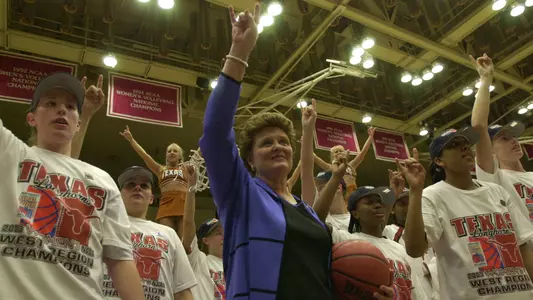
Fifteen years ago, Conradt took the Longhorns to the 2003 NCAA Final Four – the third in program history, which includes the 1986 NCAA Championship – with a uniquely self-motivated and driven team. It was a collection of talented players, put together by Conradt and her staff, which included current head coach Karen Aston as associate head coach and chief recruiter.
They came together from a wide variety of backgrounds, but with the same goal in mind. A decade and a half later, eight members of that 2003 Final Four team have gone on to pursue careers in coaching.
"It does not surprise me," said Kathy Harston, an assistant coach at UT from 1989-2007 and now Senior Associate Athletics Director for Sports Programs. "When you look at so many of them on the team, it never bothered them to put in extra time in the gym. They were all gym rats and always working on their games. They all loved working [summer] camps and were really good at teaching the game, especially with the youngest level of kids."
The 2002-03 Longhorns were coming off a 22-10 record the previous season and had lost in the NCAA Sweet 16 to Duke. Texas did not return an All-American or a first-team All-Big 12 player, and junior forward Stacy Stephens was the most decorated returning player, as she had been a 2002 second-team All-Big 12 selection.
The seniors on the 2002-03 team were Tai Dillard and Alicia Sare. In addition to Dillard and Stephens, the starting lineup consisted of sophomore forward Kala Bowers, Stanford transfer Jamie Carey at point guard and sophomore forward Heather Schreiber.
The motivation for the 2002-03 team was internal and powered by the drive of its squad members. None of the team's coaches could have pushed the players harder than they pushed themselves. The road to success began with intense off-season pick-up games.
"The team was really unique in the fact that everybody brought something unique and saw the game from a different perspective," said Stephens, who in October will be inducted into the UT Athletics Women's Hall of Honor and is an assistant coach at Our Lady of the Lake University in San Antonio. "You didn't have to have a coach. We had court coaches who made sure our energy was what it needed to be. We were competitive in anything we did. You can imagine us on the basketball court doing drills or in the weight room – not one person didn't constantly want to win."
The competitiveness was first on display during the summer months when the Texas players served as camp counselors, teaching the game to younger players. The Longhorns were passionate about helping young women become better basketball players, but they also were competing with each other to win the nightly games played between the camp teams.
"We would talk trash to each other when we were coaching 9, 10, 11-year-olds," said Dillard, an assistant coach at the University of Houston. "We were trying to coach them up to win games. It really got competitive at some moments."
Stephens agreed, saying that the team took a lot of pride in being students of the game and being able to teach it to the most novice of players.
"I loved camp," she said. "If your team was playing someone else's team, it was all about who was going to win. Everything we did, we wanted to win. But we were all pretty active in demonstrating and teaching stuff to kids. If you can explain something to a six-year-old, you really know what you're talking about."
That season, Texas welcomed Carey at the point guard position. She was a transfer from Stanford who hadn't played basketball in two years and had thought her career was over. The 2000 Pacific-10 Conference Freshman of the Year, Carey was sidelined for two seasons with concussions. After a year of concussion-free symptoms, she transferred to Texas and returned to the court.
"I think the timing of Jamie coming into the program was huge," Conradt said. "You look at the talent we had on that team and it was extraordinary. Jamie was, in my mind, the X-factor. The thing that set her apart from the rest was that she demanded something on the court from each of them. They needed someone to push them. She was not in the least intimidated and was willing to call out people who weren't doing their best. That is a very unique quality."
Carey's love for basketball had been even further solidified during her time away from the court. She took nothing for granted and competed every day as if it might be her last. It also was the impetus for her pursuit of a career in coaching.
"When I was 'retired,' I coached fifth and sixth grade teams when I was at Stanford," Carey said. "It was a dark time for me. I didn't know what I was doing or where I was going, and those kids were kind of a life-saver for me. You had to step back and figure out how to teach the game to elementary kids at an elementary level. It really kept the passion of the game alive for me.
"Ever since getting cleared after two years, I have always been bound and determined to put the ball down on my own terms. And I'm not ready to put it down yet."
Carey would go on to be the 2003 Big 12 Conference Newcomer of the Year and still ranks as the school's all-time leader in three-point field-goal percentage (.418) and is second all-time in minutes per game (31.4).
She knew immediately upon her arrival in Austin that her first Texas team was going to be special.
"I'll never forget when I first got here, we were playing pickup," Carey said. "Tai Dillard and Alicia Sare were the seniors that year. They sat down in the bleachers with our entire team and wrote a pie chart of your time that you spend every day and pickup was this minute sliver. From the very first time you walked onto that team, you knew that we were not messing around."
High expectations were nothing new for the players on the 2002-03 Texas roster. Many of them came to Texas because they wanted to win championships and were eager to improve their games.
"When I look at each of them, so many of them had come from strong high school programs that did nothing but win," Harston said. "It's why they chose the University of Texas. They knew Jody was going to push them. That's just how they operated – they were winners in everything they did. You knew exactly what you were going to get from them. They were great teammates and fun to coach."
Schreiber, who now coaches at Windthorst High School, her alma mater, and finished her career at Texas as an Associated Press All-American and a four-time selection to the All-Big 12 Conference teams, was drawn to UT by the standard of excellence that exists on the Forty Acres.
"Whenever I took my [official] visit, there was something about it," Schreiber said. "Everything at UT is big and you know they're going to give you everything you need to be successful. There's nothing that's going to be skimped on. What attracts you is that you know you're going to get the best when you go to UT."
The members of the 2002-03 Texas team aspired to be known for their commitment to excellence and for their accomplishments on the court.
"I think the biggest thing I see in coaching and leadership is that many teams want to be friends, not teammates," Carey said. "I remember growing up, my grade school coach always asked if you wanted to be liked or admired. The attitude of that team was that we wanted to be admired. On the court, we didn't really care about the liking part. We were teammates on that team. Other teams I was on, we were friends."
There were also members of the team willing to make sacrifices. With a loaded roster, it would have been easy for players to be bitter about playing time and for jealousy to ensue. It never did and every player was willing to accept the role that was needed in order for Texas to be successful as a team.
"Kala Bowers was one of the all-time leading high school scorers in the state of Oklahoma," Conradt said. "Suddenly, she comes to this team and we have outstanding scorers and there's only so many shots to go around. Kala's competitiveness and ability to take on a role was a really key component for our team. She unselfishly gave up the role she was comfortable in and relished in order to become our defensive stopper."
And while the Longhorns had all the pieces in place and boasted many unique characteristics, the team still had to battle through various highs and lows during the course of the season. Texas, ranked No. 11 in the preseason, traveled to Provo, Utah, for its first game of the season against BYU.
The Longhorns missed 18 free throws in that game and came away with a 79-63 loss to open a season that was anticipated with such high expectations.
"We ended up getting slaughtered," said Nina Norman, a freshman on that team and the program's first McDonald's All-American, who is now the head coach at Charles M. Blalack Middle School. "I remember after the game, I thought Coach Conradt was going to be truly mad at us, but she took us sledding. As soon as the plane landed, we got back to work and she let us have it. But she let us have a good time while we were there and enjoy the scenery."
Texas entered Big 12 Conference play with four losses, but the Longhorns would win 15 of their 16 league games to capture the program's first Big 12 regular-season championship. During the course of the season, Conradt earned her 800th career win, making her just the second women's coach to reach that milestone and just the fifth in men's or women's basketball.
The Longhorns also claimed the Big 12 Tournament Championship for the first time in school history and entered the NCAA Tournament with a No. 2 seed and a No. 5 national ranking. Texas won each of its first four games in the NCAA Tournament by double-digit margins, including victories against No. 17 Minnesota and No. 3 LSU.
"We were definitely the underdog in the regional," Conradt said. "Both Minnesota and LSU were very highly touted teams and I don't think people realistically mentioned Texas going to the Final Four. But their will to win, reliance and trust in each other, and willingness to push themselves had a big reward."
The Longhorns met top-seeded UConn in Atlanta for the 2003 NCAA Final Four. Texas directed the pace for much of the game, but a late-game push by the Huskies gave them a 71-69 victory.
The Longhorns ended the season with a 29-6 overall record, including a perfect 15-0 tally at home. They finished the year rated No. 5 in the Associated Press poll and No. 3 in the Coaches Poll.
The culture that the players were part of in 2002-03 – a culture that was created both by their coaches and within themselves – inspired many to want to recreate that environment for young players that they aspired to coach.
"A lot of the things we saw our coaches do – how hard they worked, the relationships they had with everyone – was something we strived to have as well," Dillard said. "In addition to work-ethic, we saw intensity and passion. I think about the things they instilled in us and the ideas they had. That really tied in our wanting to be coaches and how we approach coaching with our teams."
Though the coaching staff had high expectations for the Longhorns, the players also saw how much their coaches cared about them as people and wanted them to be successful in all access of their lives.
"One of the biggest things I learned early on is why Coach Conradt and her staff - and now Coach Aston – do some of the things they do," Stephens said. "As a young college student, you're probably thinking about 'Why do we have to do that?' The consistency was so key in developing not only good athletes, but good students. I think that's the biggest thing I really take away from the coaches at Texas – they 100 percent taught us how to handle our business on and off the court."
Some of the members of the 2002-03 team never could have imagined they wanted to pursue coaching as a profession. Players like Stephens, who wanted to play basketball as a professional for as long as possible, stumbled into coaching after injuries ended her playing career.
"I really thought I'd be playing at the age of 40 – that was my goal," Stephens said. "When I got hurt playing in Portugal, that was kind of like the last straw. I had too many injuries. I actually ran into John Anderson, the coach at Fort Worth Christian High School. He said 'Come on, coach the freshman team and teach post players how to play.' That drew me into it and I just fell in love with it. My favorite moment working with players is when the lightbulb comes on."
For others like Carey and Schreiber, it was always a career path that was in the back of their minds.
"I just always wanted to do this," Schreiber said. "I always had really good coaches, even up to high school, and they were people I always looked up to. Coming in, I kind of had an idea that this is what I would end up doing. The coaching we were able to have at Texas just reaffirmed that and helped me to continue on to that direction."
That direction for many was solidified by their experience on a very special Final Four team, that was self-motivated, talented and driven. The opportunity to play for the University of Texas and compete on the biggest stage, inspired many of the team's members to pursue careers in coaching once their playing days at UT were done.
"It opened their eyes to what coaching is about," Conradt said. "It's hard for an 18, 19, 20-year-old to be publically criticized. When you play at the University of Texas, you have to own that. Some people shy away from that. Other people say, I will show you what I can do. That team had the ability to do that. They didn't let anyone else define who they were. They were very close as a team, they loved each other and wanted to perform for each other.
"Coaching is so rewarding in so many ways, but it's also a very, very difficult job. What I say about coaching is if you can live without it, don't do it. If you are passionate about it and can get somebody to pay you to do it, it's the best of all worlds."
2002-03 TEXAS WOMEN'S BASKETBALL PLAYERS WHO PURSUED COACHING
- Kala [Bowers] Gaines – Former High School Coach
- Jamie Carey – Assistant Coach, University of Texas
- Tai Dillard – Assistant Coach, University of Houston
- Anissa Hastings – Head Coach, Stevens High School [San Antonio, Texas]
- Nina Norman – Head Coach, Charles M. Blalack Middle School [Carrollton, Texas]
- Coco Reed – Former High School Coach
- Heather [Schreiber] Stark – Head Coach, Windthorst High School [Windthorst, Texas]
- Stacy Stephens – Assistant Coach, Our Lady of the Lake University [San Antonio, Texas]
ALSO WORKING IN SPORTS
- Tamra [Cobbins] Gibson – Associate Director, Academic and Career Counseling, University of Kansas