The University of Texas at Austin Athletics
UT welcomes nation’s oldest living African-American Olympic medalist to campus
02.28.2018 | Texas Athletics
Herbert Douglas Jr. was on campus last week as UT Athletics partnered with the LBJ School of Public Affairs and other campus organizations for event as part of the 2018 Barbara Jordan Forum.
By James Rodriguez
Just a few weeks shy of his 96th birthday, Herbert Douglas, Jr. can still regale a room with a good story.
Douglas has plenty of tales to choose from. As the oldest living African-American Olympic medalist — he earned a bronze medal in the long jump at the 1948 London games — his legacy also includes a trailblazing career in the corporate world, where he rose to prominence as one of the first African-American executives at a national company.
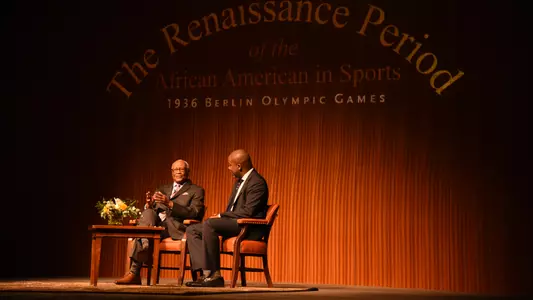
He arrived at the LBJ Presidential Library on The University of Texas campus on Feb. 20 to continue telling his story as part of The African American Athlete: The Renaissance Continues, an evening of discussion hosted in part by Texas Athletics that included a screening of the documentary The Renaissance Period of the African American in Sports. As co-producer of the documentary, Douglas continues to shine a light on African-American Olympians who came before him, most notably the nine Black track and field athletes who combined to earn 13 medals in the 1936 Berlin Olympic Games. That group of athletes, which included transcendent star Jesse Owens, serves as the subject of the film.
"That's when we proved that those of us of color could compete against anybody in the world," Douglas said.
Douglas grew up in Pittsburgh in the 1920s, when supermarkets had yet to replace the family-run stores that stood on street corners. His mother sent him down the steep hill from the family house to the nearest store to buy food five or six times a week, and the young Douglas would take off jogging up and down the hill. Years later, he realized he had inadvertently created his first training schedule.
In elementary school, the young Douglas never lost a race. By the time he was a junior in high school, Douglas was a true force to be reckoned with on the track. He won three city championships in the 100-meter, 220-meter and the long jump. The next year, he repeated the feat and went on to win three state championships.
Douglas learned early lessons of perseverance from his father, who went blind after suffering a heart attack at the age of 43, when Douglas was just five years old. Douglas' father spent 30 years in business, and was blind for 24 of them. The elder Douglas was the first African-American in the country to receive a Seeing Eye dog. Good genes run in the family — Douglas' father received his sixth Seeing Eye dog at 93 years old.
"He showed a positivity in keeping the business and raising his two children," Douglas said. "I learned how to be positive and independent."
A chance encounter with Jesse Owens when Douglas was just 14 years old also provided inspiration for Douglas' own journey to the Olympics. Owens was exiting a building after campaigning for a local politician when Douglas approached him and introduced himself. Owens slung his arms around the teenager's shoulder as Douglas rattled off his personal bests in his events.
"He was a very kind man, a very giving man," Douglas said. "I told him my record in the long jump, and he said, 'You did better than me.' He was encouraging me, but I didn't know that at the time. I believed him. He had an impact on me."
Douglas began his collegiate career at Xavier University of Louisiana, a Historically Black College or University (HBCU) in New Orleans. After a brief interlude during World War II, during which time he remained in the United States to help his father run his business, he resumed his collegiate career at Division I University of Pittsburgh.

Douglas qualified for the 1948 London Olympics, traveling by boat to a country that was elated to be hosting the games after emerging from the horrors of the war.
"People were very, very hospitable," Douglas said. "You could tell it was coming from their hearts. They were happy that we were coming to London to participate in the games. Those of us of color, we could go anyplace we wanted to go. It was really a liberal feeling that I had never witnessed before."
Douglas soared 24 feet, 9 inches to claim bronze in the long jump, cementing his place alongside other great Black athletes, including his idol Owens, who overcame discrimination to excel on the international stage.
"When you're standing on the podium and you hear the national anthem, and then you see a flag go up, it always hits your heart," Douglas said. "It hits your heart primarily because you know you're one of the best athletes in the world at your event."
Douglas returned home to the realities of a country that was still marred by segregation. Unfazed, he began a career in business and climbed the ranks in sales at Schiefflin & Co., which would eventually be acquired by Moët Hennessy. Along the way, he made sure to combat discriminatory hiring practices by adding African-Americans to the ranks of employees. Douglas retired as a vice president at the company, and left behind three other Black vice presidents.
Douglas has remained busy since retiring 30 years ago. When Douglas won his medal in 1948, Jesse Owens mentioned to him that he remained hurt after being snubbed for the James E. Sullivan Award, which was award annually by the Amateur Athletic Union (AAU) to the nation's most outstanding athlete. At that moment, Douglas committed to starting an award in Owens' honor. The Jesse Owens International Athlete Trophy and the Jesse Owens Global Award now stand as monuments to Owens' legacy, and have been awarded to a host of luminaries including Nelson Mandela.
"In the 20 years before [Owens] passed, we were on the phone talking to each other at least two or three times a month," Douglas said. "That's the impact he had on me. He was my idol. And next my mentor, and then finally a friend all those years. And we never talked about track. We talked about business."
He also continues to serve as an inspiration to future generations of Black athletes. He was joined onstage by former NFL and Texas defensive lineman Cory Redding, who had the chance to meet Douglas in the green room before the event.
He's a great historian," Redding said. "To soak up knowledge from him, it's priceless. I understood that I'd never get this opportunity again, so I wanted to just pick his brain and ask him questions about business, about sports, about the changes that he's seen in life and what he sees for the next five years. Just to get his answers, it's priceless."
Redding said he and other athletes owe a debt of gratitude to Douglas and his fellow Olympians.
"I learned a lot tonight," Redding said. "I learned a lot about history, about African-American athletes and what they stood for and all the trials and tribulations they faced and overcame. Understand that I'm standing on the shoulders of people who paved the way for us way before my mother was even born. What a great honor to learn that history."