The University of Texas at Austin Athletics
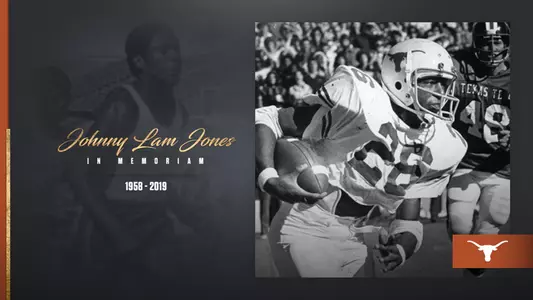
Texas Athletics remembers Johnny Lam Jones
03.15.2019 | Football, Texas Athletics, Track & Field / Cross Country
The Longhorns’ former football and track star passed away after a lengthy battle with cancer.
A public funeral service for Johnny "Lam" Jones is scheduled for 10 a.m., Friday, March 22 at Ebenezer Baptist Church, 1010 East 10th Street in Austin. Viewing will be Thursday, March 21, from 3-9 p.m. at Mission Funeral Home Serenity Chapel, 6204 South 1st Street in Austin.
The University of Texas lost a legend with the passing of Johnny Lam Jones on Friday after a lengthy battle with cancer. He was 60 years old. A multi-sport star for the Longhorns, Jones was a two-time All-American on the football field and a United States Olympian in track.
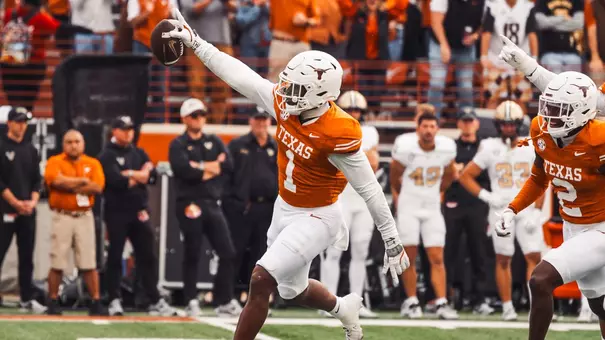
A native of Lampasas, Texas, Jones lettered in football from 1976-79 and in track for the Horns in 1977-78. He was the football team's Most Valuable Player in 1978 and earned All-America honors in both 1978 and 1979. A two-time All-Southwest Conference performer, Jones scored eight touchdowns of 45 yards or more in his career in the burnt orange. On the track, Jones scored 29 points during the 1977 SWC Championships and ran a 9.85 100 meters during the 1977 Texas Relays.
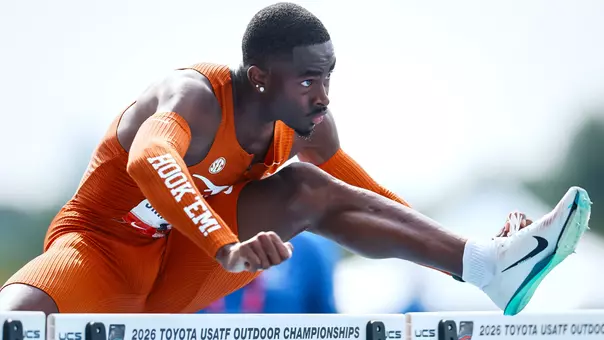
Jones was a member of the U.S. Olympic Track team in the 1976 Montreal Games before his freshman year at Texas. He won a gold medal as the second leg of the 4x100m Relay team and finished sixth in the 100 meters. On the track, he was an All-American as well, finishing second at the 1977 NCAA Outdoor Championships in the 100m and seventh in the 200m.
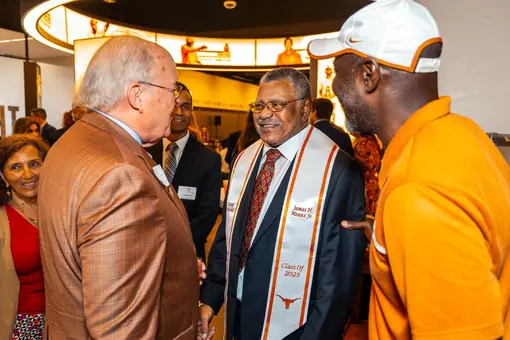
Jones, who was born April 4, 1958, was inducted into the Longhorn Hall of Honor in 1994. He is also a member of the Texas High School Sports Hall of Fame.
The Legend of Johnny Lam Jones
As track & field events began at the 2008 Beijing Olympics, Legendary Longhorn Sports Information Director Bill Little shared a story on one of the Longhorns' most famous two-sport athletes, Johnny "Lam" Jones. Arguably the fastest man in football, Johnny began his legend when he came from behind to win the Class AAA Mile Relay at the UIL Championships in Memorial Stadium. But it would be his performance in the 1976 Montreal Olympics, as a sprinter in the 100 meters and a Gold Medal winner as a member of Team USA's 400-meter relay team, that would cement his fame. Here, in his own words from the book "What It Means To Be A Longhorn," as told to Little and Jenna McEachern," is Johnny's story. "What It Means To Be A Longhorn" is published by Triumph Books, and is available online and at most book stores.
JOHNNY "LAM" JONES (in his own words)
Before I came to Texas, I'd qualified for the Olympic team, gone to the Olympic trials, gone to Montreal for the Olympics and won a gold medal. It was pretty much like a haze for an eighteen-year old kid to be going through. It was a blur for me, but someone else may have handled it a lot better.
Once you decide where you're going to school, even if you're still in high school, people view you as being part of that new family. Even though I was at Lampasas running in the Olympics, I was representing The University of Texas. At the state track meet we won the state AAA championship for Lampasas High, but a part of me was still representing The University of Texas. I've been very fortunate in sports; I don't have a single most memorable moment. I have been real blessed that I've had a number of moments.
People ask me, "Hey, what was it like to win a gold medal in the Olympics?" They look at me like I'm crazy when I say, "It's almost as exciting as running in the state meet in Texas." Winning our team championship was probably my most special moment.
It wasn't the race, the mile relay, that made it so special, but that winning the state championship was our goal. People talk about "The Race," but the special part about that was that a lot of people were involved. We were in that position all the time; we were behind like that every week, but that's the way we ran. Those guys didn't have to run as fast as I did, they just had to run as fast as they could. As long as everybody did his best, we'd have a chance to win. All those people saw it at the state meet, but that's what we did every week.
Lampasas High had the track records posted on a banner in the gym. I had the record for the 440 and for the 220, so I'd been pestering the coach to let me run the 100. I wanted that record, too. He got tired of me pestering him, so on Wednesday before the Brownwood track meet he let me run the 100, a practice race. He marked off a hundred yards on the old dirt track, and I ran the race. He had a little smile on his face as he looked at his clock, but he wouldn't let me see the time. He said, "Don't worry about it. You did pretty good. Run another one." He made me wait while he marked off the track again. He stepped it off all over again. I didn't think about what he was doing at the time, but he was double-checking the distance. So I ran another one. This time he had a bigger smile on his face, but he still wouldn't let me see my time. On Saturday, Coach said, "I'll let you run the 100, but you still have to run your other races." So, that day I ran the 440, the 220, the mile relay, and in the 100 I ran a 9.2 in the finals. That's what I had run that day on the high school track.
So that was the beginning of "The Race." When I came into Coach's office that next Monday, he had newspapers spread out all over his desk. The papers used to publish all the best times across the state. He had figured out that if he took me out of the quarter and if Mike Perkins, our other quarter-miler, could make it to state, and if I won the 100 and 200 and we could win the mile relay, and if we picked up some points with the long jump or with Perkins, then we could win the state meet by two or four points. The state championship came down to that last race. It was between us and two other teams, and whoever won the mile relay was going to win the state meet.
That special moment wasn't about me. The joy came from us winning. I had gone to state my junior year by myself and had won state in the quarter. It wasn't as much fun; it wasn't half the joy of those other guys getting to come along.
As a player in high school, you felt so honored that Coach Royal would even consider you to play at his school. You might be thinking about going to some other school, but when you found out that UT wanted you, it was a done deal. That's how it was for me, anyway.
Texas recruited me as a running back. I came through with Coach Royal's last class; then he retired and Coach Akers switched offenses. With Earl back there we didn't throw the ball that much. But when we did throw it, we were pretty good at it.
I might have gotten closer to my coaches had I done things differently, had I not been so dysfunctional in some areas. I didn't take advantage of having someone older to help guide me and keep me on the right path. When I think of how I spent my time and how disorganized I was, I see that I didn't allow myself the opportunity to develop special relationships with coaches. There were guys who were more mature than I was who were close to their coaches. It was like having a homing beacon, somebody to keep you close to the ground. And back then, my feet were planted firmly in mid-air.
But when you're a Longhorn, you're part of a special family, a special group. You get the feeling that other people feel it's special, too. They might be an alum of another school, but deep down inside they wish they could say there were a Longhorn. Some might admit it and some might not, but it's like if they went somewhere else, they settled. Some people will tell me, "I went to such and such school, but I wish I could have gone to UT."
This school impacts your life because you're placed in an environment where you always want to do your best. That's the kind of people you're around at Texas. It helps guide you and mold you and puts you in a conscious awareness about what The University is about, the pride and the traditions.
I wouldn't change anything, not for a minute, not for a second. A person couldn't ask for a better roller coaster ride than what I've been on--still standing and fortunate to be able to sit here and talk about it. You know that poem "Footprints in the Sand?" I'm the reason they wrote that…I'm the one He's been carrying all this time.