The University of Texas at Austin Athletics
10.23.2026 | Longhorn Sports Properties / Learfield
The UT Austin graduate and former Marine Corps major will be honored when Texas Football hosts Ole Miss on Oct. 24.
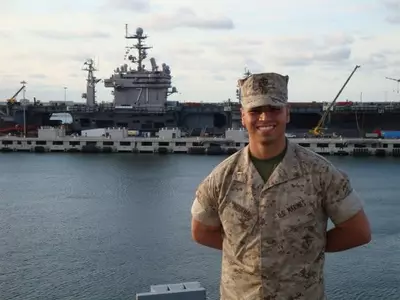
Yonic Medina's path to becoming an officer in the Marine Corps began in earnest at The University of Texas. A first-generation college student in the mid-2000s, Medina described his outlook as "open-minded, always hopeful and positive about what the future could bring."
With that vision of possibility and a sense of opportunity, Medina took faithful, purposeful steps forward; he was motivated by challenges to grow equipped to serve and make a difference in the lives of others.
"UT Austin gave me the chance to not only change my life trajectory but also provide the opportunity for my family to understand the impact of higher education and continue that legacy," Medina said.
Medina graduated from Dallas Skyline High School, was awarded a full Marine-option Naval Reserve Officers Training Corps (NROTC) scholarship and earned his undergraduate degree in chemical engineering from UT in 2008. From there, he served nearly eight years on active duty rising to the rank of major and serving in roles including signals intelligence officer, operational leader and recruiting station commander.
"I think about my service like my time at UT. It gave me an opportunity to better myself, practice discipline, improve my leadership skills, and then come back and try to make a positive impact in my local Dallas community," Medina said.
Progressing from an NROTC midshipman into an officer took Medina to Officer Candidates School and The Basic School, an education program for officers-in-training. Medina said relationships formed among classmates and roommates reinforced the significance of what they were learning and how those skills could be applied.
"You think, 'Ok, this could impact another Marine's life,' and you pay more attention than a general college class," Medina said. "What motivates you to pay attention is how you can use those skillsets in the future and ensure you are a competent officer going out to the field."
Medina was designated a signals intelligence officer and assigned to 3rd Radio Battalion; he led Marines responsible for collecting, analyzing and communicating intelligence in support of military operations throughout the Indo-Pacific region. Medina also deployed independently in support of Operation Tomodachi following the 2011 earthquake, tsunami and Fukushima Daiichi nuclear power plant accident in Japan.
Throughout his intelligence assignments, Medina led organizations of up to 220 Marines. He also established and led smaller, specialized units, including radio reconnaissance units.
"You want to be forward-thinking and innovative with technology in order to mitigate threats," Medina said. "It's a fast-moving field. If you're not engaged, your skillset will diminish, and the thing that keeps you engaged is wanting to maintain a high degree of competence in the role. Once you get to the fleets, the folks who you work with or who report to you, they have the expectation of their leader to be technically competent and have that credibility."
When Medina decided to transition out of active-duty service in 2016, he relied on his wife's experience to determine new steps forward that were also vision-oriented and purposeful. Because of their multiple moves between duty stations, she was acquainted with job transitions and adjustments to new markets, industries, and time zones.
"She said, 'I don't think it's a good idea for you to just apply to jobs. I think you need a transition plan,'" Medina said.
He earned his MBA from Duke in 2018, and during that time, Medina learned how to apply the skills and knowledge he gained in the military to the civilian workforce. In multiple roles at Microsoft, Medina has worked in financial services, as well as cloud computing and agreements; currently, Medina supports Berkshire Hathaway portfolio companies and helps lead their data, cloud and technology implementation strategy.
"With this customer base, often they are in industries where they are the incumbent or have legacy ways of doing things. They are looking for an outside perspective on how to modernize," Medina said. "Ninety percent of conversations I have with customers is helping them with business problems and how to differentiate.
"It's really just a different form of service."
Medina's post-military life brought him back in his hometown of Dallas, where years earlier conversations with a Marine recruiter planted the seed for how service and education could shape his life. Medina is paying it forward and planting new seeds in different ways, such as taking his nephew to UT football games to inspire his college decision.
"Faith is a foundation for daily decisions, and I felt a calling to help my family in Dallas – brothers and sisters and nephews, as well as parents. My faith led me to do that," Medina said. "Being the first person in my family group to go to college, I saw it as a critical opportunity to take advantage of, and I want that to keep going."
Thanks to the Texas Lottery, great things are happening all across Texas. The Texas Lottery consistently contributes nearly $2 billion of lottery revenue each year to good causes like public education and veterans' assistance programs. Beginning with the first veterans' dedicated scratch ticket game in 2009, the Texas Lottery has now contributed over $313 million to the Fund for Veterans' Assistance.
Since 1992, the Texas Lottery has generated more than $43 billion in revenue for the state of Texas. Through strict adherence to its vision, mission and core values, the Texas Lottery is dedicated to ensuring that this support continues. The Texas Lottery's functions and activities are administered by the Texas Department of Licensing and Regulation (TDLR), the state agency responsible for licensing and regulating a broad range of professions, occupations and industries in Texas.