The University of Texas at Austin Athletics
Bill Little commentary: Everybody's All-American
05.12.2003 | Football
The picture on page 185 of Lou Maysel's excellent book "Here Come The Texas Longhorns," is poignant today. It features the Orange Bowl Trophy from the Longhorns' 1949 victory against Georgia, the governor of the Lone Star State, Beauford Jester, and the nattily dressed captains of the team, Tom Landry and Dick Harris.
The lone survivor of the photograph, Dick Harris, slipped from the earthly torment of Alzheimer's Disease and died peacefully on Saturday. Jester died not long after the picture was taken, a heart attack claiming him as the first Texas governor to die in office. Landry, of course, went on to great fame as an NFL player and coach. He died Feb. 12, 2000, after a long battle with leukemia.
They were bright-eyed, then, those young men in their snappy business suits. Destiny had smiled on them. They had co-captained a Texas team to a gratifying 41-28 upset win against No. 8 Georgia in the 1949 Orange Bowl. Both had been a part of a stellar 10-1 year in 1947 that ended with a 27-7 victory against Alabama in the Sugar Bowl in Bobby Layne's final game as Longhorns quarterback.
Landry had come to UT in 1942 but left after his freshman season to pilot a B-17 bomber pilot in World War II. At 25, he had decided to try his hand at professional football. An 18th-round pick of the New York Giants in 1947, Landry eventually hooked up with his old club in '50 and made All-Pro there before becoming the first coach of the Dallas Cowboys in 1960.
However, the intriguing story of Harris took a different turn to success. A tall and sturdy man (he's listed anywhere from 6-foot-2 to 6-foot-4 and 212 pounds), he was a first-round draft choice of the Chicago Bears in the 1949 NFL Draft. Harris played in the All-Star game in Chicago, which matched college standouts against the defending NFL Champions.
Harris, who was only 17 when he earned the first of four consecutive All-Southwest Conference honors in 1945, turned down the chance to play pro ball and chose, instead, to enter the oil and banking business. He had been the eleventh player chosen in the draft, but the money in those days was a far cry from the millions charted today.
Over the next 40 or so years, he spent most of it in the banking business. He worked some as president of the American National Bank in Austin and served several years as the head of a couple of banks in Amarillo, but his home, and a large part of his heart and a substantial part of his banking career, would always be in his native Wichita Falls. It was there that he retired in 1993.
"He was a good man," said Rooster Andrews, who knew Harris from the time he started at Texas. "He was kind and dedicated to people."
Harris served 25 years as a member of the Board of Directors of Scott & White Hospital in Temple and his commitment to public service included serving as a county commissioner and on numerous boards of directors in the communities in which he lived.
It is not our place to understand why bad things happen to good people and the case of Dick Harris is no exception. In what should have been the golden retirement years for him and his wife of 52 years, Dorothy Jo, fate took a cruel turn. Dorothy Jo died, and soon after, Dick was afflicted with Alzheimer's. Saturday, after lunch at an assisted living center, Harris gasped and stopped breathing. Life, as he had lived it since the onset of Alzheimer's was over.
Tuesday, they will bury him in Wichita Falls and the family asks that, in lieu of flowers, donations be made to Scott & White in Temple or to the Alzheimer's Disease Research Center at UT Southwestern Medical Center in Dallas.
Bill Sansing, who was the first Sports Information Director at Texas, remembers Harris as a popular figure on the Texas campus in the postwar era.
"He had a big smile, a cheerful greeting and everybody liked him," Sansing said. "He was also a very good football player, but he had a business opportunity that paid him more money than he could have made in pro ball at the time."
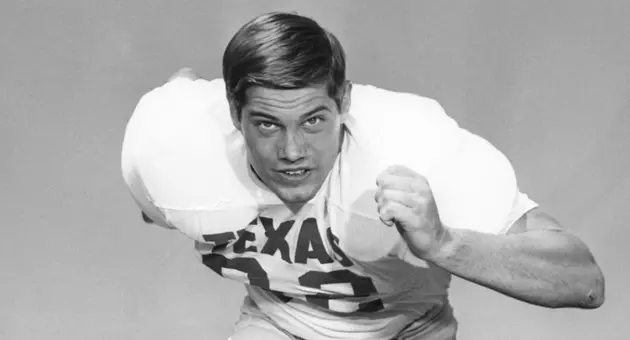
Folks say he was chosen All-American at tackle, but actually played linebacker, and by his senior season, he had etched his mark as one of the greatest centers in the history of Longhorns football.
The irony of the odyssey of the two captains is a bit of a juxtaposition, a story of fame and success at different levels. Landry went on to become famous as a player and a coach, and from a distance, he was beloved by those who really never even met him.
Harris, meanwhile, walked a different walk. He, too was loved, but by people whose lives he touched daily, maybe with a lift for a person who was just beginning his life, or maybe as a sturdy support that came at the right time for a farmer or a businessman struggling to stay upright in a strong West Texas wind.
Both, in their time, made lives a little better. Both left a legacy at The University of Texas that spanned beyond a football field or a faded picture in a book of memories.