The University of Texas at Austin Athletics
Bill Little commentary: A rose for Noble Doss
12.20.2004 | Football
The tears came softly, through the smile.
Sixty-three years after Noble Doss and his teammates' dreams were dashed, Texas is going to the Rose Bowl.
They had been so close, those 1941 Longhorns.
So close, and yet so far.
Texas football in the 1930s had been a roller coaster ride, filled with character and characters. They were fighting through the Great Depression, those children of the war.
They had seen their dads and their brothers fight the Germans, and then they had seen the prosperity that followed dissolve into nothingness. All of those things were part of their lives, and little did they know the worst was yet to come.
The Longhorns of the 1930s began the decade with renewed enthusiasm under Clyde Littlefield, who was one of the great players at Texas during the 'teens. But by 1933, Littlefield had given up his role of football coach to concentrate on a career as a track mentor that would make him a Longhorn legend.
To replace him, Texas had gone north, to the hallowed halls of Notre Dame. They took the program in a new direction, with the hiring of Jack Chevigny. Chevigny had been a huge part of the lore of the Fighting Irish. He had played for the late Knute Rocke, and he was the guy who scored a touchdown and shouted "there's one for the Gipper!" in the famous game where Rockne had made a speech about an ill player named George Gipp.
Chevigny actually opened his career with the Longhorns with a victory over the Irish in his first year as head coach in 1934, but his flash of light quickly diminished, and three years later, Texas was looking for a new coach.
And the man they hired would change the face of Texas athletics, and college football, forever.
D. X. Bible had already achieved success at Texas A&M and Nebraska when he came to Texas in 1937. His charge was to rebuild Texas, and he did. Success was not immediate. When his early teams struggled, cynics ruled.
When his early defense was ineffective, they stole a line from an old fable and called it "Ali Bible and his forty sieves."
But the tough times didn't last long. By 1940, Bible's team had upset National Champion Texas A&M, and in doing so they knocked the Aggies out of the Rose Bowl.
And finally, it all came together in 1941.
This time, it was Texas that had hopes of making it to the Rose Bowl.
As the Longhorns rolled through their season, they captured national interest. Early in November, they were the talk of college football, which in those days meant the talk of football. The NFL was just getting started, and was nowhere near the media darling it is today.
So on November 17, the men of the Texas Longhorns were featured on the cover of Life Magazine. To understand the impact, it is important to realize there were no sports magazines at the time. Life was an icon as a weekly news and features magazine. Its greatest competition, Look Magazine, trailed it in circulation. In today's diversified media, there is really nothing with which to compare. It was where America got its news features.
And there they were, 14 key players, right there on every news stand in America.
In an era where players played both offense and defense and scores generally were lower than they are today, the team had scored no fewer than 34 points in any game and had shut out three of its six opponents.
It had risen to No. 1 in the country, and with only four games remaining, it was the odds-on favorite to win the National Championship. At the end, the reward was supposed to be a trip to play in the most famous football game of the time, the Rose Bowl.
The spread inside the magazine featured candid pictures of the team members at home and on campus. And Bible might have been the most famous man in college football.
Within a month, all of their lives would change forever.
Unbeaten and dominating, they had rolled through those six games, but as the magazine was going to print, Texas was getting ready to play Baylor in what was expected to be a routine victory.
The Longhorns had just pounded SMU, 34-0, and the 1935 Ponies were the only team from the State of Texas, before or since, to play in the famous New Year's Day game, the Rose Bowl.
When the players came into the Hill Hall dining room following that SMU victory, according to historian Lou Maysel, a special surprise awaited. The house mother, Mrs. J. M. "Miz Griff" Griffith, had placed a long-stemmed red rose at each player's plate.
"This is for the Rose Bowl because that is where you are going," she said.
But the next week in Waco, the dream began to crumble.
Riddled with injuries and without some of its stars, Texas struggled, but led 7-0 at half time.
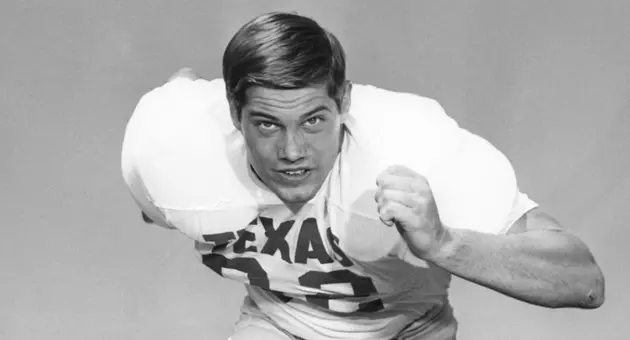
Noble Doss was a wing back, and he was playing with an injured arm and infected toe. A year before, it had been his "impossible catch" that had set the stage for the 7-0 upset of Texas A&M. It was an over the shoulder catch, on a 40-plus yard play that carried to the goal line to set up the only score. It is, 63 years later, arguably one of the most famous plays in school history.
Leading 7-0, at the Baylor 45, Doss ran the same play, an up-and-out to the Bear goal line. The pass from Pete Layden came floating down, and Doss was only a catch and a step away from taking the Longhorns to a 14-0 lead. And considering they didn't give up more than 14 points in a game all year, it would have guaranteed victory.
That is why, on a sunny Sunday in an assisted living center in the hills of Austin, Noble Doss cried last week. He dropped the pass.
Baylor scored late in the game, producing a stunning 7-7 tie. The next week, the disheartened Longhorns lost to TCU, 14-7.
The dream of the championship was gone, but the hopes of the Rose Bowl remained. Oregon State was going to play in the game, and even until the final week, Texas still was in consideration for the bid.
Bible had turned down the Orange Bowl and the Sugar Bowl, and the Oregon State coach, who was a close friend of his, lobbied for Texas in the Rose. But the Longhorns had one final game left on the schedule, ironically with Oregon.
Oregon State had beaten Oregon, 12-7, and there was concern that the outcome of the Texas-Oregon game might reflect poorly on the bowl game. That was when officials asked Bible to cancel the game.
A man of ultimate integrity, Bible refused.
"I have never cancelled on an opponent in my life," he said, "and I am not going to start now."
Rose Bowl officials then picked Duke to play Oregon State, and the greatest Texas team of its era, and one of the best in school history, was left with no place to go. They took out their revenge on Oregon, beating the Ducks, 71-7 on December 6, 1941.
The next day, the Japanese bombed Pearl Harbor, and the world changed forever.
Most of the 16 seniors, including Noble Doss, joined the Armed Services before the year was out, and two of them lost their lives in the war.
Doss returned to football, and after a stint with the NFL champion Philadelphia Eagles, he came back to Austin where he became one of the city's leading citizens and a tremendously successful insurance man.
He has been, to all who know him, one of the kindest, nicest people they have ever met. And his loyalty and support for The University of Texas has never wavered. And yet, inside that gentle heart, is the painful memory of a dropped pass.
"I think about it every day of my life," says Doss, who will turn 85 in May.
And nothing anybody can say seems to make it any easier.
"It cost us the National Championship, and the trip to the Rose Bowl," he said last week. "What is there to say about it? I dropped the ball."
You would hope that time would have helped. Folks tell him that he is one of the greatest players in school history, that he made one of the greatest, and best known plays in that era of college football.
You'd like to remind him that he set a record for interceptions for a career, a record that was tied by Nathan Vasher last year, but still stands as the oldest record in the books over 60 years since he played.
There were probably 60 or 70 offensive plays in that game, and you'd like him to hear that a single play didn't determine the outcome.
You yearn to tell him to forgive himself, to shake the shame he feels for letting his teammates down. You want the story to end differently, in the winter of his life.
But none of that will work, and here's why.
Noble Doss comes from a program that stressed personal accountability, and from the Depression Era, where all a man really had was his character, and his integrity. For him, it is all about responsibility, and for that, there are no excuses.
It is a sad thing that he holds that moment, but it is not a bad thing. Because bad things do happen, and the mark of a person is having the strength to step up and accept that, and not make excuses.
When Texas takes the field against Michigan in its first-ever appearance in the Rose Bowl, each player will take a little piece of the legacy of Doss and his teammates with them.
Because what Mr. Bible and his team did was lay a foundation, a foundation based on those qualities of excellence, responsibility, and integrity. It was that rock that set the stage for the glory that would follow, and even in the tough times, the bottom line remained that, win or lose, this is what we stand for.
Of the 14 on the cover of Life, only four still live.
In piece prepared for ABC's national telecast of the game, Noble Doss sits in a darkened room, watching a film from an old 16 MM projector.
A fresh tear moves down his face as he remembers.
The rose petals of yesteryear are long gone, faded away with the dreams.
And as he turned off the projector and moved back into his wheelchair, he paused for a moment.
"It wasn't meant to be," was all he said.