The University of Texas at Austin Athletics
Bill Little commentary: The National Championship years -- 1969 and 1970
12.26.2005 | Football
(The following excerpt is from Bill Little's latest book, "Stadium Stories...Texas Longhorns" published by Globe Piquot Books. It is available at most bookstores and online order services. This is from the chapter entitled "The Wishbone.")
The season of 1969 was the Centennial year of college football. In 1869, Princeton and Rutgers had played in the first ever game, and the NCAA had chosen to celebrate the anniversary. Each collegiate team was given a patch signifying "100," and the Longhorns chose to wear theirs on their helmets, in the cradle of the two horns on the school's emblem.
Beano Cook, who was an executive with the NCAA's television partner ABC, suggested that the network find an appropriate game to move to the end of the season, as the climax to the Centennial year. And the game he landed on was the Texas-Arkansas game in Fayetteville, which was regularly scheduled for the third week in October. The two schools agreed, and moved their October 18 date to December 6.
No one could have envisioned how successful Cook's idea would become.
When Texas beat Texas Tech on September 27, the Longhorns moved to No. 2 in the polls. But Ohio State was the defending National Champion, and the Buckeyes showed every indication they would repeat. For six weeks, the two remained 1 and 2.
Texas' final regular season game normally would have been against Texas A&M, and after playing TCU on November 15, Texas had an open date until their Thanksgiving Day meeting with the Aggies on November 27.
On Saturday, November 22, Royal took a "busman's holiday," and headed to Waco to watch SMU and Baylor play. Far away in Ann Arbor, Michigan, the Michigan Wolverines, under first year coach Bo Schembechler, were stunning Ohio State, 24-12.
Suddenly, Texas was No. 1, and Arkansas rose to No. 2. Beano Cook, who had envisioned only a good game to close the Centennial year, now had one for the ages. And Fayetteville, Arkansas, was about to become the center of the college football universe.
The hype of the game took on epic proportions. With the network and the NCAA promoting the game, President Richard Nixon joined in the excitement. It was announced that he would attend the game, and present a Presidential Plaque to the winner, recognizing them as the National Champion in the 100th year of college football. Renown preacher Billy Graham gave the pre-game invocation.
Heading into the game, both teams appeared healthy and ready, except perhaps for Texas little junior safety Freddie Steinmark, who was trying to hide a limp from his coaches, a malady caused, he thought, by a hip bruise.
It was cold, bone cold that drizzly day in Fayetteville. And that day, lives changed forever, over a football game. The night before the game, an icy drizzle rattled on the roof of the Holiday Inn in Rodgers, Arkansas, where the Texas team was staying. The field was one of the new artificial surfaces called AstroTurf, and both teams struggled to find shoes that would get good traction on the sometimes wet, semi-dry surface.
On the 45-minute bus ride to the stadium, Royal looked out at the flashing red lights of the Arkansas State Police car leading the team, and to pass the time, he called James Street to the front with him. And then, he surprised his quarterback by telling him what play he wanted to run if the Longhorns were in a position where they trailed by 14 points and needed a two point conversion to net a win.
It would not be the last time Royal would surprise Street that day. Even though the senior signal caller thought there was no chance Texas would be in such a dire situation, Street dutifully noted Royal's wish.
The game had not gone well for Texas. The Longhorns were plagued by turnovers, and Arkansas held a surprising 14-0 lead as the third quarter ended.
On the first play of the fourth quarter, Street dropped back to pass, but couldn't find an open receiver. Not known for his blazing speed, he dodged a would-be tackler and somehow out ran the Razorbacks 42 yards to the goal line.
The score was 14-6. A tie would have put the Razorbacks (as league co-champs) in the Cotton Bowl, since the Longhorns had been the year before. It also would have ended Texas' dream of the National Championship. So just as he had envisioned on the bus, Royal went for two. Street wasted no time in calling the pre-determined play (an option left), and when he cut in off left guard and into the end zone for the successful conversion, it was 14-8.
Arkansas quarterback Bill Montgomery would mount a fourth quarter drive that would bring the Razorbacks within field goal range midway through the period. A pass interference call was caused when Steinmark reached out and caught hold of Arkansas receiver Chuck Dicus when he was surprisingly beaten on a play that would have been a likely touchdown.
Montgomery was at the Texas seven-yard line when Frank Broyles sent in a call Razorback offensive coach Don Breaux had made from the press box, a call that will live in infamy forever in Arkansas. On third down, only a chip shot field goal away from an insurmountable 17-8 lead, Montgomery rolled left to pass. A Razorback receiver waited in the end zone, but as Montgomery threw, Texas halfback Danny Lester stepped in front and intercepted the ball and ran it out to the 20.
But the breath that Texas had been given seemed on life support a series later, when 4:47 remained in the game and Street walked to the sidelines to talk with Royal. It was fourth down, three yards to go, and the ball was at the Texas 43 yard line. A packed stadium and an estimated television audience of 28 million watched.
It was then that Street got his second surprise of the day from Royal. The choices seemed fairly simple. First, there was Worster up the middle. But Texas had found trouble running against the Razorbacks all day. Street himself had turned the option up for the two-point conversion, but the center of the field was slippery, and Arkansas would expect a running play. Cotton Speyrer was the Longhorns' top receiver, and a short pass to him seemed the most logical selection to Bellard, who was calling plays in the press box, as well as to Street.
At half time, Randy Peschel, the Longhorns' tight end, had told Royal that the Arkansas secondary was meeting him in close to the line of scrimmage.
"I think I can get behind them if we need it," he had said.
And, Royal determined, that was exactly what Texas needed right now.
"Run 53 Veer Pass," Royal said. The play called for Peschel to run a deep flag pattern. Mike Campbell, Royal's valued friend and defensive coordinator, heard the call and jumped back.
"Darrell," he said. "There's only one receiver out, and he's deep. It's all or nothing."
"Fifty-three Veer Pass," Royal repeated.
Campbell turned and gathered his defense around him.
"Get ready," he said. "We're fixing to give them the ball at our own 43, and we've got to stop them one more time."
Street turned as he headed on to the field, and walked back toward Royal.
"Coach, are you sure that's the play you want?" he asked. Emphatically, Royal told him that it was.
Texas had believed that the Razorback defense was studying the Texas huddle throughout the game, trying to pick up any sign they could. So Street, when he got in the huddle, looked straight at Speyrer.
"I'm looking at you, Cotton, but I am talking to you, Randy," he said. "You guys aren't going to believe this play, but it is gonna work."
History records it as perhaps the most significant play in Texas history. Peschel barely got a step on the Razorback defender, and Street threw a perfect pass that hit him in stride at the Arkansas 13-yard line. Through the fog and icy mist, Texas had made the play of the game in the Game of the Century. On the next snap, Ted Koy followed the block of Bobby Wuensch 11 yards to the two. It was the longest rushing gain for Texas on the day. Jim Bertelsen, a sophomore who had taken Chris Gilbert's left halfback position when he graduated, scored the touchdown.
Happy Feller, who R. M. Patterson thought might have been nervous as a sophomore against Oklahoma, booted the extra point that gave Texas a 15-14 lead. But Arkansas had 3:58 in which to answer. They were at the Texas 39-yard line when the drama finally ended. Tom Campbell, one of the twin sons of Campbell the coach, intercepted Montgomery at the Longhorn 21.
Texas ran out the final few seconds.
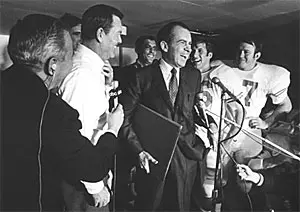
In the crowded locker room in a grey pill-box building in the southwest corner of the stadium, Texas celebrated. Nixon presented Royal and the team captains with the plaque.
As Texas left the stadium, gentle snow flakes fell on the team buses as they made their way through the Ozark Mountains, 50 miles to Fort Smith, where they could catch the plane home.
A crowd of 10,000 fans swarmed onto the runway when the team arrived in Austin. Street, who was claustrophobic, stayed on the plane until everybody else had moved away from the stairs.
What Texas had earned was not only the National Championship and the SWC title, it had achieved the right to be a part of more history. After more than 40 years, since the days of the famed "Four Horsemen," Notre Dame had agreed to play the Longhorns in the Cotton Bowl game. Things could not have been more jubilant for Texas football, but all that was about to change the next week.
Freddie Steinmark, the young safety who had perhaps saved the game by interfering with a receiver, still was bothered by the hip injury. On Tuesday, doctors discovered the cause of the pain: he had a huge tumor in his hip. Friday, less than a week after the victory, his leg was removed because of bone cancer.
The disease, at the time, was almost always fatal. But Steinmark wasn't willing to give up. He beat the odds by walking down the tunnel into the Cotton Bowl three weeks later for the game against Notre Dame, and he stood on the sidelines the whole time as Street and Worster and Koy and Speyrer and the Texas defense and Tom Campbell worked their magic one final time. A fourth-down pass, this time from the Irish 10 to the two, had set up the game winning touchdown. Tom Campbell's interception of Joe Theisman sealed the 21-17 victory.
In the locker room, Royal and the team gave the game ball to Steinmark. A year and a half later, the spunky safety lost his battle with cancer. He died in June of 1971. The scoreboard in the stadium in Austin was dedicated to his memory, and when Mack Brown came to Texas to coach in 1998, he established a tradition that calls for all players to touch Steinmark's picture on the scoreboard before they enter the field. He told them to do it for the courage that Freddie showed in his battle for life.
Street was gone, but with Eddie Phillips guiding the Wishbone, the Longhorns of 1970 would pull off a miracle win over UCLA and go on to extend the winning streak to 30 games before finally falling in the Cotton Bowl in a rematch with Notre Dame on New Year's Day, 1971. That team, however, earned the 'Horns third national championship when the UPI Coaches' trophy was presented at the end of the regular season.
Teams all over the country experimented with Royal's creative formation, and Bear Bryant at Alabama and Chuck Fairbanks at Oklahoma would install versions of it that would lead to more national championships.
Royal would stick with the formation until he retired from coaching in 1976, winning four Southwest Conference titles over those next six seasons.
While it was a significant era in college football, Royal's legacy would best be remembered for the two dramatic victories which closed the 1969 season. To that point, his reputation had been as a conservative, run-oriented coach who once made famous the saying "only three things can happen when you pass, and two of them are bad."
Royal had said it as a joke, but the reputation stuck.
After the victory over Notre Dame in the Cotton Bowl, a senior citizen was running the old hand-operated elevator which went to the press box in the facility on the State Fair Grounds. A writer coming back from the dressing room climbed aboard for a trip back to the top.
"I'll tell you one thing," said the old man, shaking his head and thinking of the fourth down calls against the Razorbacks and Irish, "I wouldn't want to get into a card game with that Darrell Royal...boy, is he a riverboat gambler...."
The "wishbone" was a bone shaped like the letter "V." Kids would fight for the right to pull the bone apart. You would make a wish, and if you got lucky on the bone break, you supposedly got your wish.
And in the late 1960s, Darrell Royal and Texas obviously chose wisely as they reached for the "pulley bone," and grasped a brass ring.