The University of Texas at Austin Athletics
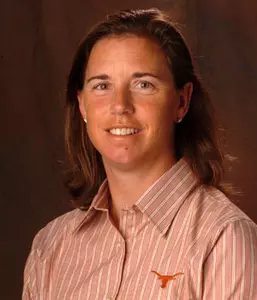
Q&A with Patty Fendick-McCain: Part one
09.12.2005 | Women's Tennis
This is the first of two installments to help you learn more about the newest member of the Texas Longhorns coaching staff - Patty Fendick-McCain, who takes over the helm of the UT women's tennis program. Fendick-McCain, a former pro tennis standout and NCAA champion while at Stanford, sat down with TexasSports.com to talk about her first month on the job.
First, welcome to Texas! Please tell us about the pace of your life since being named the Longhorn women's tennis coach in mid-July...
PFM: "It has been an interesting transition, because I am going to a semester school (with fall and spring classes) from Washington, which was a quarter school with four semesters each year. Usually, I have September off to recharge my batteries. Now, that time was consolidated into about 48 hours! But, the new job and new atmosphere have rejuvenated me to the point that I haven't worried about the transition.
My husband (Scott McCain) has a really tough summer, because he coaches on the Association of Tennis Professionals (ATP) tour. So, I had to work on getting our old house sold, having a new place to live and getting our two little girls (Keegan, 4 and Hayley, 2) here. It has been a little bit crazy! He had not seen the new house until he got back from the U.S. Open. Fortunately, he wasn't too upset with me and my choices. He has been very supportive."
What have been your impressions of Austin and the UT community? ... Many might not know that you came to Austin a long time ago and had some great tennis success here!
PFM: "I remember coming here 20 years ago for the NCAA Championships (as a Stanford player). I was so impressed with the facilities. It (Penick-Allison Tennis Center) was brand-new, and it felt almost like a temple. It was far beyond what we had at Stanford at that point. The whole atmosphere here impressed me. People really support tennis and they're enthusiastic about it.
Texas is bigger and bolder than anywhere else on the planet. When you come to Texas, there's a feeling that the athletics department wants to accomplish feats at the highest level and aspires to win championships. Having the success I've had as a player, I always enjoy being around people who philosophically feel the same way I do. The administration has been great and has allowed me to voice what I feel needs to happen to achieve those things. Coach (Jeff) Moore's shoes are big shoes to fill. He was such a prolific winner. He has had quite a lot of success, so stepping into his shoes is quite an honor."
Compare and contrast life in Austin with life at your previous stop, the University of Washington, in Seattle.
PFM: "I think a lot of the core values in Seattle are here in Austin as well. Austin does seem to be very family-oriented, and where we were living in Seattle was very family- oriented. My children are pretty athletic, and that was one of the things that was so exciting for my husband and myself. We're moving to a place very similar to where my husband and I grew up in the Sacramento (Calif.) Valley. The weather is almost identical to this and you have a lot more opportunities, athletically, with great weather and great facilities. For us, that was the biggest thing we were excited about with having our kids grow up here."
You inherit an experienced team with five singles starters returning from a team which seemingly came out of nowhere - as the No. 11 seed - to reach the NCAA Championship title match last May and finish second nationally. Is there more for this team to accomplish, or has it reached its potential?
PFM: "I certainly don't think they've reached their potential yet. We've been discussing some skill production-type things with the players on the team. I think they're going to add a little more value to their own games.
The NCAA Championship week is a very interesting animal. It's not always about who is the best team. Typically, it's about who wants it more and who is willing to go the extra distance. Obviously, these players did a fantastic job of that last year. They played with so much heart, passion and determination.
Those aren't things you can teach. You have to have that fire in your belly in order to produce at that level, and obviously they have it. The fun thing for me is experimenting with some of the skills they have already and exposing them to some things they haven't heard before. They've been great and they have liked it so far."
What specific strengths do you bring to the Texas women's tennis program?
PFM: "After 30 years of tennis as a player and now as a coach, I've been there and done that from pretty much every possible angle -- except for winning a team championship. I was part of winning individual championships during my playing career. I have a good notion of how to go about winning. Here at Texas, the tradition is already in place. Once you've walked into a program that has won championships, the team has the mindset that it knows it can do it. Trying to create something out of thin air and creating tradition is much more difficult.
I am excited to walk into a coaching situation like this, and put my mark and know-how on the program. I think it will be beneficial for our UT student-athletes to have someone who played in the Stanford tennis dynasty here, someone who knows what they have accomplished and how they accomplished those feats. What I bring is that knowledge and experience, and I know how to fuse being a student and being an athlete. That was a very big challenge where I came from (as a player) and I had the best four years of my life at Stanford. That's my hope and desire for every player on our Texas team - to have the same kind of experiences I had."
What goals do you have in mind for the team this season?
PFM: "I strongly believe my role as a coach is not necessarily just as a coach. It's also as a big sister, mother figure, mentor, whatever you want to call it. It is my job to see the big picture at all times, whether it is athletically, academically or socially. It is extremely important to me that the young women on my team have the opportunity to fulfill their potential in every particular arena and that they don't get their lives out of balance in one way or another.
I honestly believe after everything I have seen and been through that if your life is out of balance and there is too much tennis or too much academics or too much social life, the other things are not going to blossom and you are not going to get as much out of it out of those other areas.
That's the fun part for me and that's why I do what I do. It's about life lessons. At the end of the day, it's not about the X's and O's. It's about being an integral part of their lives on a one-on-one basis and as a team and getting to see them grow as people and living up to their potential by the time they leave. It's neat when they come back six months later or years later and say, "Now I know what you were talking about!"
CONCLUSION OF PART ONE OF FENDICK-McCAIN'S INTERVIEW.
Please check back later on TexasSports.com for the second installment of her Q&A.