The University of Texas at Austin Athletics
Bill Little commentary: The colors
09.02.2005 | Football
Saturday's game in DKR-Memorial Stadium, perhaps more than any in recent times, will be a blend of color.
On one hand, there is a celebration of "Texas Orange," the burnt orange pigment so associated with Texas Longhorn athletics, and The University of Texas at Austin.
On the other, there is the red, white, and blue of America, as compassion, fierce determination, and pride swirl across a green football field with a message of unity.
And all of it will come together for the simple flip of a coin.
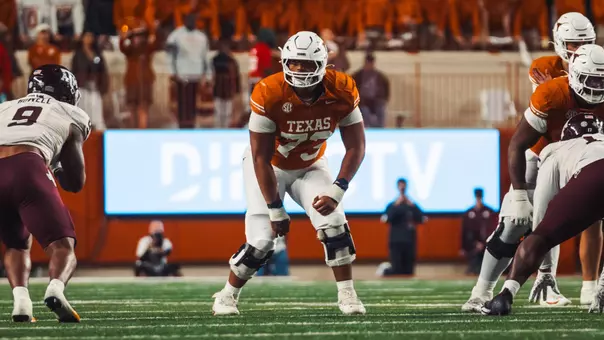
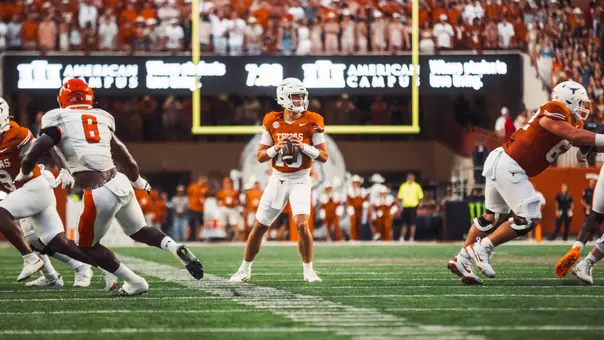
Long before the tragedy of Katrina, the Texas-Louisiana-Lafayette game was chosen as a tribute to the past history of Longhorn football. To honor all of those who had played football at Texas, the team of 2005 chose to wear what are called "retro uniforms."
Chances are, you have heard the stories about how the burnt orange of Texas football came to be. And chances are, those stories are wrong.
Prior to the season of 1928, a young Texas hero named Clyde Littlefield was in his second year as head coach of the Longhorn football team. Littlefield, who had established himself as one of the greatest players in school history during the era between 1912 and 1915, was already becoming known as an innovator.
As track coach, he had started the Texas Relays, and he was trying to build on the tradition he and some other greats of the early 20th century had begun.
That was when Littlefield zeroed in on the color of the Longhorn jerseys. Until then, Texas had used a bright orange, and in the days of the soap suds and the wash boards, the color would gradually fade to yellow.
In fact, the color would look so faded, opponents began using the derogatory term "yellow bellies" to describe Texas.
The well-traveled Littlefield sought help, and he went to a fellow named O'Shea at the O'Shea Knitting Mills in Chicago. Littlefield told O'Shea about the problem, and his friend promised he would work up some different colored yarn.
"When you get the color of orange you like, we're gonna establish it as your orange," Littlefield remembers O'Shea as saying.
And that is how "Texas Orange," the dark orange color known throughout the sports world as "burnt orange," came to be...but the story has a postscript.
The dye which O'Shea used to create the color came from Germany, and during World War II, the supply obviously was stopped. So Texas went back to a lighter color.
When Darrell Royal came to Texas in 1957, he began seeing pictures of the past where the Longhorns wore a unique orange. He asked his friend, Rooster Andrews about it, and he did some research. Rooster was able to find the exact color which O'Shea had created, and duplicated it.
And that is how, in 1962, Royal changed the Longhorn football jerseys back to "Texas Orange." Other Longhorn teams followed, and Saturday night, the 2005 team pays tribute to the era of the early 1960s by wearing "retro uniforms."
When Texas first changed the jerseys, because Royal was known for favoring the running game, there were those who thought he did it as a deception, to match the color of the football...and it is true that from 1962 through 1964, Texas won 30 games and lost only two.
Fact is, however, that half of those victories came on the road, when Texas wore solid white uniforms. But what we know is, some folks never let facts get in the way of a good story.
In recognition of that early 1960s era, Coach Darrell Royal and the two surviving tri-captains of the team--David McWilliams and Tommy Ford--will be honorary captains, and meet at midfield with the officials and the captains of the Ragin' Cajuns.
And that is where the second part of our story comes in.
Throughout the game, there will be an emphasis on helping the victims of the storm which devastated the Gulf Coast region. All of last season, including in the Rose Bowl against Michigan, Texas was led on the field by Ahmard Hall, a Marine veteran, carrying the American flag.
Saturday, those honors will go to senior Karim Meijer, a special teams player with a 3.9 GPA who earned a football scholarship this fall.
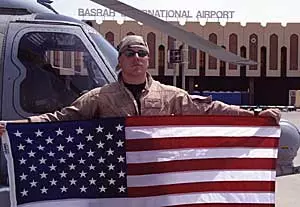
The flag he will carry was given to the team on Thursday by Nathan Kaspar, a 2001 Longhorn letterman who flew the flag as a Navy helicopter pilot on missions over southeastern Iraq.
Meijer is carrying the flag because Hall has been chosen to represent the team as its captain at the coin toss.
In such troubled times, where Americans are in harm's way for different reasons worlds apart, it seems an almost incongruous blend, this weaving together of football tradition and the flag of The United States of America.
But what we will celebrate Saturday night is the people, the players of the Burnt Orange and the people ofThe Flag.
As our servicemen and women fight terrorists who would threaten our freedom, damaged souls struggle to put the pieces back together from an unthinkable tragedy.
We are told that 11,000 refugees from New Orleans are now housed in the Astrodome in Houston, and Thursday night, for a couple of hours, they were able to put aside their troubles and find relief from a televised football game featuring the New Orleans Saints.
Some years ago at a seminar on "Integrity in Sports" held at the LBJ Auditorium, the question was asked, "Why does sport matter so much?"
The late congresswoman Barbara Jordan answered, and this is what she said:
"Why does sport matter so much?"
"It matters because sport is vital, it is viable, it is basic, and it is essential. Sport is not a frivolous distraction as one may first, without thinking, believe. Sport is an equal-opportunity teacher. It is a non-partisan event. It is universal in its application.
"I see sport as an antidote to some of the balkanization that we see occurring in our society; everybody wanting their own private little piece of turf; an absolute abandonment of any sense of common purpose, of common good. It is almost a cliché to say there is no `I' in the word team. If you are so focused on self, you cannot have any awareness of the common good.
"Another reason why I believe sport is essential is self-esteem. In order to be a contributor to American life, each individual needs to have a high regard for himself or herself first. Sport can do that. If you get out there and you have never been recognized for anything before in your life, if you show some capability, some particular tilt and talent for a sport, it gives you self-esteem.
"I believe that sport can teach lessons in ethics and values for our society. It is attractive to the young, and how many times have we heard someone despair over the plight of our young people." If you give them something to engage their energies, you would see that it might be something which lures them into the community of mankind and womankind."
Mack Brown has asked all Longhorn fans who will attend the game to give to established agencies so that help can be sent to the victims immediately. He also asked people of faith to pray.
Barbara Jordan probably would have done the same. But on Saturday night, her words about the purpose of sports ring.
This is why we will play.