The University of Texas at Austin Athletics
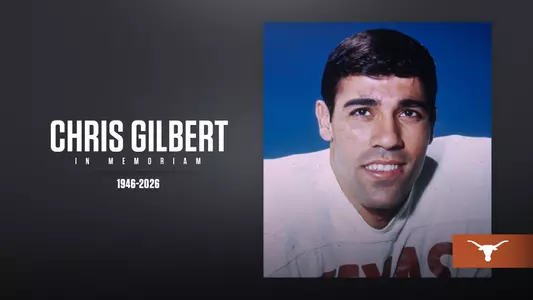
Longhorn Legend Chris Gilbert passes away
02.09.2026 | Football
A College Football Hall of Famer, Gilbert was a consensus All-American in 1968 and the first player in college football history to rush for over 1,000 yards in three consecutive seasons.
A memorial service will be held on Thursday, February 19, at 11 a.m. at George H. Lewis & Sons located at 1010 Bering Road in Houston, Texas.
A College Football Hall of Famer who was a central figure in the creation of Darrell Royal's famed Texas wishbone offense, Chris Gilbert passed away Monday in Houston at the age of 79.
Gilbert, who lettered at Texas from 1966-68, cemented himself in college football history by becoming the first player to rush for 1,000 yards in three consecutive seasons. In his college career, Gilbert received All-Southwest Conference honors three times and was a consensus All-American as a senior in 1968. That year, he finished eighth in the Heisman Trophy balloting and was a co-captain of that year's Southwest Conference co-championship team that finished 9-1-1 and ranked No. 3 by the Associated Press and No. 5 by UPI. As the wishbone hit its stride, that team ended the season with nine-straight wins, capped by a 36-13 victory over No. 8/7 Tennessee in the Cotton Bowl.
One of only two Longhorns to earn team MVP honors for three consecutive years (Colt McCoy, 2007-09), Gilbert became the first Longhorn to rush for 2,000 yards and then 3,000 yards in a career. In all, he totaled 3,231 rushing yards (still ranks sixth on the UT all-time list) and 28 touchdowns in his career. With a 107.7 rushing yards per game average, Gilbert is in an illustrious group of five Longhorn greats that averaged better than 100 yards rushing per game for their careers. That group is led by Ricky Williams (136.5 ypg) and includes Cedric Benson (113.1 ypg), Earl Campbell (111.1 ypg), and Bijan Robinson (110.0 ypg).

induction into the College Football Hall of Fame
After college, Gilbert would go on to be drafted in the fifth round of the NFL/AFL Draft by the New York Jets. He would later be inducted into the Texas Athletics Hall of Honor in 1978, the Texas High School Football Hall of Fame in 1990 and the College Football Hall of Fame in 1999.
After graduating, Gilbert, along with his former Texas Longhorns teammate Corby Robertson, co-founded Camp Olympia in 1968, which has since become one of the most successful summer camps in Texas. The camp has provided generations of children with a positive and enriching experience, playing a significant role in the local community. Camp Olympia, a key part of his post-football legacy, remains a testament to his commitment to youth development and the Texas community.
Following his time in football, Gilbert transitioned into a successful career as an investor and business executive in Houston. His business ventures flourished, demonstrating his strong leadership and entrepreneurial skills.
Recently, Gilbert was the recipient of the 2024 PwC Doak Walker Legends Award. The award was created in 1998 to honor former running backs that excelled at the collegiate level and went on to distinguish themselves as leaders in their communities.
Below is an excerpt from legendary Texas sports information director Bill Little's book "What it Means to be a Longhorn" as told by Chris Gilbert (published 2007):
I came to attend The University of Texas for two basic reasons: Coach Royal and The University of Texas alumni. Coach Royal visited my family and me at my home and made a great first impression. He was friendly, an excellent communicator, and convinced my parents that UT was the best place for me to attend college. What he initially did not do was convince me that he really wanted me to come to Texas.
Most coaches told me that I would start immediately if I came to their school. Some coaches even told me they would make me an all-conference or All-American player. Some even offered me financial perks and incentives. Coach Royal offered me a full four-year scholarship and nothing else.
Because Coach Royal's approach was so low-key, I wasn't really convinced he wanted me to come to UT. In talking with him, I mentioned the things other coaches were saying and offering, wondering if he would match their offers. He did not. What he did tell me was that he promised he would give me a hard look and a chance to make the starting team. That was it! I thought about that for a long time, and at first, I thought he didn't really want me that badly. The more I thought about his offer, it finally came to me that he did want me, and that none of the others could deliver on their word that I would be an All-American or anything else. All anyone can do is to provide you with the opportunity to succeed. I came to the conclusion that Coach Royal was one of the most honest coaches I had ever met. He knew he could deliver on his promise. How could those other coaches deliver on their promises?
A University of Texas alumnus named Weldon Smith invited me to attend a dinner on March 2, 1965, at the Rice Hotel in Houston, Texas. Texas alumni from all over the world celebrate this day as Texas Independence Day.
When I walked into the ballroom of the hotel, I was overwhelmed with the hundreds of friendly UT alums who were in attendance. Many of them went out of their way to introduce themselves and to tell me they hoped that I would attend UT. Coach Royal was the main speaker for that evening's program. He made a point of introducing me as a part of his speech, and he told everyone he hoped I would choose to attend The University of Texas. The audience responded with a loud cheer, and it sealed the deal for me. That is how I got to Texas.
 Receiving a college scholarship was special to me. In return for being given a scholarship, I felt an obligation and had a desire to help make The University of Texas football team the best team in the nation. It took four years to reach that goal.
Our football teams had disappointing seasons for the first three years I attended UT, but things changed my senior year. We had a great senior class in 1968 that led a talented group of underclassmen to the beginning of the longest winning streak in the history of The University of Texas.
Two equally meaningful moments occurred for me that season. The first moment came at the end of the 1968 game against A&M. The game was played in Austin, and Texas dominated the game from start to finish. We won the conference championship that day, and as the game ended, I stood on the field and looked around the stadium like I had never done before. I remember thinking that we truly had a great team and realized I would never play another game in this great stadium. It was an emotional moment for me. But we did have one more game to play, which brings me to the other memorable moment.
On January 1, 1969, Texas played Tennessee in the Cotton Bowl. Texas dominated the game from the kickoff to the final whistle. For all practical purposes, the game was over by halftime. Everyone on our team got to play.
Texas ended up third in the nation that year. As players, we felt that there was no team in the country that could beat us. We felt, as did many of the Longhorns faithful, that at that point in time, we were the best football team in the nation. The 1968 football team started what would eventually be the longest winning streak in Longhorn history.
At the end of the Tennessee game, I remember thinking that I had fulfilled my personal obligation of four years earlier. I had earned my scholarship and had reached my goal of helping make The University of Texas football team the best team in the nation. It was a sweet moment and one that I will never forget.
You don't have to be a UT football player to understand what it means to be a Longhorn. There are hundreds of thousands of UT alumni who feel as I do. They love Texas for many reasons — some personal and many commonly shared. The University of Texas is a great institution that has a profound effect on the state of Texas, our country and the world. Alumni enjoy going back to the campus to reminisce and see how The University has developed over the years. Many alums give back to The University because The University gave so much to them. As Longhorns, we think of The University as family.