The University of Texas at Austin Athletics
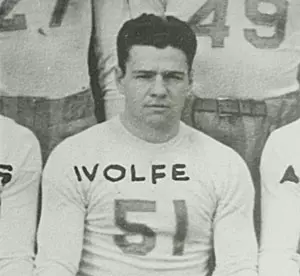
Bill Little commentary: Hugh Wolfe -- The first of many
04.26.2007 | Football
Some will be at Radio City Music Hall in New York City, others will wait patiently in their hometowns or on their college campuses, while millions will watch the event unfold Worldwide on television. The disposition of millions of dollars will be determined on a fateful weekend. Young men whose life dreams of playing professional football will swell with pride and falter in disappointment, all in a matter of 48 hours.
And in Stephenville, Texas, Hugh Wolfe will take note, and remember.
Wolfe, who will turn 95 on June 13, holds the distinction of being the first Texas Longhorn ever taken in the NFL draft. And almost 70 years ago, in the summer of 1938 when Wolfe started what is now the longest string of consecutive years with a player drafted by any NCAA school, he didn't even know it happened.
Wolfe had come to The University of Texas in 1933, and gone on to become one of the greatest athletes of his time. In an era when Texas football was in a depression, Wolfe was a shining light. He earned five letters in football and track and field, was a two-time All-Southwest Conference selection as a bruising, 200-pound fullback, and won the SWC discus title in track and field.
He was timed at 9.8 seconds in the 100-yard dash, covered 440-yards in 49.2 seconds, high jumped over six-feet, cleared 13-feet in the pole vault with a cane pole, and threw the discus a record 163-feet.
But it was for his football work that first the Pittsburgh Steelers, and then the New York Giants, sought to sign him after the NFL draft of 1938.
"I was actually drafted by Pittsburgh," Wolfe said this week. "But was traded right away to the New York Giants for (Byron) "Whizzer" White. Whizzer (who would later become a justice of the U.S. Supreme Court) demanded a $15,000 a year contract, and the most the Giants were paying was $8,000 to Tuffy Leemans. They couldn't pay what Whizzer wanted, so they traded horses for me. My contract with the Giants was for $4,000."
That, in itself, was a lot of money in 1938, particularly for a young man who had worked his way through school with various jobs, including sweeping out Gregory Gym two hours a day for 50 cents an hour.
Wolfe had come to Texas after spending time in junior college at Tarleton State, in his home town of Stephenville. He opted for Texas after dreaming of playing at Notre Dame.
"One of the reasons I went to The University was that I wanted to go to Notre Dame, and my folks wouldn't let me go to a Catholic school. So I went down and talked to Clyde Littlefield, who was the head football coach at the time at Texas. He told me they were going to play Notre Dame the next year, and I thought, 'Well, this is the next best thing,' so it influenced me to go to Texas."
Littlefield had departed by the time the Longhorns played the Irish in 1934, but Wolfe was very much a part of the action.
"I made the longest run of the game, 38 yards," he recalled. "It was a big thrill." And to add to that thrill, Texas won the game, 7-6, handing the Irish their first-ever opening game loss in South Bend.
To survive in the tough financial times, he parlayed the part-time job mopping floors into several other opportunities, and wound up "hustling" his room and board.
"I don't know how I got by," he says. "But I managed some way."
Hampered his whole life with vision problems caused by a bout with measles as a child, he missed the 1935 season with eye surgery, but returned to earn All-SWC honors in 1936 and 1937, and was named second-team All-America by UPI in 1937.
His greatest game actually came in a loss to No. 1 ranked Minnesota in 1936. In that game, he quick-kicked 90 yards, had an onsides kick that traveled 50 yards into the Gopher end zone and was recovered by a Longhorn teammate for a touchdown, and set a school record with a 95 yard-kickoff return for a touchdown.
"That kickoff return was a fluke," he told the late Lou Maysel in his book, 'Here Come The Texas Longhorns.' "I picked out the biggest one and ran straight at him, faked left, cut right to see nothing but daylight and the man who held the ball for the kick. He was just getting to his feet when I said, 'goodbye.' Shirley Temple could have made that TD."
Whether the popular child actress of the era could have or not was irrelevant, Hugh Wolfe was on his way to stardom.
Jack Chevigny, who had taken over for Littlefield as the head Longhorn coach in 1934, ended his short tenure at Texas after that 1936 season, and Texas hired D. X. Bible to come in and turn the program around.
Unfortunately, few positive things happened that first season under Bible when the Longhorns went 2-6-1, but one of them was a stunning, 9-6, victory that knocked Baylor out of a chance to go to the Rose Bowl. Wolfe, still suffering from eye problems, was cross-eyed after his surgery.
"That was okay," he said after booting a 38-yard field goal to win the game. "I had no problem. I could see three or four goal posts, and I figured I'd hit it between some of them."
Wolfe would go on to conquer the eye issue, eventually flying his own plane and visiting 42 countries.
The NFL draft took place after that 1937 season, and at the same time, Hugh was invited to participate in the East-West Shrine Game and the College Football All-Star game, a high profile contest in Chicago matching the defending NFL champions with a group of collegiate all-stars.
"Before I left for Chicago, Mr. Bible told me I had a tentative contract with the New York Giants," Wolfe said. "I didn't sign one until I got to New York. I went from Texas to Chicago, and then from there to the Giants. I went in and signed the contract, and didn't even read it. That was a lot of money, then."
Wolfe's time in the NFL was short.
"We won the championship, and I played one year. I took early retirement," he said jokingly. "Actually, I had a chance to coach an all-star team in Hawaii, and I liked that possibility. So I took that job and went down there for a year. Then, I came back into business with my father, who was dying of prostate cancer."
That business was called Wolfe Nursery, and it would become known nationwide as one of the largest distributors of mail-order garden plants. From there, he would expand into the aluminum gate business, and later an air pollution control firm. He would become immensely wealthy, and served on countless civic and statewide committees and boards, including the Board of Regents of the University of North Texas.
So he won't flinch when the dollars roll for the young men of today, because he made his in another life. Does the big money of today bother him?
"I don't know how to express an opinion on it," says Wolfe, who was inducted into the Longhorn Hall of Honor in 1977. "As long as it's there, I guess it's okay for them to have it."
And for several Longhorn stars whose names will be called during this weekends NFL draft, extending the leagues longest string of consecutive years with a draft pick to 70, an opportunity to reap the rewards of years of hard work and commitment is now within their grasp.
With each selection, we can all now reminisce about the man who started it all so many years ago, Hugh Wolfe.