The University of Texas at Austin Athletics
Texas-Alabama series stories: 1973 Cotton Bowl
12.30.2009 | Football
Dec. 30, 2009
Lead and notes by Bill Little, Texas Media Relations
(Editor's Note: Texas first played Alabama in 1902, and thus this pairing ranks as one of the oldest on record for the Longhorns. Texas holds a 7-0-1 lead. The first three games - in 1902, 1915 and 1922 - all ended with the Longhorns' shutting out Alabama. The teams didn't play again until the 1948 Sugar Bowl following the 1947 season. That began a series of five bowl games that featured some of the best match-ups in college football, as well as a couple of individual efforts where one player, and one play, made all the difference. Here is a look at those bowl games.
1973 Cotton Bowl - One Small Step for Texas
Darrell Royal and Bear Bryant were two giants of a coaching era that produced something of an oddity in a profession known for its heated competitiveness - guys who could battle each other on the football field, and be great friends off of it. The relationship had begun when Bryant was coaching at Texas A&M, mentoring the legendary John David Crow. Royal had become the Texas coach in 1957, and that season he took his Longhorns to College Station and beat Bryant, Crow, and the No. 4 ranked Aggies in a 9-7 upset.

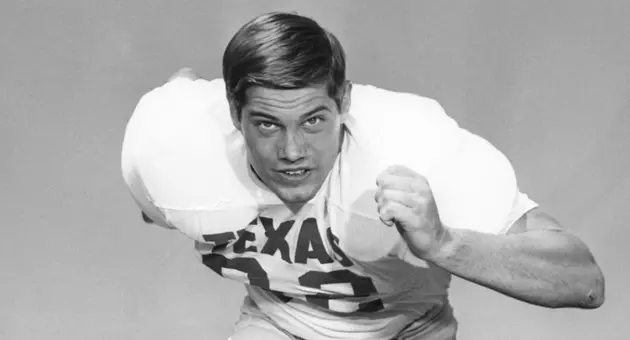
The 1972 Longhorns were led by two of the greatest offensive players in school history - tackle Jerry Sisemore and fullback Roosevelt Leaks.

The 1973 Cotton Bowl came at a time when Royal's offense - The Wishbone - was still riding a wave of success punctuated by the back-to-back National Championships and a 30-game winning streak from 1968 through 1970.

Following the 1977 season, the late Austin American-Statesman sports editor Lou Maysel published a sequel to his popular chronicle of Longhorn football history. This excerpt begins following Texas' 38-3 defeat of Texas A&M on Thanksgiving night in a Memorial Stadium in Austin sporting a newly completed 15,000 seat upper deck on the west side.
From "Here Come The Texas Longhorns, Volume 2," is an account of that final meeting on the football field of Bear Bryant and Darrell Royal.
Two of the Texas defensive players were very outspoken why they wanted to win the game. "We wanted it bad because they're Aggies and because we wanted to take a 9-1 record to the Cotton Bowl. We wanted to show Alabama they're not playing a chicken team," linebacker Glenn Gaspard crowed. "Those signs about us playing Alabama in the Chicken Bowl really chapped me," defensive back Tommy Keel said.

The "chicken" references stemmed from the label put on the Texas-Alabama meeting of two Wishbone teams, but were tied to Alabama's choice of playing Texas rather than facing tougher foes in the Sugar or Orange Bowl. One of those who objected to Bear Bryant's decision was Notre Dame coach Ara Parseghian. "From everything I've read and by their own admission, Alabama took the easy way out," Parseghian said. At that time he still entertained slim national championship hopes and needed to have Southern Cal, Alabama, Michigan and Oklahoma, the 1-2-3-4 teams in the ratings, beaten in their final games.

Southern Cal disposed of Notre Dame and went on to a perfect season and the National Championship, but Alabama and Michigan both tumbled. Alabama's defeat was a 17-16 stunner by Auburn, which won by running two late blocked punts for touchdowns. The defeat dropped Alabama to No. 4 in the ratings. Texas profited little, advancing to No. 5 in the last UPI (coaches poll) ratings but slipped back to seventh in the final AP ratings before the bowls.

Despite the loss to Auburn, Alabama was established as a seven-point favorite because the Tide had the best of it in most matchups, except the records of the two coaches in their meetings. Bryant showed only a tie in the 1960 Bluebonnet Bowl in three previous clashes with Royals, a close coaching friend with whom he consulted regularly and from whom he had drawn much advice when he switched to the Wishbone.

Alabama also ranked higher in statistics than Texas except in defense against scoring in which the Longhorns were eighth in the nation (10.8 points per game). The Tide was in the top 10 in five departments - second in total yardage defense (212.2 per game), fifth in scoring (35.7), sixth in rushing (302.9), 10th in total offense (409.2) and also 10th in rushing defense (114.8). Texas was well down the list in total offense (356.2) but did finish 10th in rushing (276.0).

The edge in personnel also went to Alabama because it had more backfield speed and a slight edge in honors. Sisemore made all the major all-American teams but so did Alabama's 265 pound guard, John Hannah. Center Jim Krapf and defensive end John Mitchell also were picked to at least one all-American team while Gaspard made some second teams.

Alabama held the upper hand to start the game, witnessed by a sellout crowd of 72,032, but slowly Texas turned the tables and finally won the game by 17-13 on quarterback Alan Lowry's 34-yard touchdown dash with 4:22 to play. Although he had an attack of tonsillitis and a 100-degree fever, Lowry had a clear enough head to suggest the winning play. Texas had used that play only once before and it almost produced a touchdown late in the Utah State game.

"That play was really Alan's. He suggested it a couple of series earlier. I called it, but it was his idea. We like to have his thinking as well as that of the coaches," Royal said.

What Lowry saw was that Mithcell and the Tide cornerback were closing down tight to stop Leaks and also running back Tommy Landry on the inside belly play. This time he faked to Leaks and then Landry, hid the ball on his hip and headed wide around left end on a bootleg play.

"Texas had been using the fullback play on third and fourth-down situations the whole game. It was third-and-two and he made a great fake to the middle and sucked everybody in," Tide defensive back Steve Wade conceded. Mitchell took the fake too and when he tried to head Lowry off, he and Wade tripped each other enough to get eliminated from the play.

Lowry, who only had modest 4.7 speed wasn't home free when he turned the corner. He had to elude another Tide back, Mike Washington, and made his cutback to the inside when he reached the 10. Most press box watchers thought he nicked the sideline when he planted his left foot to cut back and the TV instant replay seemed to indicate the same thing. Lowry admitted after seeing the films he may have stepped on the line but said at the time, "I don't think I even got close to the sidelines."

(EDITORS NOTE: A review of the game films showed that Lowry's foot landed squarely on the out-of-bounds portion of the 10-yard line, but the official trailing the play was distracted for a split second by a block by UT end Rick Davis, who sent an Alabama player tumbling threateningly toward the official just as Lowry stepped on the line. Television replay for the officials, of course, was not available at the time.)
It took a lot of outstanding defensive play earlier in the game to keep Texas close enough for Lowry's run to win it because the opening quarter created the impression that Alabama would win going away. Greg Gantt kicked Alabama into the lead with a 50-yard field goal on the first possession and star halfback Wilbur Jackson toured right end for 31 yards with a pitchout to put Alabama 10-0 ahead. The score came the play after Wade intercepted a Lowry pass and returned it 42 yards.

Texas drove right back but bogged down after reaching the Tide 3(-yard line) and had to resort to Billy Schott's 24-yard field goal. Alabama matched it to end the half with a 13-3 lead.

Just before coming out for the second half, his team's show of emotion surprised Royal. "It was something this team never had shown before. It's something you don't instill in a team. It was something that was just deep within them," Royal said. Why did the Longhorns react as they did? "We've been blown out the last two Cotton Bowls and we've come a long way this year," Sisemore said. "We wanted to make up for the last two, and we didn't want to stop here this season."

Texas' hopes also brightened when Leaks, who had to leave the game twice in the first half because he was dazed, was permitted to return. "We just put him out on the field to see if he would maybe go in the right direction. He did," Royal said. "We stayed with our right side because of Sisemore. He'll make a hole for you and you don't shut down Leaks off tackle." Leaks said afterwards he couldn't remember anything. "I don't even remember carrying the ball. I hurt everywhere," he said.

With Leaks working mainly behind Sisemore and guard Travis Roach, the Longhorns went 59 tedious yards in the third quarter. Lowry scored on a three-yard keeper and then Terry Melancon, who subbed in at left halfback although he had played sparingly since the Oklahoma game, made two key interceptions.

The second was a leaping theft of an apparent 34-yard touchdown pass from Terry Davis to Wayne Wheeler, who had the ball in his hands for an instant. "He just took the ball away from me and that's all there is to it," Wheeler said. Surprised he had such a key role in the game, Melancon said, "I never dreamed it would come to this."

Texas immediately set off on its winning touchdown drive and a pair of Lowry passes to Pat Kelly and Julius Whittier bridged most of the yardage before Lowry's TD dash. Howver, Alabama didn't die with Lowry's run. The Tide drove back and came up to fourth down with a yard needed at the UT 43. Jackson tried the right side but his fullback missed his blocking assignment and Jackson got shocked for a yard loss by UT linebacker Randy Braband, who was named the game's top defensive player.

"It means more to me than anything I've ever done," said Braband, crediting knowledge of Alabama's tendencies for the stop. "We watched their films and 90 out of 100 times when they had short yardage situations, they ran over Hannah. It was just a matter of playing the percentages."

Lowry got the nod over Leaks as the top offensive performer, 30 votes to 27, but together they supplied most of Texas' 378 yards. Leaks gained 120 yards, his seventh time over the 100-yard figure during the season, on 25 carries. Lowry gained 117 yards on 16 plays and his 5-for-11 passing produced 61 yards. Alabama's rushing game was held to 138 yards and Davis accounted for 174 of the Tide's 186 air yards with a 10-for-17 day.

Bryant was as magnanimous as always in defeat. "Texas deserved to win the game. They are a great team. Whenever you come back like that you are," he said. "I think really and truly that the game was won on the sidelines and in the press box booth. They did a terrific job running the game and going against our weaknesses, I did my usual lousy job. I'm not proud of the job I did." He also said he wasn't sure his team was a great one. "I thought it was three or four weeks ago but they made too many mistakes great teams don't make. Still I'm proud of this team…but not too proud."

Royal was beaming with pride over the team he had called "average as every day's wash" prior to the season. "I couldn't be prouder of the coaches and the boys. We started slowly this season, but we would end up as a pretty solid football team," he said. "In fact, I would say our defensive team this year would have to rank with the best we've had at Texas. There is some inexperience there, but there's some talent too, and a lot of spirit and desire."

The two teams each got $455,965 to split with their conference brothers but Texas profited the most in the polls. The Longhorns moved up to No. 3 behind Southern Cal and Oklahoma in the final AP poll of the nation's sports writers and casters. When the ratings were mentioned right after the game, Royal had said, "Wherever they vote us, I hope they don't move Alabama down." His hope was not fulfilled. Alabama slipped from fourth to seventh on the basis of the twin defeats by Auburn and Texas.

The game marked the fifth straight appearance by the Longhorns as the Southwest Conference champion in the Cotton Bowl, and it would be the last of five Royal victories in the Classic. In his 20 years at Texas, Royal's teams would appear in the Cotton Bowl game nine times.

It also marked a unique time in Texas football. Royal's celebrity status had reached beyond the gridiron into the world of country music. As the team had practiced in preparation for their bowl trip to Dallas, Royal had gathered his players and staff in the "T" Lounge at the stadium for a private concert with a new friend - a country music writer and singer who was just beginning to get some interest.

His name was Willie Nelson.

NEXT: A quarterback draw surprises the college football world.