The University of Texas at Austin Athletics
05.26.2011 | Football
May 26, 2011
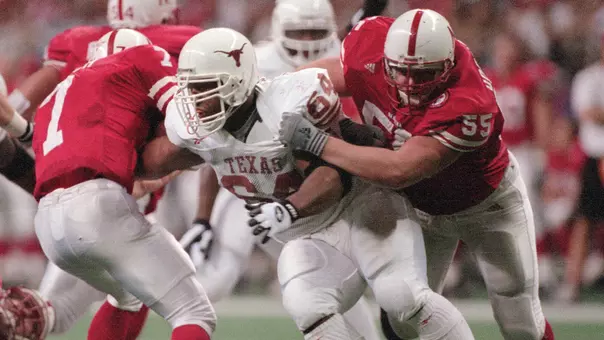
Pat Culpepper was a linebacker for Texas from 1960-62 who led the team to two SWC championships in 1961 and 1962. He is best remembered for his hit [along with Johnny Treadwell] on Arkansas' Danny Brabham in 1962 that forced a fumble at the goal line and spurred the Longhorns to a 7-3 victory and a SWC title.
How excited are you to be inducted into the Texas High School Football Hall of Fame?
Well just look around me, all of these displays of great players. Of course whoever picks back in the fifties has to have a great memory, because there aren't any fans or anything else, so it's more a word of mouth deal. We were fortunate in Cleburne [Texas] because we played against great teams like Temple, Garland, Sweetwater, and so many [other] great teams we played against. We were lucky to win some of those, and it brought attention to our little town. So I get rewarded for this, along with David McWilliams who came before me, but we played high school football together and college football together at Texas. It's good for Cleburne right now, because we are struggling a bit right now in football. So all of the folks in town got excited about it, so it made me feel good that I could help in that capacity, to bring a little light on football back in our town.
Did you ever think you would receive an honor such as this?
Not really, because when you are growing up you see so many great players like Bobby Boyd, Larry Hickman, Jerry Tubbs - who played for the Cowboys later, and who of course was an All-American at Oklahoma. You see those kinds of players, and when you are growing up you don't picture yourself in a group like that. So being here is certainly an honor for me.
Why did you choose to play football at the University of Texas?
They took about 55 players in those days, and I was one of those 55. Coach [Darrell] Royal was looking for guys that wanted to play against Oklahoma, and that's the kind of challenge he put out. I had seen the Oklahoma-Texas game when the last Texas [team] had beaten them, and Eddie Crowder was the quarterback at Oklahoma with Billie Vessels, and Texas won 9-7. I thought that was a great arena, and I thought going to Texas I would get to play in that game. So it was great to play for Darrell Royal and to play with all of the great players like Scott Appleton, and Don Talbert, that were All-Americans, and James Saxton. All of those guys were great players that I played on defense for. So that was a great thrill for me. And because I played at Cleburne, and we won, I got a chance to go to Texas.
How did Coach Royal influence your career after playing for him at UT?
He got me a lot of jobs. I would call and say, "Coach, I am interested in this kind of job." And he would call [someone for me]. Coach would call, and he gave me my first coaching job, and he also got me on at Colorado with Eddie Crowder. Coach Royal and Crowder were close because of the Oklahoma connection, so he helped me there. And then when I was head coach at Northern Illinois, he came up and spoke at a clinic, and we had two thousand area Chicago coaches come in to that school for the first time and see our facilities and listen to coach Royal. So he's always been like that for me, wherever I have been.
What was it like to coach on a national championship team?

Well, I was a coach of the national championship team in '63. That was my first year coaching. And then my second year we had an assistant coach that hurt his back skiing, and we needed to recruit, and [Royal] said that if you're interested in going into coaching, I have got a spot. I was going to be commissioned in the Marine Corps, and I told him and said that I had to turn in my commission, I've got to go into the reserves, and he said whatever it takes, you come on with us. I came in and recruited in the San Antonio area. And then in `64 we played Alabama in the Orange Bowl and beat them. Coach [Paul "Bear"] Bryant never beat Coach Royal. So that was a great thrill to watch that staff work because I had played for them, and when you watch a group of people work that are successful, it's good for you as a young coach.
What was it like winning Texas' first national Championship in 1963?
That group, we had played together for two years. It was Duke Carlisle, Tommy Ford, and that whole group. So they got to a point that before they played the Navy team in the Cotton Bowl, a lot of people were talking bad about them nationally like they hadn't played anybody, or they were lucky to beat Oklahoma. And they built up Navy so much that those boys at Texas that I was coaching, you didn't have to say much to them. They were ready to stop Roger Staubach. We had worked hard on containment, and when he would start one way and roll back, there was a defensive end in his face. It absolutely stopped their attack. Also, Navy had played goal line defense in the middle of the field, and we hit them with two touchdown passes in the beginning of that game. It was fun to be on the sideline watching that, and the first time Roger Staubach rolled out, Tommy Nobis hit him right in the chest in front of our bench, and I'll tell you what, we could have played the Russian Red Army after that one because it made our whole bench come alive.
Tell us about your big hit on Danny Brabham against Arkansas.
Arkansas was averaging 42 points a game, and that was in 1962 which is almost unbelievable. They came into Austin, and it was a hot night - it was 89 degrees. They had us down 3-0 and they got the ball down on our two yard line, and that's when Johnny Treadwell said we have got them where we want them. They had thrown the ball to get down there, and they ran their fullback, and our defensive line got under [current Dallas Cowboys owner] Jerry Jones and their group up front, and we hit Danny Brabham at the same time and the ball rolled right over our shoulders. And that young man, Danny Brabham, got death threats for the next two weeks. That affected him the rest of his life. That's how big [the game was], and it wasn't on television. It was on radio and the 64,000 people that were there and that was it. But that picture was captured by Al Panzera of the Fort Worth Press, who got down in the endzone expecting a touchdown and caught that picture. I sign - usually once a month - photographs of that reproduction.
Why is that game so special to people in Texas?
Maybe they remember it more because they heard it on the radio. It's incredible how many people remember that game. It was a great game, because we were No. 1, and we had been No.1 since the season started. And Arkansas came in at No. 7, but two teams had lost that afternoon. It was a night game and they had moved up in the rankings, and it was quite the football game. We scored with thirty-six seconds [remaining] to win, and we go to the dressing room, and Coach Royal said the people aren't leaving unless we go back out on the field. We got back on the field, and then we went back to the dressing room, and Lyndon Johnson - Vice President Johnson - was on the phone calling Coach Royal. It was quite a momentous occasion, and I don't think anybody went to sleep that night. The horns were honking on campus. You couldn't go to sleep. Everybody was up yelling and going on in the streets. It was just that kind of game because we won on a 20-play, 85-yard drive, with three fourth-down conversions. So it was just one of those deals.
What does the game of football mean to you?

It's the epitome of competition. I wasn't a big guy, and I had to make up a lot of ground. In my coaching career I tried to put that in players - that size doesn't matter, it's what's in your heart. If you really want to win, and if you really want to work, you have got a chance. I think that generation that I came through, epitomized that. So the coaching part was fun and the playing was tough, but it had its rewards along the way. Now, I was lucky to play with some real good football players as well, so that helped a lot. Playing for Darrell Royal was unique. That was a great staff, and the Southwest Conference was extremely strong at that time. Rice was a great team under Jess Neely. Baylor was [an] excellent football [team]. SMU had a very good football program. Of course, Arkansas and Texas were back and forth, and you had a great conference. Texas Tech was just coming in, and Texas A&M was always tough, but they changed coaches too many times after Bear Bryant. That was a great time to play in the Southwest Conference.