The University of Texas at Austin Athletics
A Reunion of Champions
09.05.2013 | Football
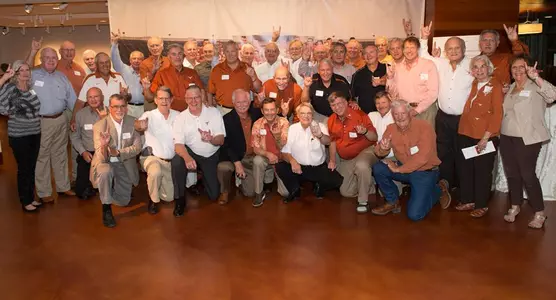
The members of the1963 National Champions came together to see old friends and to reminisce about the 50th anniversary of their historic achievement.
Fifty years ago, 62 players changed the identity of Texas Football. To honor the significance of Texas' first national championship, the members of the 1963 Texas Longhorns and their family members traveled to Austin for a reunion fit for champions.
On Friday evening, August 30, the surviving members of that special team gathered on the eighth floor of the Red McCombs Red Zone at Darrell K Royal-Texas Memorial Stadium for dinner and a chance to reflect on their invincible season.
"It is really hard to put in words to see guys that you haven't seen in 10 or 15 years and some even longer," said end/receiver Pete Lammons. "To come back and just reminisce on what we went through and what we were able to accomplish with a lot of hard work, is just a lot of fun."
In all, 46 players or family members representing deceased players or coaches, attended the event. Notable persons filling in for their relatives who have passed included Tresha Steffens, who was there representing her brother, All-American Scott Appleton, and former Longhorn Tom Campbell who stood in for his father, former defensive coordinator Mike Campbell.
Some of the notable conversation topics were the defeat of No. 1 Oklahoma in the Red River Rivalry to become number one team in the country themselves, as well as dominating No. 2 Navy in the Cotton Bowl that left no doubts that Texas was the true National Champion.
"It does bring back a lot of memories and to look around at some of the players, I think about some of the plays they made. It has been a long time but I can still remember specific plays," said end Charlie Talbert.
Along with dinner, the team got an exclusive look into the H.J. Lutcher Stark Center's newest exhibit displaying photographs and memorabilia from that season.
"We had great fellowship among the players, and I think we all had the same kind of attitude and goals for the team," said Tommy Ford, who was a team captain and an All-American that year. "It meant something to go out and win the ball game. Everybody was pretty much dedicated to making Texas a good team and the place to be. I think everybody did what they were supposed to do, and it turned out good for us."
At the center of the Stark Center exhibit hung a huge mural of the team, and each player autographed the portrait over their own visage. The mural is the showpiece of the exhibit and a lasting representation of that important time in The University of Texas' athletic history.
Many of the players also had the chance to reconnect with the only surviving member of the coaching staff, Art Davis, who coached the defensive backs that year. Davis, 78, traveled from Portland, Oregon, with family members just to be a part of this momentous occasion.
"I love being here. I have so many glorious and wonderful memories of this place. Great guys, great team," said Davis. "I was fortunate to be here to tell you the truth. I was fortunate to be here and be associated with this team.
"What stands out, I guess you would say, is how well these guys played as a team. The toughness, the skill, the determination. The class of this group of guys was just so impressive to me. They won so many times with a never-give-up attitude."
While having Davis back was special for the players, it was bittersweet that their other mentors have passed, particularly the man who was responsible for it all.
"[This] was a good bunch of guys that came together that Coach [Darrell] Royal rounded up, but the key to all this is Coach Royal," said quarterback/safety Duke Carlisle, who was named Top Back of the 1964 Cotton Bowl after passing for 213 yards and two touchdowns, and rushing for 54 yards and another touchdown.
"Coach Royal came on the scene in the late 50's and it took him only a few years to get the program in shape, and then he began to put together teams that were able to do what they did," added Carlisle.
"It was exciting to be on a national championship team. It's a wonderful thing to be a part of and remember, but the important thing is that Coach Royal came in and accomplished that."
While Royal's passing left all at the reunion with heavy hearts, having his loving wife Edith Royal in attendance eased some of their sadness. All the players made sure to spend a few moments catching up with "Miss Edith," and she beamed with pride as she hugged all of her husband's former charges.
"They played for one of the great coaches who will go down in history as one of the great coaches in football – Coach Royal," remarked Davis. "I played for him at Mississippi State. He was a great man. I miss him, and I am sorry he is not here with us."
The T-Association, with help from head coach Mack Brown and Chip Robertson from the football equipment staff, put together a souvenir bag filled with unique gifts that included a football with their photo printed on it and important facts about that season; a keepsake poster of a Texas helmet with the number "63"; an exclusive Texas coaches polo with a "'63" emblem ; and two tickets for the New Mexico State game.
The marquee item in the bag was a commemorative jersey with each player's number and name as a reminder of their past glory on the hallowed turf of DKR-Texas Memorial Stadium.
"We were able to do it. We were able to win the championship. We were at the right place at the right time with the right coach. I am so happy that I was one of them," Talbert said.
On Saturday, August 31, the reunion members returned to the stadium they had had so much success in to welcome the 2013 Texas football team as it arrived to face New Mexico State in the season opener. The 1963 National Championship team also had an additional opportunity to walk onto the field where they became Texas legends, as they were honored and praised by the nearly 100,000 fans in attendance for what they had achieved 50 years ago.
"I think the same thing going through everybody is that we accomplished something that was really difficult to do. That never goes away, even with the no hair or white hair or the extra pounds," Lammons said with a laugh.
"It really is a great feeling to be able to see this and go back [home] with the memories from this."