The University of Texas at Austin Athletics
02.05.2014 | Football
Head coach Charlie Strong announces 2014 signing class
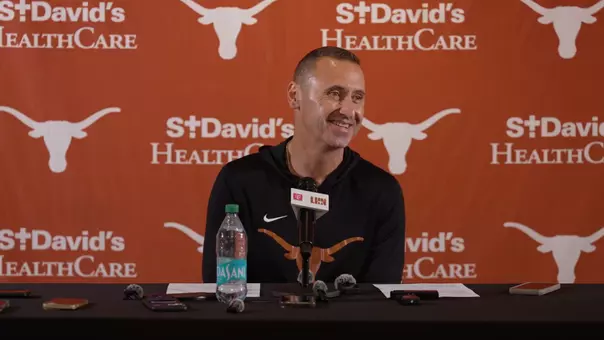
Head coach Charlie Strong
Opening statement: It's been a very intense couple of weeks and what we were able to do, as a staff was we wanted to keep this class together and it was an outstanding class. And then we were able to add a few players ourselves by our guys going out, but it was key for our coaching staff to get within the state and develop a relationship, not only with the new recruits that we were signing, but also with the high school coaches here.
I have a list here and I'd like to go down this list and just talk about some of these players and give you an opportunity to just hear [about them].
Alex Anderson was an offensive lineman from New Orleans, we were able to get on him late and he was an early enrollee for us. The thing about him is just coming out of high school to college is a big adjustment, especially when you're a big guy and the thing he is going to be able to do is get in the weight room and just get into the offseason program.
Andrew Beck is a linebacker from Tampa Plant. I can remember when I was at Louisville we had a chance to evaluate him. Beck's going to be an outstanding player. And also Beck is an early enrollee.
Roderick Bernard is a running back, wide receiver, just one of those athletic guys out of Sharpstown down in Houston. An outstanding player.
John Bonney, defensive back from Lamar. I think with Bonney we had to recruit his dad more than him. My man just loved to talk. He had a whole lot of conversation for us.
[Donald] Catalon is a running back out of Houston Eisenhower. You know the amazing thing about going into that school was, when I went into the school, the coach said, 'Hey, there is someone here that would like to meet you.' And I said well whom would that be and he said, 'Well he told me not to give you his name.' So I go walking down the hall and I see this player and he was a linebacker for me, played at Notre Dame, named Nix. We started laughing and telling stories. I didn't even know he was a coach because we recruited him out of Kilgore and now he is coaching there at Eisenhower.
Terrell Cuney is an offensive lineman from Jasper and the thing about it, is we needed to get linemen in this class and now to get a second lineman with Cuney.
Poona Ford, I know everybody heard his commitment. He was able to go up to Charlotte to get on ESPN to make that big commitment. And the thing about Poona as a DT, big guy with some size there. You're always looking for size.
Armanti Foreman, wide receiver from Texas City with his brother D'Onta Foreman: Two athletic and two skilled players.
[Edwin] Freeman was able to go into Bowie. You know the thing with Freeman, and I always laugh because whenever I go up to Dallas where Bruce Chambers did an outstanding job and the thing he did was develop an outstanding relationship with Freeman, but a big safety is a big safety for us.
Garrett Gray is a wide receiver from Marble Falls and the thing about Garrett is also a big body, can body up and can play an inside or outside, has very good speed. Kind of reminds me of a player that I had out of Florida and I told him that when I was talking to Garrett. I said I can remember going to Riley Cooper's house and I said he had the size that you have right now.
Jason Hall, a defensive back from Grand Prairie, is really an outstanding size and a good athlete.
[Cameron] Hampton, a linebacker out of Dallas Carter, has a lot of speed and you look at Hampton as one of those backers that we are going to have cover up and let him run.
Jerrod Heard is a quarterback who won back-to-back state championships. The good thing about Heard is that he's an athlete; he can throw the football but he can also beat you with his legs.
Lorenzo Joe, a wide receiver out of Abilene Cooper, is a good size. All of our wide receivers have a really good size to them and the thing about it is when you get them in the weight room, they'll just get bigger and just build more bulk on them.
[Dorian] Leonard, a wide receiver out of Longview, had a chance to watch him in the gym, he's 6-foot-4 and very athletic. He's long and has a really good length.
Chris Nelson is a defensive tackle out of Lakeland. Lakeland is a city that I've always recruited out of. I can remember recruiting that city with The University of Florida and signed seven players out in one year.
Jake McMillon, a defensive tackle out of Abilene, has a really great family and an outstanding coach. I can remember when I made that trip out there and it was really cold that day and it just felt that the wind was going to blow you away, but I was teasing him, I said, Jake I have to hurry up and get inside because it is a really cold day.
Derick Roberson, a defensive end from San Antonio. The thing about Derick is with his size, he's going to be able to put on weight. He's very athletic, has a good speed and is going to be able to put pressure on a quarterback for you.
Jermaine Roberts, a defensive back out of St. Augustine, is an outstanding player, not very tall, but the thing about it is he can run and he is very athletic.
Elijah Rodriguez was another offensive lineman that we got on late. Coach Wickline was able to find him late, him and Coach Koenning did a good job and brought him in here the last weekend and was able to make the turn and get another offensive lineman in the group.
Kevin Shorter is a running back out of Newton, Texas who is an outstanding athlete.
And then Black Whiteley is a tight end that we were able to go pluck out of junior college.
But overall, an outstanding class, and just like I said what we want to do is keep this class together and let our coaches just get out there and develop relationships within in-state. We know that we can do a lot better and we will do a lot better recruiting knowing that we have control over the state and get our work done.
On keeping class together through coaching transition: It's not so much reselling the University of Texas, it's more selling ourselves. It's all about relationships and they didn't really know us. I think we lost two of them (commits), I don't really know how many we really lost. But just knowing this and when a new staff comes in, a recruit has to be comfortable with you and that's why it was so critical for us to go in and see every recruit that we did sign here.
On recruiting the defensive line through de-commitments: No, but what we were able to do was to be able to go out and get Poona (Ford) and Chris Nelson, so you lost two and you were able to go get two. You were able to balance that back. We needed those two guys because you lost two defensive tackles. You are always looking for big guys because if you are going to have a good football team, the strength of your team is going to be up front. It's going to be built around your offensive and defensive lines.
On rating the class and the efforts to bring these guys in through the transition: You think back when I made my opening statement and about how intense these last few weeks have been. We weren't able to go on the road until January 16th. I'll say this, our staff went right to work and they even then, I don't know if I had them all hired at the time, just them going to work and just making sure we kept everything in place. Now we lost some guys, but we just wanted to keep them in place and build a relationship with them like I said earlier because now, when you are out and try to re-recruit, which is what we were doing, you have to sell ourselves.
On trying to re-recruit players that had de-committed: I sometimes think about this, and I'd like to see this happen and I'm not working for the NCAA but I'd like to say this: in a situation like this, if a coach leaves in the middle of recruiting and a guy has made a visit and they have a visit left because they get five, they should be able to come back and use one of those five to visit with the staff on campus. Now they can really find out who you are and sell them again and give them a chance. If they visited in November or December and then everyone else starts recruiting them, they remember the last guy that they spoke with and that happens a lot. We weren't able to do that and get them back on campus, so we had to go and re-sell ourselves and go to their home and give them the hour or however long they had to sit down and convince them. You also have to convince their high school coach about who you are and what you are all about.
On recruiting the state of Texas: We're still the University of Texas. We will always be the flagship University of this state. It's hard to try to keep guys in, but you have to go recruit them and not be afraid to go battle those Southeastern Conference teams, whomever they may be. That's going to happen, people are going to come into your state because also we can go outside our state if we really need to and take one or two. Someone is always trying to say "hey, we are going to go into there and get one." There are enough good players here because even if you go recruit them, you still need to develop them. That is the key, is to develop and turn that player into a really good player.
On the type of player Texas looks for: I don't know if there is a word to describe this group, but you are always looking for character because you always want to start off with good character. Then you start off with size and speed. One thing that speed does, no matter if you are big guy or little guy, is that you are going to be able to build off of that speed and make sure that player can develop and put on more weight. Are you looking to put on weight or take off weight? A football player is a football player and there are enough of them around. So now, once you get them, the question is can you develop them. The key is can you develop the player. I always go back and look at those top classes, and I always say "where are they now?" Some of them have made it and some of them have gone to the NFL, but a lot of them have fallen off and they just didn't develop.
On if he felt like his hands were tied in honoring scholarship commitments from Mack Brown: I didn't feel like my hand were tied at all. I know that Coach (Mack Brown) had built a great program here and he has built it the right way. I knew the players that had committed to him were outstanding players and outside of that, outstanding people and that's what you look at. I didn't feel like my hands were tied at all because I know this - that we were able to go out and recruit some ourselves. It's so hard because when you go out and make a coaching change, you go out and try to get back in the mix with some of the players that have gone out and committed someplace else. They really don't know who you are. It's best to hold on to what you got rather than go out and look for something else.
On if he is a believer of early commitments: Well it's just going to make the job of the coach harder because right now, they don't have enough time anyway so now you go with early commitments and that time is really shrunk now. You like to give the coaches some time to just relax themselves. When you start talking about early commitments, when does the recruiting end?
On Denton, Texas (Guyer) QB Jerrod Heard and the importance of the QB position: It's always great because when you talk about the quarterback position, he's always going to be one of the leaders of your team. He's an outstanding athlete and, like I said, not only can he beat you with his feet, he can throw the football. He's just a quality person, because you always talk about the character of the young man. He comes from a great family - great mom and dad - but that's what you want and that's what you look for in your program.
On how many from the recruiting class could play next season: That's a tough one because this is what I always say to the guys I have right now: if a freshman comes in and plays in front of you, it's your own fault because you've been in the program and know what the program is all about. They have to come in and learn the program. For little guys – not so much little guys but skill guys – it's not that hard because if you can run, you can run; if you can cover, you can cover; if you can catch the ball, you can catch the ball. For the big guys, you are looking at someone who comes in as a freshman and you have some guys that have been in the program four or five years, now he (freshman) could never match up with him (upperclassman) strength wise. Even with the guys that have played, he can never understand the games because he has to come in and learn the whole game.
On Newton, Texas (Newton) RB Kevin Shorter's injury: What we are going to do I think with Kevin is when he gets here, the doctors are going to re-evaluate him and then I think I'm going to just go off of what our doctors say.
On the biggest points of emphasis for early enrollees: They have been placed with the upperclassmen so they are going to hear the same message they hear. The message is that what we are trying to do now is to just build a football team. We have a chance to evaluate the football team and now that the coaches are back off the road from recruiting, they can sit down with just positions and guys can have just individual meetings with the players and just try to build a relationship to figure out who they are and what they are all about.
On recruiting offensive linemen: Our recruiting office did a great job of just going in and just making sure we find some more. Like you said, when you have one committed and looking at a recruiting class, you would like anywhere from six to eight linemen because you know there will always be a turnover and then you are going to continue to build. You'd like to say let's go get four offense, four defensive linemen and build around those guys because you want to build around those guys. It was critical for us to go get some more linemen.
On ideal roster numbers: You always figure that you need to go get offensive linemen and what we do is go by a number system. I think with offensive linemen, you would like between 15 and 16 on scholarship. With quarterback, you would like anywhere from four to five. I think now with Jerrod (Heard) coming in, we only have three on scholarship. We always have to look at our numbers and see where we are and where our points of emphasis have to be. Even though on our defensive line, I know we are kind of stacked inside; now we need some guys on the outside. When you talk about the big guys outside, the rush guys, you are feeling pretty good about your DBs. The skill guys, we feel good about because a defensive back can always go play wide receiver or a wide receiver can always go make the trip to defensive back. Some of those positions, you need a specific player for and you need to make sure you go get them.
On what the class of 2015 will look like: Well you are always trying to form the stages, but I will say this that you have 25 scholarships to give out. Who are the top-10 players, let's go get the top-10. Who are that next ten or the guys that just fit your needs where you can build around because when you get the second ten, you are going to build around those. You take the other five and see if there is a late bloomer out there. There is going to be someone out there that isn't going to make an early decision. Let's make sure we save a scholarship there.
On de-commitments: Well you can't be concerned and worried about the ones you didn't get, you have to be worried about the ones you do have because those ones that could get you beat. With the ones that de-committed, if they decided that the other place is the best for them, there isn't much you can say because you recruited them and it just didn't happen.
On Houston, Texas (Sharpstown) WR Roderick Bernard's versatility and if he's capable of playing multiple positions: You can because he's a skill player. If you need him on defense to go cover, he is a good enough athlete that he can cover. If you need him to go run the ball, he is fast enough and quick enough and has enough size and speed to go run it.
On QB Jerrod Heard's role of helping recruit players: Jerrod is an outstanding player and once he made a commitment, he stuck to it. Not only Jerrod, we had a number of players that came down and were able to see a really good basketball game. What we tried to do as a staff to make sure the guys that we had committed was to bring them in the last weekend so those guys that hadn't had a chance to meet our staff had a chance to meet the staff. When you went to go see them, you only had the chance to bring the position coach and recruiting coach; so when you get those players on campus you are able to have them meet the staff.
On next step in coaching after Signing Day is over: What you like to do now that Signing Day is over, it's about finding out who our football team is and we have to learn our football team. We haven't been able to be around them because the last two weeks, you have been going, going, going. Now that we are back, we can get back into football and just focus in on our players and have them know who we are. Everything is about relationships and we have to build a relationship with our football team and get around the players so that they have a chance to be around us. You get a chance to see them work but it's going to be good because I think we have an outstanding group of guys that are doing it right and doing everything that we are asking them to do right now.
On how redshirting players will be determined: I don't ever talk about redshirting to a player. If he redshirts, it's totally up to him where he wasn't ready. If he is good enough and ready to go play, he'll get an opportunity.
On recruiting six out-of-state players: Six does seem like a lot but when you lose players, you have to find a way to make sure you can go recruit and make sure you can make up for it. That is why we were able to go get Poona (Ford) and Chris Nelson and then (Alex) Anderson from Landry-Walker (New Orleans) was just sitting there late for us. You just have to make sure you go get your needs wherever that may be. If it happens to be out-of-state, then that's where it was. We are always looking to control this state and stay within this state.
On playing freshmen: If you look at it now, if a freshman is good enough and you redshirt him, he'll be gone in three years anyway. You just allow those guys to grow up, you let them mature and get around your team. If they are good enough to play, we aren't going to hold them back. We aren't going to be one of those staffs that is to say he isn't ready when we know he's ready. When he's ready, he'll get an opportunity.
On how he got familiar with the recruits: What we did was when we got here, our recruiting staff was able to meet and get a really good look at them and knowing when you walked in, you at least were familiar with them. You could say you saw that run or saw that hit. You do have to be familiar with who are talking to so when you walk in, you aren't walking in blind.
On if he feels like the staff carries themselves as being the staff at a flagship university: Our staff does because they know exactly where we are. This is the University of Texas, so you know you are going to get in every door you can so now it's just about selling the University and selling this town and just selling ourselves and the program.
On how the team is taking the transition of the strength and conditioning coach: I think they are taking it pretty good because the time that I've been able to be around them they have really enjoyed it and any time a guy changes his body he's really going to enjoy it. So I think that what's happening, they are changing their bodies and enjoying the work. They are doing everything we are asking them to do right now as far as on the field and off the field as well. They are going to class, so they are doing the little things. Everything we have asked of them, they have done it so far.
On what he liked so much about those guys, like Chris Nelson, so early in the process: Well you look at big guys, and you are always looking to recruit big guys and guys that are really athletic and can get out of blocks and they can run. And you just are going to build them up more and you hope they are going to continue to get stronger and faster and just use their athletic ability, but when you're looking at those type of players, it's really hard to find. It's hard to find defensive linemen and when you have a chance to go grab a couple, you have to get them within your program.
On if there are any positioning moves with the roster they are looking at: No, I haven't had that much time to just really study our roster and see if a guy needs to make a change. Because what you want to do before you ever do that is you like to get them out there and watch them run around in spring practice and just see exactly who is going to be given that opportunity. Because a lot of times guys don't like the move so you have to somehow convince them, but you like to convince them after you've seen them instead of saying [laughing], "Hey, you need to go move right now." He's just going to look at you and say, "Coach have you seen me play?" But you like to see them play first before you ask them to move.
On what he saw out of those 13 games he watched of Texas last season: Well it's not fair for me to sit up here and say because the only thing I was looking at was personnel, I wasn't looking at the schemes and that. I was just trying to figure out who was this guy and what position is he at. Did he graduate? Is he still here? Is he still on the team? And more than anything you just want to see they players and just see how they play game by game and see who they. And what they are looking for, just defensively, is can we play the scheme we have? Will they match up and will they fit the scheme we have with what's on the field?
On demands he has for quarterbacks David Ash and Tyrone Swoopes for leading the team this year: Well the quarterback position is a position of leadership for you. It's a position that gets a lot of credit and then when things don't go well, they are the ones that it falls on their shoulder. So they have to be leaders because when you think about it, who touches a ball more than a quarterback? And I think that both of them understand that. They have been coached and they understand what is expected of them.
On if any guys are going out for track this spring. Well some guys are out there. [laughing] I don't know how well they can run, they say they can run so I let them go out there and try, but if they are going to go and finish last, they won't be out there running, they can come out for football. But no I think I have like three or four out there running.
On if he loves recruiting: I love recruiting. You know the reason why? You have a chance to not only sell your program and sell your university, but you get a chance to build a relationship. And you go out and meet more people. That's the fun part about recruiting because the players are going to be who they are and then you just try to figure out what they are all about and what their goals are. And you ask them what really do they want to do with your life and what do you really want to accomplish. That's the good thing about recruiting. I do really love recruiting.
On how he feels his staff members that don't have ties to Texas have acclimated themselves in the short time they've been here: The thing about it when you think about just recruiting is if you can talk a little, and [defensive backs coach] Chris Vaughn can talk, if you can talk a little then I think that you can go into a school and recruit. You're not only selling this university, but you're selling yourself also. If you can build that relationship with the high school coaches, you know they are going to be more than willing to work with us, because of who we are. We are The University of Texas and this is the state of Texas so when we walk in the door is going to be open for us.
On if he feels like he knows what areas he wants certain coaches to recruit: No, we are going to get into it during the spring and we are going to start talking about that next week, just where we are going to place guys in their different areas and just find out where they are most comfortable.