The University of Texas at Austin Athletics
Texas-Notre Dame Chronicles: Part One -- The First Meeting
08.24.2016 | Football
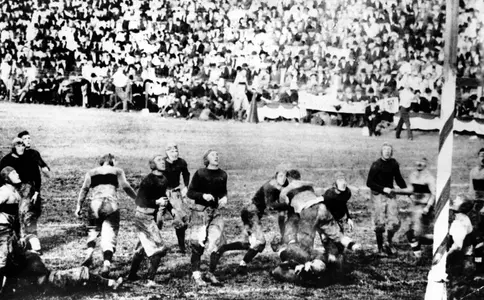
When the Fighting Irish of Notre Dame headed into Austin for a Thanksgiving Day game in 1913, football had suddenly caused quite a stir in the sleepy city on the banks of the Colorado River.
(First of a series)
EDITORS NOTE: Notre Dame and Texas currently rank second and third behind Michigan as the winningest teams in all of NCAA FBS history. And while the two have jockeyed back and forth in the chase to possibly eventually catch the Wolverines, the series between the two has leaned decidedly in favor of the folks from South Bend. Texas has won only two of the eleven games played, but that doesn't reflect the historical significance of the series -- where each game seemed to matter, and each featured unique moments, as well as unique stars.
Our stories begin just over one hundred years ago, when a young university down south in Texas was positioning itself to be a factor on the landscape of the game colleges up north had been playing since 1869.
Texas was only in its twenty-first season in 1913, but the powerhouse that had first emerged in 1893 had been "feeling its oats" for most of that time. Since a loss to Oklahoma early in 1912, UT had rolled through a dozen straight opponents -- not allowing more than a touchdown in four of its seven games in 1913, and shutting out the other three.
So when the Fighting Irish of Notre Dame headed into Austin for a Thanksgiving Day game at the end of the season, football had suddenly caused quite a stir in the sleepy city on the banks of the Colorado River. Texas had scored 243 points and allowed just 26, including a 77-0 shutout of Baylor, a 52-0 whitewashing of Southwestern and a 46-0 pounding of Kansas State.
Notre Dame had shocked the East with an historic 35-13 defeat of Army a month before the showdown in Austin. The upcoming game was called "the most important ever played in the state and the biggest in the south and west that year."
The stars were plentiful as well. In the early days of the forward pass, Notre Dame's Gus Dorais had established himself as a legitimate aerial star, as had Texas' Clyde Littlefield. Pete Edmond and Louis Jordan, two future World War I heroes who ranked as the greatest athletes in the early part of the 20th century, and stalwart "Pig" Dittmar anchored the Longhorn line. For the Irish, the team captain was the legendary Knute Rockne, who would go on to later become famous as the Notre Dame head coach.
But Texas' secret weapon -- and all you Olympics junkies will like this one -- was star running back Paul Simmons. Simmons had perfected a unique running style which included rushing to the line of scrimmage, and then doing an aerial somersault over the defenders.
Long before television replays, Simmons' reputation preceded him. So much so that Notre Dame Coach Jess Harper brought his 22-man team to Austin three days before the game on a special train car. As if preparing for battle, the Irish camped at St. Edwards University, which shared the same Catholic affiliation as Notre Dame. There, they got a briefing on Texas, and specifically Simmons.
In the Kansas A&M game -- which is now Kansas State -- three Longhorn players scored two touchdowns each, but the game's most spectacular play --according to the late historian Lou Maysel -- was one of Simmons' touchdowns.
Simmons was a fine runner and a slashing tackler, but he had another talent -- he was a gifted tumbler. So on one of his touchdown runs, Simmons came down to the final defender, who zeroed in for the tackle.

At that point, Simmons leaped up and did an acrobatic mid-air somersault, landing on the diving defender's back and running untouched for the touchdown. The Kansas A&M player tackled air. Numerous times in his career Simmons would use that play effectively. After being tipped off however, Notre Dame devised a way to stop him. They anticipated his leap, and had players stand and catch him in mid-flip. But in the spirit of good sportsmanship, the Irish were respectful to their hosts.
"They told Paul when we were lined up, friendly like, that if he tried it, they'd stop him," recalled teammate Alva Carlton. "But that didn't mean anything to Paul because he'd been told that before. He tried it on them and after a couple of their players stopped it good, Paul never tried it again."
Despite that, Simmons wound up with a respectable performance. But the Longhorns, despite trailing only 13-7 heading into the fourth quarter, were worn down at the end of a 30-7 Notre Dame win. Still, the game was a success of sorts. More than 7,000 fans had come out on a 75-degree Turkey Day at old Clark Field, and many more watched from nearby housetops. After paying what was then a "whopping" $4,000 guarantee, Texas cleared about $3,500.
That was enough to allow the young program to finish in the black financially -- finishing the season with total receipts of $19,030, against expenses of $16,731.
With little of the fanfare brought by the initial meeting, the once-beaten Irish returned to again end the season against a 6-2 Longhorn team two years later. The result was similar -- Notre Dame won easily, 36-7. But by then, the Longhorns were embarking on competition in the newly formed Southwest Conference. It would be almost 20 years before the two would meet again, this time in Texas' first sojourn to South Bend.