The University of Texas at Austin Athletics
Texas-Notre Dame Chronicles: Part Two -- Upset in South Bend
08.27.2016 | Football
An old Notre Damer returns home to defeat Notre Dame.
(Second of a series)
EDITOR'S NOTE: For the past few years, Texas and Notre Dame have jockeyed back and forth as the second and third winningest Division I college football programs in America. The series between the two teams began over 100 years ago, and while the meetings have been infrequent, they have been unique. None more so, however, than the Longhorns' first trip to South Bend in 1934. It came at a time when the country was coming out of a world war and was in the midst of the Great Depression. And it thrust Texas onto the national college football scene in a big way.
Clyde Littlefield had been a star athlete and a major part of Texas football for more than 20 years when he elected to step aside as head football coach following the 1933 season, and his choice left Texas with a decision to make. He had brought a degree of stability, was respected and genuinely liked. But Texas fans had begun grousing that he was "too nice" to get the job done in the toughening world of college football.
St. Edward's University, the little college just south of the Colorado River in Austin, had been the proving ground for Longhorn baseball, when Texas had looked to the south to find wildly successful head coach Billy Disch. Now, another opportunity seemed to come knocking.
Jack Chevigny was one of the great names in Notre Dame history. Chevigny had been a protégé of the late Knute Rockne. He had played for him -- in fact, in the "Win One For The Gipper" game, Chevigny is said to have scored an important touchdown and then exclaimed, "That's one for you, Gipp." Many thought that Chevigny, had Rockne not died in a plane crash, might have been the next coach for the Fighting Irish.
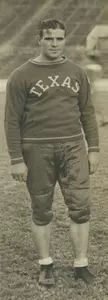
Instead, here he was, coaching in Austin, Texas, for a school whose priests came from the same Catholic order as Notre Dame. So with the Notre Dame job out of reach, Chevigny, with great looks and sleek black hair, moved a few miles north to the Texas campus for the 1934 season after Littlefield chose to step aside.
"Handsome Jack" brought a lot of flashy style and a lot of showmanship to the coaching job when he was hired. In the spring, he proclaimed on the occasion of his hiring, "I shall do my best to make the flag of Texas fly high among those of the schools in the nation."
Among the innovative things he would bring that first season of 1934 was the first network broadcast of a Southwest Conference game. A huge league battle between Texas and Rice in Houston prompted the Humble Oil Company to put together three clear channel radio stations -- KPRC in Houston, WOAI in San Antonio and WFAA in Dallas, effectively forming a state-wide broadcasting network.
He also inaugurated the Orange-White spring intra-squad game as part of the festive "Round Up" activities on campus, and drew 4,000 fans to the contest.
But Chevigny's greatest moment would come in the very first road game of his Texas career. By chance, the Longhorns were scheduled to play Notre Dame in their second game of the season. Chevigny's team had opened with a 12-6 victory over Texas Tech, and as the Longhorns prepared to head to South Bend, a pep rally drew over 6,000 students. Many were hopeful, but most realists thought that a more likely outcome would be something on the order of the 30-7 and 36-7 losses Texas had suffered at the hands of the Irish in Austin two decades before.
Chevigny delivered a masterful pre-game speech, recalling his time with Rockne, and speaking of his own father, who -- he said --was gravely ill. He had the team so emotional that one player actually tripped because of tears in his eyes when the team burst out of the locker room.
Notre Dame fumbled the opening kickoff, and Texas recovered at the Irish 18. Bohn Hilliard, the star running back for the Longhorns, would score the game's first touchdown on an eight-yard run. Hilliard kicked the extra point, and Texas was on its way to a stunning 7-6 victory.

Chevigny had pulled off the impossible. His team had handed Notre Dame its first-ever opening game home loss. And, after the game, the young Longhorns coach would be seen visiting with his father, who somehow miraculously recovered from his "illness" in time to attend the game.
The victory earned Texas a new level of respect in college football and in its own hometown. When the train carrying the team pulled into Austin at 7 a.m. the next Tuesday, a huge crowd, including Gov. James V. Allred, was there to greet them.
The Longhorns went on to carve a 7-2-1 record that season, but Chevigny's bright light would dim too soon. Over the next two years, the Longhorns would post back-to-back losing seasons of 4-6 and 2-6-1, and by the end of 1936, the coaching tenure at Texas of the showman Jack Chevigny had ended.
In a time when the country was mired in the Great Depression, Chevigny gave the University, and the state, something to be proud of; a milestone of history that has never been forgotten. And then, he was gone. But while he left football and entered the oil business, his unique story continued to weave its way into Longhorn lore.
The Longhorn players were so impressed with their victory over the Fighting Irish that they gave their coach a gold pen and pencil set engraved "To Jack Chevigny, an old Notre Damer who beat Notre Dame."
Sadly, when World War II broke out, Chevigny entered the Marines, and was killed in the Battle of Iwo Jima in 1945.
That much, we know as fact. A former UT official remembered borrowing the pen from Chevigny many times. So such a pen apparently did exist. Here is where the story becomes strange. Thousands of miles away, and at least eleven years later, a popular national radio commentator named Bill Stern told this story on his weekly broadcast.
According to Stern, when Japan surrendered in September of 1945, officers of the United States and Japan gathered on the Battleship Missouri to sign the papers to end the war. One of the American officers noticed a Japanese officer signing with a shiny gold fountain pen that appeared to have some English writing on it. The officer asked to see the pen, and he read the inscription: "To Jack Chevigny…."
Stern's version of the story concluded with the US officer putting the pen in his pocket, and eventually returning it to a member of Chevigny's family.
Years later, researchers and writers attempted to verify the story. By then, of course, all the parties involved were gone. They could find no relative who knew anything about the pen. But truth or fiction, the case can be made for vetting the story, and either corroborating or debunking it.
Most of the Japanese soldiers died on Iwo Jima, so the pen's alleged odyssey remains a mystery. On the other hand, how would Stern, even though he was known to embellish things a bit, come up with an off-the-wall story like that?
What we do know is that on a September day in 1934, a handsome young man named Jack Chevigny led his Texas team to its signature victory of the first fifty years of Longhorns football.
And you can write that down.