The University of Texas at Austin Athletics
10.02.2020 | Football
Retired Army colonel to be honored when Texas Football hosts TCU.
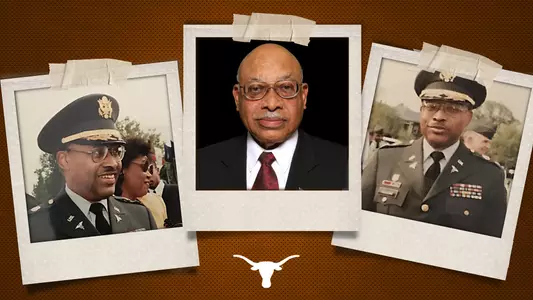
 Listening and leading go hand in hand. Learning makes it a threefold cord and thus the charac-ter thread that connects Leon Holland's growth from a chemistry teacher's son to a retired Ar-my colonel.
His curiosity to know, the family encouragement he received to find out and the desire to con-sider the needs of others inspired Holland to run for student council, become a Boy Scout and eventually graduate from The University of Texas as the first Black student to receive an ROTC commission.
In addition to teaching high school, Holland's father was also a World War II veteran, and so Holland's call to service was a "given."
"You just knew you were going to serve your country," Holland said. "And I wanted to serve as a commissioned officer."
Holland was among the first cohort of Black undergraduate students at UT Austin in the fall of 1956. Although family tradition initially compelled Holland to consider Wilberforce University in Ohio, he was persuaded to attend UT Austin because of the in-state tuition and its proximity to his hometown.
Growing up in culturally diverse San Antonio, Holland intermingled with white neighbors, His-panic playmates and Chinese owners of the neighborhood grocery store. Even though his school-ing was segregated, Holland said he did not encounter overt racism or encounter threatening racial adversity.
Upon enrolling as a first-year university student, Holland was expecting something similar to the inclusive and understanding environment in which he was raised, but the campus climate he experienced was something altogether different.
"That was a shock to the system," Holland said.
 Harsh language, exclusionary behavior and systemic structural barriers defined Holland's un-dergraduate experience, but he did not withdraw into sorrow. Instead, he activated his caring mindset and grew as a pioneer and activist. He peacefully marched and demonstrated to raise awareness of sustained inequalities and demand accessibility to basic structures of support.
For instance, some classes assigned work that required students to watch and review movies that were only available at the Varsity Theatre near campus, which unfortunately did not wel-come Black patrons at the time.
"It was the principle of the matter," Holland said when describing his motivation to participate in social movements and protest.
Holland said he did find a sense of belonging among his ROTC classmates and instructors. Hol-land graduated in 1961 with a degree in secondary education and a teaching certificate. He re-ported for duty three months later, and he advanced to the rank of colonel before he retired in 1991.
"No matter where you go, you are never a stranger among military folks," Holland said. "We respect each other. Of course you have to recognize differences, but when you see beyond that, into the needs of every individual, it's basically the same."
Communication fundamentals defined Holland's advancement in the Army. He describes him-self as a "situational" leader who assessed the needs of individuals and what was required of each person to contribute to group success.
"I care for people," Holland said. "I always knew that I was there for them. They weren't there for me."
The same mindset applied among civilians could also advance communities and society as a whole toward a more inclusive and just environment.
"If people reached out to each other and got to know each other, they can get over the differ-ences," Holland said. "You realize a person's inner being is more important."
Thanks to the Texas Lottery, great things are happening all across Texas. Every year, more than $1 billion of lottery revenue goes to good causes like public education and veterans' assistance programs.
Beginning with the first veterans' dedicated scratch ticket game in 2009, the Texas Lottery has now contributed over $142 million to the Fund for Veterans' Assistance, with this past year be-ing the Texas Lottery's largest contribution to-date.
Since 1992, the Texas Lottery has generated more than $31 billion in revenue for the state of Texas. Through strict adherence to their vision, mission and core values, the Texas Lottery is dedicated to ensuring that this support continues.