The University of Texas at Austin Athletics
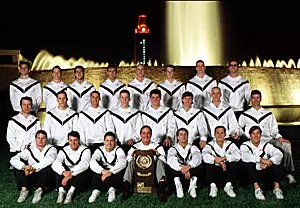
National Championship moments: 1989 Men's Swimming and Diving
12.18.2006 | Men's Swimming and Diving
From the moment it climbed out of the pool as the NCAA Champion the year before, The University of Texas men's swimming and diving team was tabbed by nearly everyone as the favorite to repeat in 1989. The Longhorns did not disappoint.
Texas performed according to expectations throughout the season and held the No. 1 ranking all year. When the teams returned to Indianapolis for the 1989 meet, predictions were that the Longhorns would win handily.
Texas was loaded, paced by a trio of Olympians: Shaun Jordan, Doug Gjertsen and Kirk Stackle.
Even UT head coach Eddie Reese -- always the cautious one -- admitted the day before the start of the meet: "On paper, you would have to go with us as the favorite."
But Reese quickly added, "But the meet takes place in the water, not on paper. You still have to go out there and perform well. There are always a handful of teams who can win it. Anything can happen."
What did happen was exactly what the predictions said, as the Longhorns won their second straight NCAA title and their third in the 1980s -- all under Reese. Jordan, Gjertsen and Stackle showed the talent that earned them berths on the 1988 U.S. Olympic team, and their teammates proved that they deserved their advance billing.
The tone for the meet was set early. With Gjertsen on the anchor leg, Texas opened the meet with a victory in the 200-yard freestyle relay. The Longhorns went on to build a 31-point lead after the first day, extended the margin to 70 points after the second day and finished with a winning total of 475 points -- 79 points ahead of runner-up Stanford.
Jordan continued to solidify his standing as one of the world's top freestyle sprinters. He ranked fifth for high-point honors at Indianapolis with 50 points, as he won the 100-yard freestyle, finished second in the 50-yard freestyle, sixth in the 200-yard freestyle and swam on three winning relay teams. Three weeks earlier, Jordan had won high-point honors at the Southwest Conference Championship, where he set meet records in the 50-, 100-, and 200-yard freestyles.
Gjertsen was the ultimate team man in Indianapolis as he swam in 13 races in the three days. He scored in three individual events: third in the 200-yard freestyle, which he won in 1988, third in the 200-yard individual medley relay and 15th in the 200-yard backstroke. He was spectacular in the relay events, anchoring Texas to four victories, including three with dramatic come-from-behind sprints.
Stackle spent the week showing why he was considered one of the world's top breaststrokers at the time. He reversed his finishes of the prior season, winning the 200-yard breaststroke, where he had been runner-up in 1988, and finishing second in the 100-yard breaststroke, which he won the year before.
"This was an especially tough year for those guys," Reese said in regards to his Olympians after the meet. "That post-Olympic year can be real, real tough both physically and mentally. But all three of those guys swam really well. It was a great team effort."
While Jordan, Gjertsen and Stackle were the headliners, the Texas victory was very much a team effort. Fifteen Longhorns scored in individual events, and UT scored in 19 of the 21 events. Texas was shut out only in the 200-yard butterfly and the three-meter springboard.
As was the case in the 1988 victory, relays were a key for the Longhorns. Texas won all three of the relays in '88, only the second time that had happened at the NCAAs. Two relays were added to the 1989 meet -- the 200-yard freestyle and 200-yard medley. While Reese questioned what effect the extra events might have on the meet as a whole, the Longhorns rolled up 192 points in the relays with victories in the 200-, 400- and 800-yard freestyle relays and 400-yard medley relay and a third-place showing in the 200-yard medley relay.
When his team won the NCAA title in 1988, Reese said they did it by outworking everyone else. At the start of the 1988-89 season, he warned the squad against resting on its laurels.
"This year's team will have to be sure they don't think they can win it on reputation," Reese said prior to the season.
Apparently, Reese never needed to worry about his team's attitude.
"We were completely focused on what we had to do," said Keith Anderson, who was fourth in the 100-yard butterfly and swam on two of the winning relays. "From the first day we got in the pool last fall and every day all year, we trained like we were No. 1 and we intended to stay that way."
Five UT freshmen -- Jason Rhodes, Ethan Saulnier, Matt Stahlman, Jeff Thibault and Alex Wittig -- scored at Indianapolis in their first National Championship.
Gjertsen enjoyed the way the freshmen were introduced to the NCAA meet.
"The three of us who were at the Olympics didn't get back into working out with the team until November, so we didn't get to know the freshmen for awhile," he said. "It was really sweet to be able to show them what it's like to win."
Reese paced his Longhorns through the 1988-89 season with the main goal of peaking for the NCAA Championships, but along the way Texas rang up several impressive victories, including dual meet wins over South Carolina, Florida, Texas A&M, SMU and TCU, a triumph at the prestigious Dallas Morning News Classic and a 10th-consecutive Southwest Conference (SWC) title.
The 1989 National Championship capped off a decade that established the Longhorns as one of the elite swimming and diving programs in the nation. The Longhorns captured three National Championships during the 1980s (1981, '88 and '89), in addition to three second-place showings and three third-place finishes. Texas athletes captured 17 individual national titles and 12 relay victories at the NCAA Championships during the decade and won all 10 SWC titles.