The University of Texas at Austin Athletics
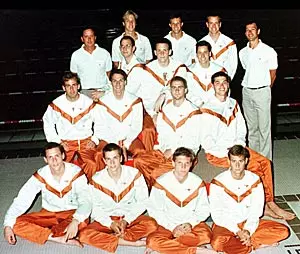
National Championship moments: 1990 Men's Swimming and Diving
05.14.2007 | Men's Swimming and Diving
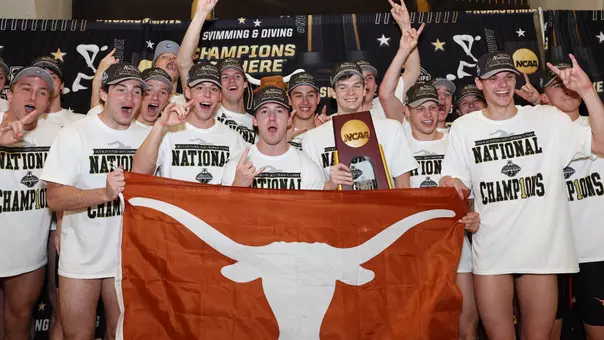
It was March 25, 1990 and Texas swimming coach Eddie Reese was addressing an Erwin Center crowd that gathered to salute three Texas teams. The men's and women's basketball teams had just bowed out of the NCAA playoffs after reaching the Elite Eight, and the Texas men's swimming and diving team had won its third straight NCAA Championship the night before in Indianapolis.
After introducing his team, Reese very calmly said, "This very probably is the best college swimming team there has ever been."
It was a pretty strong statement, especially coming from a coach known for his cautious words. It made even the marginal UT swimming fan sit up and take a notice.
Later, Reese admitted that he might have been caught up in the ceremonies, but he stood by what he said. "It might have been a little bit of that (the excitement of the moment), but it's easy to make a case," Reese later said. "We set a scoring record at the NCAA Championships (506 points). We won by a margin of about 70 points (actually 83). We set American records in the two relays and came close in another. We scored in 20 events and had 15 different people score. It was just a tremendous effort."
The title solidified Texas' standing as the dominant college program in the sport. The Longhorns were the team of the 1980s in college swimming with three national championships, three runner-up showings and three third-place finishes.
The 1990 victory was made more impressive because the result was supposed to be close. Stanford and Southern Cal were expected to take the Longhorns down to the wire.
"On paper, it looks like it's going to be as close a meet as we've had in the last ten years," Stanford Coach Skip Kenney said the day before the competition began.
"Going in, I really thought we could lose this year," Reese said, "but we got such great performances. This was probably the best one (NCAA meet) we've had. Had we swum like we did last year, we would have been a second-place team. Last year, we were coming off an Olympic year and we didn't taper right. We still won but weren't at our best. But this was a great, true team performance."
The 1990 Longhorns were a collection of established superstars Doug Gjertsen, Kirk Stackle, and Shaun Jordan, rising stars Jeff Thibault and Ethan Saulnier, plus several others who were dependable scorers.
Seniors Gjertsen and Stackle, 1988 Olympians and former NCAA champions, concluded their college career in fitting style. Gjertsen won his third individual NCAA title by taking the 200-yard freestyle in 1:33.15. He had won the 200 backstroke as a freshman and the 200 freestyle as a sophomore. He also anchored Texas to victories in three relays: American records in the 400 medley relay (3:09.70) and the 800 medley relay (6:21.39) and a win in the 400 freestyle relay. It brought his career total of NCAA victories to 12 -- three individual and nine relays.
Stackle also recorded his third individual NCAA title with a win in the 100 breaststroke. He had won the 200 breaststroke as a sophomore and the 100 breaststroke in 1989. Stackle also swam on that American-record setting 400 medley relay team to bring his career NCAA victory count to five.
Stackle's best performance came in the 200 breaststroke, where he was runner-up for the second straight year. This time, his 1:54.81 bettered the American-record of 1:55.01, but was second to Michigan's Mike Barrowman, who clocked a 1:53.77 for the new record.
"I was upset at first because I had looked at my time and knew I had broken the record," Stackle said. "But, at least I'm getting closer to Barrowman. Next year will be very interesting."
Jordan, a junior and another 1988 Olympian, was hoping to add another victory to his 100 freestyle title at the 1989 NCAAs. He was unable to score a win, but he posted three strong second places: in the 50 freestyle (19.66), the 100 freestyle (42.84), and the 100 butterfly (47.58). He also swam on four winning relays: the American record-setting 400 medley and the 800 freestyle, plus the 200 freestyle and the 400 freestyle.
Sophomores Thibault and Saulnier showed why the Longhorns should be optimistic about the future. Thibault made the championship final in both backstroke events, taking second in the 100 and eighth in the 200. Saulnier placed ninth in the 500 freestyle and helped put UT into a commanding lead on the last night with his fourth-place finish in the 1650 freestyle
The Longhorns gave notice when they concluded the first night of the meet with an American-record 3:09.70 in the 400 medley relay with the foursome of Thibault, Stackle Jordan and Gjertsen. That gave Texas a first-day lead with 163 points, followed by Southern Cal's 146 and a distant Michigan with 107.5.
The second day was even better. The Longhorns continued to score consistently and took a big lead after the 1-2 finish by Stackle and Hans Dersch in the 100 breaststroke. Texas ended the second day with another American record, as Jordan, Adam Werth, Matt Stahlman and Gjertsen recorded clocked in at 6:21.39 in the 800 freestyle relay, giving UT 360 points and a comfortable 49-point lead entering the final day.
Texas had the meet in hand after the trials on the last day when the Horns qualified five swimmers for that evening's championship finals. "At that point, we knew we would have to screw up pretty badly not to win," Jordan said.
If there was any doubt left, it was wiped out after the first event of the final evening session -- the 1,650 freestyle -- where Saulnier placed fourth in 14:53.85 and Andre duPlessis took seventh in 15:02.05. With the meet all but clinched, the Longhorns did not coast, but rather poured it on and after winning the finale event -- the 400 freestyle relay -- UT had an 83 point victory, compiling a meet-record 506 points. Southern Cal was runner-up at 423 and Stanford finished with 354 points.