The University of Texas at Austin Athletics

Longhorn Hall of Honor: Kris Kubik
11.19.2011 | Men's Swimming and Diving
Nov. 19, 2011

Travis Feldhaus, Texas Media Relations
Kris Kubik gathered his team in a hallway just off of the pool deck at Ohio State's McCorkle Aquatic Pavilion and asked his swimmers to take a seat on the floor.
The Longhorns had just overcome a bout with an obstacle that loomed even larger than their formidable opponents in the water at the 2010 NCAA Championships. A crippling stomach virus sapped the energy out of several Longhorns a mere two days in advance of the national meet and even took its toll on head coach Eddie Reese.
But, as Texas had done nine times before, it was about to become the NCAA champion, anyway. With only one event remaining in the meet, all the Horns needed was to complete the 400-yard freestyle relay without a disqualification and they would be crowned the national champions.
Kubik, in his unofficial roles as the team's organizer, father-figure, shoulder-to-lean-on and sounding board, sat down the Longhorns who were not warming down for that final 400 freestyle relay and began a discussion heard nine times before. It was time to explain how Texas celebrates a national championship.
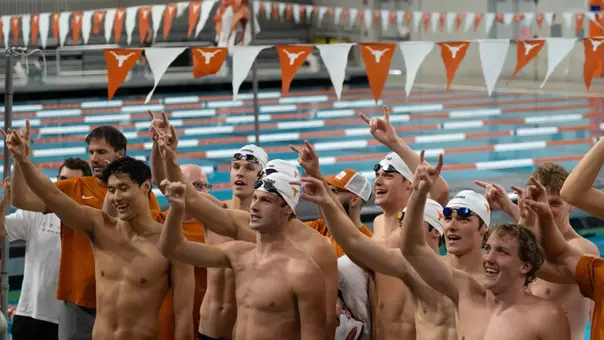
"You are going to step in off of the starting blocks, pop up out of the water, congratulate each other and put your Horns up," Kubik said. "And then, we're going to sing 'The Eyes of Texas' with our family and friends while we're in the water. I've seen teams do this the wrong way. We're going to do this the right way."
Texas successfully completed the 400 freestyle relay and sealed its 10th national championship with an even 500 points for the meet. The Horns took possession of the championship trophy and then placed it aside for the customary celebration in the pool.
The Horns hopped in the pool, and the celebration was on. Kubik, who lamented earlier that week that the stomach bug could wipe out the Horns' shot at the national title, was relieved. So, maybe for the first time in his 25 years at Texas, he passed on his own understated way of celebrating.
"Oh, you know how Kris is; he always likes to steal the spotlight," said former Longhorn Ricky Berens, his voice dripping with sarcasm. "Then, he goes and does his flip into the water."
Indeed, he did. Kubik had some fun with his entry into the water, but one thing remained a constant: the athletes went first. Nothing has changed.
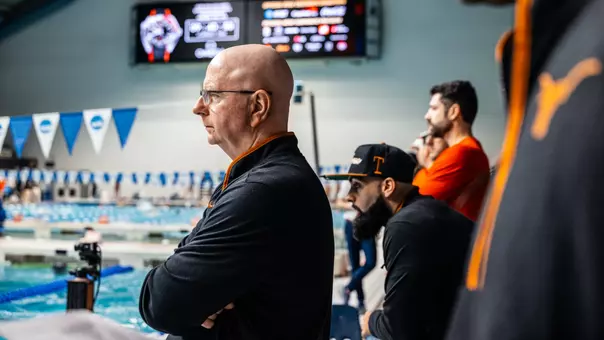
The tall, slender man who has walked hundreds of miles along the pool deck at UT's mammoth Lee and Joe Jamail Texas Swimming Center is a soul whom you owe yourself the opportunity to encounter. His pupils will tell you he has as many good stories as gray hairs in his head - quite a few, to be sure. All kidding aside and in fairness to this native Tennessean, his wisdom preceded his hair color literally decades ago. A man ahead of his time? He outran time in a footrace long ago, and then he paid it a compliment. That's Kris.
The tangible accomplishments were the driving force behind Kris Kubik's induction into the University of Texas Men's Athletics Hall of Honor. He has joined Eddie Reese to win 10 NCAA titles and mentor countless Olympians and NCAA individual champions, in addition to swimmers at all levels. It took Kubik all of 29 years to earn his spot alongside many of Texas' premier student-athletes, coaches and administrators for excellence in collegiate athletics. If an additional Hall of Honor was established to recognize influential leaders who impart lifelong lessons and look out for the betterment of the student-athletes, look no further than Kubik as the first inductee, sport-wide.
"Kris is being inducted into the Hall of Honor for his great contributions to The University of Texas and to the UT men's swimming team," Texas head men's swimming and diving coach Eddie Reese said. "But, he needs to be in there for what he does for the individuals, as people. Most of the athletes come here, swim for four years and move on to face the rest of their lives. Kris has helped them with all aspects of that, while they are in school and when they're out."
To suggest Kris Kubik has a knack for creating perspective is to say Kevin Durant was a prolific scorer as a Texas basketball player, or Earl Campbell was adept at running over would-be tacklers, or Greg Swindell was a heck of a pitcher in his day at Texas. Just stating the obvious, in other words. There was never an NBA, NFL or Major League Baseball draft for Kubik to enter to reach the next level. The next level was his, and still is. But, just as those former Longhorns greats had their skill-set, so does Kubik. The art of perspective is as valuable to he and his swimmers as the promise of getting faster in the pool.
"I remember I was in the Olympics one time, getting ready for the finals of the 100 breaststroke," said former Longhorn and Olympic gold medalist Brendan Hansen. "Kris gave me a picture of myself he found somewhere, where I'm flexing my muscles. I was probably seven years old. He gave it to me, and underneath it, it said, `This kid has always dreamed of winning a gold medal!' You get so wrapped up in a pressure-packed situation, and a moment like that brings it all back into perspective. He puts swimming at the ground level and puts life first. His point was, `You're still that little kid. Just go have fun and enjoy yourself.'"
For Kubik, perspective goes hand-in-hand with compassion. To him, he and the athlete are in every battle together, whether it's figuring out what's next in life after swimming, or the very next event at a swim meet. The irony for the swimmers at Texas is they will never know what it's like to be on an island even though they are surrounded by nothing but water most of the time. The swimmer can take on that challenge and take Kubik into the fight with him.
"In 2004, I missed making the U.S. Olympic team by one spot, and I was so devastated," said Texas-Ex and Olympic gold medalist Garrett Weber-Gale. "I didn't know what to do. I was bawling my eyes out, and it was the biggest disappointment to me. Kris talked to me afterward, and he was the perfect guy with words. The scoreboard was still showing the results from the 100 free finals. He said, `Remember this feeling right now and promise yourself you won't let yourself have this pain and disappointment ever again.' He helped me get through that a lot. Over the next four years, people like Kris and Eddie Reese were so positive."
It was no wonder that when Weber-Gale won the 50m freestyle at the 2008 U.S. Olympics Trials, it took him less time to hop out of the pool, chase down and hug Kubik than the time it took him to finish the race.
"When I won that race, it meant everything to see Kris and Eddie afterward," Weber-Gale added. "Sometimes people don't understand the coach-and-athlete relationship. Those guys know more about me than most people ever will. Seeing them there at that time was a big moment. And, the moment I had in 2004 fueled me to have the success I had in 2008."
Kubik is your coach, but he is also your friend. He takes the latter as seriously as the former. The coach in Kubik is happy for the swimmer who reaches his goals. Kubik, the person - all coaching aside - is more fulfilled by the swimmer finding what he is looking for when his time in the sport is over.
"When I finished up my competitive career, Kris would come to lunch with me and talk a little about my ideas of what I wanted to do in my post-swimming life," said Texas-Ex and Olympic gold medalist Ian Crocker. "He has always been so supportive. Ultimately, he became one of the groomsmen in my wedding. That says a lot about the relationship he has made with me. He has those kinds of relationships with the hundreds of other swimmers who have come through here."
And that friendship doesn't require allegiance shaded in burnt orange. His friends come in many colors: the red and black of Georgia; the blue and red of Arizona and the Cardinal and white of Stanford, among many, many others. You may go against him on the recruiting trail, but on the pool deck, he is the friend with whom you want to catch up.
"I love being on the pool deck with Kris," said University of Georgia head men's and women's swimming and diving coach Jack Bauerle. "He's a lot of fun and has a great sense of humor. The drudgery of our sport can knock you down, so you have to carry a sense of humor with you day in and day out, mornings and afternoons. It's nice to have someone like Kris around. Simply put, I never walk away from Kris without feeling a little bit better.
"With all of the success he has enjoyed at Texas, he still is no different than when I met him 27 or 28 years ago," Bauerle added. "He might brag on some of his athletes, but it is never about what he does or what the program does under his watch. If you're a parent, you would like your kids to be around him."
The year or two preceding an Olympic Games often sees professional swimmers changing their training environments in search for a fresh start on their final push toward the U.S. Olympic Trials. Former Auburn swimmer Eric Shanteau made such a move to Austin to begin training with Kubik and Reese. In the months leading up to the 2008 Olympic Trials, Shanteau was part of a breaststroke training group that featured Hansen and Scott Spann, Jr., the son of former Texas swimmer Scott Spann, Sr.
In the spring of 2008, just before the biggest meet of his life, Shanteau received unwelcome news from a physician.
"I'll never forget the meeting I had that day," Shanteau recalled. "I was diagnosed with testicular cancer at 11:30 a.m., and I saw Kris and Eddie that day at 1 in the afternoon. It was one of the first times I said out loud that I had cancer."
Naturally, Kubik assumed his role as a caretaker and set the wheels in motion to change things for the better.
"Kris gets on the phone and calls (former Texas swimmer and Olympian) Bill Stapleton, who is Lance Armstrong's business manager," Shanteau said. "Bill then calls Doug Ulman, the president and CEO of Livestrong, and it really just snowballed from there. Kris was the initial guy who started everything with me and Livestrong. They were responsible for putting together a great army of doctors and a great support system for me. Kris was the one who got all of that rolling."
Shanteau faced two daunting challenges ahead of him: beating cancer and making the U.S. Olympic team. The latter task came first. His doctors cleared him to compete at the U.S. Olympic Trials, where he made the U.S. Olympic team in the 200m breaststroke. He competed at the 2008 Beijing Olympics, underwent cancer treatment afterward and later was pronounced cancer-free.
"It really could not have been any better of a situation for me, for Kris to be able to support me through the Olympics and then with my treatment. Kris was the catalyst that started everything in terms of me beating cancer."
Shanteau and his fiancee, former Auburn swimmer Jeri Moss made the decision to have their wedding ceremony in Jeri's native southern California. Then came the decision of who would officiate the ceremony. A mutual acquaintance who was special to the bride and the groom seemed to be a fair choice. It soon became apparent that the choice was an easy one.
"Jeri and I thought about who we wanted to have marry us, and after giving it a lot of thought, we wanted someone who knew us both very well, someone who knew our lives and what we did together. I remember leaving Kris' office after I told him about my cancer. He called Jeri and said, `Hi, I'm Kris. I'm Eric's coach. You don't know me very well, but you could probably use a friend.' Three years later, when it came time to get married, in terms of one person knowing both of us really well, I think Kris filled that position as best as anyone. We're so glad he did that for us."
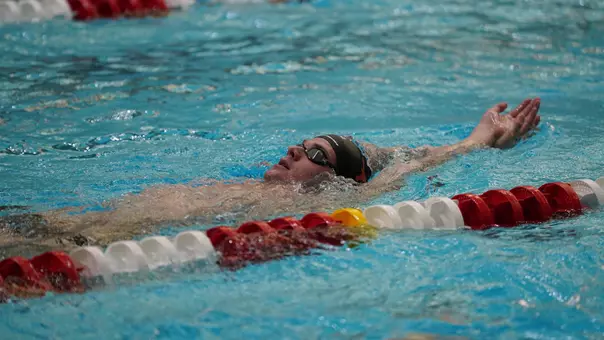
Kubik has a history of producing elite backstroke swimmers, and in the last decade, no one owned the backstroke more so than Texas-Ex Aaron Peirsol, who made his first Olympics appearance as a teenager before enrolling at UT in 2002. Peirsol continued to develop under the tutelage of Reese and Kubik upon his arrival at Texas, and he ultimately won gold medals in the 100m and 200m backstroke events at the 2004 Athens Olympics.
Peirsol won gold in the 100m backstroke at the 2008 Beijing Olympics and took the silver medal in the 200m backstroke. Disappointed in the outcome of the race, Peirsol took solace in words from Kubik.
"I had just won silver in the 200 back, and it was a very good race," Peirsol said. "I thought I was capable of winning the gold, and when I didn't, I felt like I had just missed it. In a nutshell, he told me that if that were the worst thing to happen to me that year, that everything was going to be just fine. It was just a very powerful moment, very important to me in my career."
The high regard in which Kubik is held in the swimming community enabled him to be a part of U.S. coaching staffs at the 2008 Beijing Olympics and the 2009 FINA World Championships in Rome, Italy. And, he could have parlayed his many connections into a head-coaching position virtually anywhere he wanted in college swimming.
"Every time one of those jobs have come up, I told Kris, `If you want it, I will try to get it for you'," Reese said. "He knew I didn't want him to go. He loves Austin, loves the job, loves working at The University of Texas. He made so many friends early in his career here that he didn't want to leave. I would love to hear why he never left."
The answer, simply, is that for Kubik, leaving Texas would have rung hollow, no matter what any new opportunity presented.
"I have had opportunities to leave, and I said, `No, thank you, but I appreciate the phone call'," Kubik said. "It sounds cliché, but there truly is no place like Texas. There's no place like Texas because of the people who are here, the people I work with every single day, the students I work with every single day. The area in which I live is beautiful and healthy. The support from this athletic department for swimming and diving is unparalleled in this country. I couldn't fathom being any place else and not always look back and say, `Why did I leave Texas?' This is where I've grown."
It is things like growth, making memories and imparting wisdom that have become hallmarks of the Texas swimming empire under Kubik and Reese. Observers may point to the 10 national championship banners hanging at the Texas Swimming Center and suggest that it is all about winning. Sometimes, it is about the moments that precede those images of victory that etch themselves into a mind forever. Winning isn't Kubik's favorite memory at Texas. He has won a lot, and he will win a lot more. Often times, moments offer a symbolic value that trump anything else.
"At the 2001 Big 12 Championships, we had a swimmer who was hoping to make the NCAA Championships in the mile (1,650 freestyle), which is on the last day of the meet," Kubik recalled. "He swam the mile, and he finished in a time that, in our mind, would not qualify for the (NCAA) meet. But, all of the guys really wanted him to make it. So, he decided to try it one more time.
"At the conclusion of the meet, after the Big 12 awards ceremony, we had the whole team on the pool deck, and he started swimming it again. About halfway through, we could tell by the time he was going that he was not going to make it (the NCAA meet). Eddie jumped in and stopped him.
"We were in the locker room," Kubik continued, his voice choking with emotion, "and our 35 guys sat there and spoke about how much Texas swimming meant to them. When Eddie and I were walking out to our cars afterward, I looked at him and said, `It doesn't matter what happens at the NCAA Championships. We just won.' And then we had one of the greatest NCAA Championship meets this team has ever had. That kind of sums up this experience at Texas for me."
The Kubik-Reese coaching tandem, arguably, is the most successful and impactful duo to affect any one sport at The University of Texas. Kubik and Reese complement each other with leadership styles that maximize the experience for the student-athlete. But, make no mistake, it is a relationship that yields benefits mutually, as well.
"He's just a good friend who looks out for me," Reese said. "He knows when I need to be sent home or when I need something special. He reads everybody like that, and he is real good at it. It has kept me going forever, and it keeps me looking forward to workouts. He makes sure I make the right decisions. It would have been a challenge without him, and fortunately, I never had to find that out."
"Eddie (Reese) couldn't live without him," Bauerle, the iconic Georgia coach, adds. "It's a symbiotic relationship that Eddie and Kris have. More than anything, Kris has a lot of expertise, a lot of insight into how people work."
"The best analogy I can think of," Hansen adds, "is that Eddie is the quarterback who can't win the game without his All-American offensive lineman. Kris won't get the attention because he doesn't have the ball in his hand. What makes Eddie `Eddie' is Kris, and Eddie will tell you that. And, just like a quarterback in a postgame interview, the first thing he'll say is, `I want to thank my offensive line.'"
"I don't know I've ever looked at what I do at The University of Texas as being a job," Kubik said. "I look at it as I get to go to work with a dear friend in Eddie, and we get to work and shape the lives of friends in our athletes. I have been completely blessed to have an opportunity to work with Eddie as long as I have. He is an absolute genius in life and a genius in coaching swimming."
It is a partnership Texas fans can and should be proud of, an association marked by class and accountability, all the way. No detail is left untouched.
"We work with our athletes to be really good human beings," Kubik said. "We remain a yes-sir, no-sir, please-and-thank-you group of people. We cross our hearts with our hands when they play the national anthem. We are very cognizant of the enormity of the role we play in trying to represent The University of Texas very well as a group. When we travel, all of our actions as a team are reflections of not only our team but the individuals, students, faculty, staff and alumni of The University of Texas."
Coaches can leave us too soon, and when they depart, their spirit lives on for generations. The University of Texas has the good fortune of celebrating the living, and people like Kris Kubik and Eddie Reese are going nowhere. They are the past, the present and a sizable part of the future because of the indelible legacy in place.
"This is a program I believe will continue to be strong for years and years to come," Kubik said. "It's neat to look back and see a guy like Jimmy Feigen, one of our seniors, who was taught how to be a Longhorn by a guy named Garrett Weber-Gale, who was sort of taught how to be a Longhorn by a guy named Ian Crocker. Ian was taught how to be a Longhorn by a guy named Neil Walker, who was taught by a guy named Josh Davis, who was taught by a guy named Shaun Jordan. And, Shaun was taught how to be a Longhorn by a guy named Chris Jacobs, who was taught by a guy named Kris Kirchner. All of that goes back to the fall of 1978 when Eddie and I got here to the present day.
"It's something where if you've never been here or been part of the atmosphere at Texas, then you might not understand it. But, if you're around it for a day or two, you would certainly get it and say, `I don't blame him a bit for staying where he is.'"
Stay as long as you like, Kris.