The University of Texas at Austin Athletics
Bill Little commentary: The odyssey of George Sauer
05.15.2013 | Football, Bill Little Commentary
May 15, 2013
Bill Little, Texas Media Relations
In the poem, "The Road Not Taken," the writer Robert Frost discusses the options faced by a traveler who comes to a crossroads in life and has to decide which direction to travel.
"Two roads diverged in a wood," wrote Frost. "And I--I took the one less traveled by, and that has made all the difference."
Welcome to the life story of George Sauer, Jr.
Sauer, who was 69 when he died last week after a long battle with Alzheimer's disease, was a poster child for Frost and his story of choices.
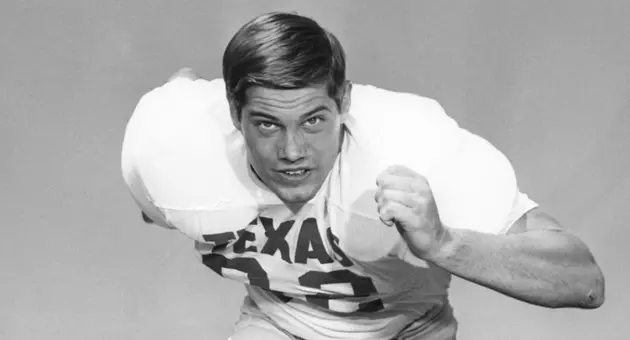
Born the son of a football coach, Sauer was a prototype wide receiver in the early 1960s in college football--at a time when they didn't have prototype receivers in college football. At 6-2 and 195 pounds, he chose to come to The University of Texas just as the Longhorns were flowering into full blossom in the early era of Darrell Royal's success.
The game of college football was evolving--at a perfect time, it seemed for George Sauer Jr. The days of players playing both offense and defense were ending, and Sauer's arrival at Texas with a talented freshman class seemed to indicate a new direction for the run-oriented Texas Longhorns. He was redshirted after his freshman season, sitting out the season of 1962. He was destined it seemed, to be a part of some amazing success at Texas.
Even so, Sauer had trouble cracking the lineup of the talent-laden Longhorns--a power-running winged-T team which admittedly distained the forward pass. Until, of course, they needed it. In his twilight years, Royal often looked back on his career and mused that despite a reputation for not throwing the football, some of his greatest victories came because of the forward pass.
|
|
Sauer first became a part of that scenario in the Cotton Bowl victory over Navy that capped the Longhorns' unbeaten National Championship season of 1963. While wingback Phil Harris caught two touchdown passes, Sauer had a 21-yard reception that set up the Longhorns' final score in a 28-6 win.
The next season, the NCAA relaxed its rules on substitutions, allowing platooning when the clock was stopped. That meant more playing time for Sauer, who was clearly more suited as an offensive player. His pass-catching skills were critical in the Longhorns' come-from-behind victory over Baylor, including catches of 10 and 25 yards on the final drive which helped preserve what would turn out to be a 10-1 season.
It would be an ironic matchup later that season, however, that would underscore his travels with destiny. A lone, one-point loss to Arkansas had knocked Texas from an unbeaten season and a trip to the Cotton Bowl, but the No. 5 ranked Longhorns were rewarded with a trip to the first-ever prime-time Orange Bowl game against No. 1 Alabama. That is where the entangling alliances got complicated.
Alabama was quarterbacked by all-American Joe Namath, who was in his senior year for Bear Bryant's Crimson Tide. Earning the quarterback start for Texas was a strong-armed, part-time defensive back named Jim Hudson. The `Horns leading receiver that season, with all of 13 catches, was junior tight end Pete Lammons. In that game in Miami, Texas won, 21-17, and Sauer electrified the crowd with a 69-yard TD pass reception from Hudson.
It was also a time of a dramatically changing landscape in professional football. In 1960, the American Football League had been formed as a fledgling competitor to the established National Football League. While the NFL had a strict policy that frowned upon drafting any college player with eligibility remaining, the AFL had no such standards.
Sauer had just completed his junior season (because of the redshirt year) at Texas, and seemed headed to be a part of a 1965 senior class that would feature defensive star Tommy Nobis. But Sauer's father, George Sauer, Sr., (a former coach at Baylor) was the personnel director for the New York Jets of the American Football League.
Against strong protests from Royal (which included banning of AFL scouts from the UT campus), the Jets drafted George Sauer, Jr., and he became the first Longhorn football player to leave early for professional football.
The irony, of course, in the road that Sauer took was that it would unite him on the Jets with Namath and Hudson. Soon to follow would be Lammons and defensive tackle John Elliott, as four former Longhorns became part of a glorious era for the Jets, teaming with Namath for fame on and off the field.
Sauer rode Namath's arm into history in Super Bowl III, when he had eight catches for 133 yards in the Jets' 16-7 win over the heavily favored Baltimore Colts of the NFL. Hudson also had a key interception in the game, which was a turning point in pro football as it showed that the AFL could compete with the older, more established NFL, just as the two leagues were on the eve of a merger which had been set for 1970.
By the end of the season of 1970, George Sauer Jr. had played six seasons with the Jets. He had been a four-time league all-star. He played in 84 games and had 309 catches (which still ranks ninth in Jet history) for almost 5,000 yards (ranks sixth) and nearly 30 touchdowns. He had more than 3,000 receiving yards from 1966-68 and had his best year in 1967 when he had an AFL-best 75 catches for 1,189 yards and six touchdowns.
Again at the divergence of two paths, Sauer walked away from the game. He was 27 years old and at the peak of his game.
To understand the man, it would be important to understand the times. The late 1960s had been a time of cultural change in America. There were riots, hippies, and a war in Vietnam. Whether George was caught up in that, we will never know. We do know that the son who had grown up in football all his life would later say that he was disillusioned with the structure that existed in the game. He left the big city and wrote novels and poetry, and became a textbook graphics specialist.
What is important to understand here is that it is not for us to judge whether George made wrong choices or right choices. It is simply our charge to recognize that he made his choices.
In his passing, yet another victim of an insidious disease at too young an age, we can salute what he did and respect who he was.
It is left to us to understand that in life, we may never know the lot which is ours or the lives we touch with what we choose to do. And it is that which defines the journey--on the road which we take.