The University of Texas at Austin Athletics
09.24.2014 | Football
Defensive coordinator/secondary coach Vance Bedford visited with the media.
Longhorns Gameweek | Texas-Kansas Game Preview | Tickets
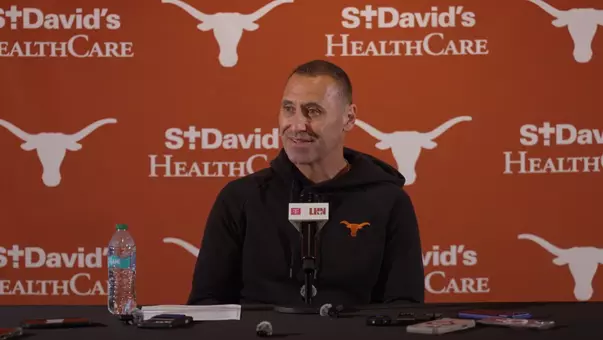
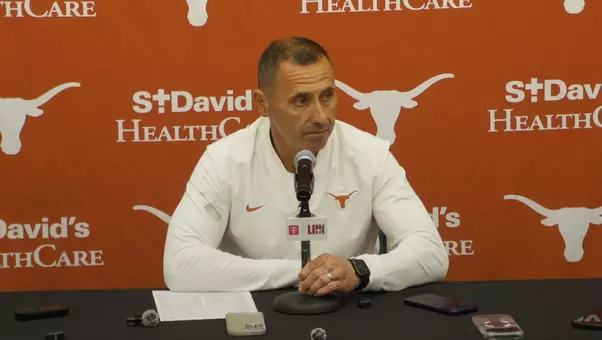
Defensive coordinator/secondary coach Vance Bedford met with the media Wednesday afternoon. Bedford talked about the off-week, the play of the defense and preparations for the Kansas game (3 p.m. Central, Saturday). Below are quotes from Bedford's availability.
On losing Desmond [Tank] Jackson to a foot injury: Tank is a big loss. Tank is our emotional leader on defense. He comes to practice and works hard every day. He plays with a lot of enthusiasm and that is contagious and we are going to miss that. We are going to miss that leadership and that's a big part of it. We have Hassan Ridgeway, who was backing up Malcom [Brown], now he has to go to nose [tackle]. As far as a physical presence, I think we'll be good there, but as far as enthusiasm, emotional leader, you can't replace him. Paul Boyette, a young man out of Humble, Texas, he's also playing in there. So we are going to rotate those two guys in there at nose guard and see what happens. There's no doubt in our mind as a defensive staff that those guys will do a great job for us.
On what they focused on during the bye week: Number one, get them healthy. That's the best thing about it. Sit back and evaluate where we are as a defense. Go back to fundamental drills. We had more individual time than we normally have just teaching how to get into a stance, how to get off of a block, work on getting in a football position, work on tackling; just the simple things of the game of football. Football 101 is what we went back to this past week.
On the need for senior leadership: You really do because the game starts there. If you have a solid foundation - which is your seniors – it's like if you build a house, you don't start with the roof, you start with the bottom, and that's our seniors. That's the core of this football team on offense, defense, and special teams. When they are playing well and leading the right way, there's a good chance you'll have success on the football field. Those guys can play better than what they are playing. Again I have to go back to, we are going to miss Tank. I think he is a big part of who we are and the direction we are trying to go to right now. Ced [Reed] has to take that role as being the emotional guy. He's a very quiet young man, a class act. He really is and has done a tremendous job in lot of ways. We need his emotional leadership at this time. Jordan Hicks is another guy who leads by example and he's started to take a vocal role on this football team. Steve Edmond is another young man who's a senior -- he's played a lot of football around here -- we need for him to grow up and step up as a leader emotionally. Those guys do a great job in practice and run to the ball on game day, but now we need them to lead some of the young guys on the football team.
On if freshman DE Derick Roberson has a chance to play this year: It's a long season, so it's hard to say at this time if he's a redshirt guy or if he's going to play. We just have to see how the season goes.
On if recruits are asking about discipline in the program: I hope they do because I tell them the truth. This is a place where we want to help you grow and develop and be successful not only on the football field but off the football field. When you leave The University of Texas, you are able to go out into the real world and deal with people because we want to prepare you for that. Part of our jobs, part of our responsibilities are to be able to do those type of things, to develop people to go out there and maybe be out there asking questions, maybe running for office, maybe it be a policeman, maybe it be a fireman. That's our responsibility to these people because right now there are issues all over this country, not only at The University of Texas. People think it's the only school in the country that has problems. Really? Let's go do some research. We just have a coach that is sitting back, trying to develop young people to be the best they can be and that's what our responsibility is to anyone out there who comes here. Are we going to have to discipline? Yes, just like you have at home, hopefully, you have that at home. That's what parents are looking for from a coaching staff, a university to help develop their sons and daughters to be the best they can be. So at the end of the day, when we go out and recruit, and we ask the hard questions to counselors, to teachers, to parents, we want to bring the right people here to The University of Texas. That's what we want to do, surround them with the right people. When you have a quality person and surround them with the wrong people, you hope that they can stand the test and do the right thing, but sometimes they don't. So part of our research is to do that.
I coached in the NFL for six years, and we spent a lot of money looking at first and second round picks from private investigations to FBI to find out who they are what they are doing and they still make mistakes. So when us college coaches across this country, we don't the money or time to spend like the NFL does, what do you think is going to happen?
On if other teams are using discipline as negative recruiting tool: I hope they do because I think it's a positive. Because if someone is using it as a negative against us, then you talk to parents and they go "really?" So it's ok to let your son do whatever he wants to do whenever he wants to do it, and they are going to say no. What's the difference? We want to make people do things the right way. When you talk about core values in somebody's home, you are going to tell your son or daughter to not be honest? You're going to tell you son or daughter it's okay to steal? You are going to say it's okay to use drugs? If you have a son, it's okay to hit a female? So that's okay if they are in your home? I don't think so. We are not doing anything different from what a parent is doing in their own home. What's wrong with that? I want someone out there to tell me what's wrong with that because something is obviously wrong with us being like parents because I'm getting that question. So what's wrong with that? Whose got a question about what's wrong with that if you have kids? Nobody said anything.
On if he understands that fans just want to see wins: There's no doubt about that. Guess what we as coaches want to see? We want to see wins too. In today's society, how much are you willing to sacrifice? I know the person in section 400 don't see things that way. They are going to say well for the last 16 years we had X-amount of wins and that's great and Coach [Mack] Brown did a tremendous job here. Right now, you have a new head coach and people are saying that he's trying to change the culture. I wish I knew exactly what that meant. At Louisville, we forced kids to do things the right way, they grew up, and they started graduating and to go out in the real world. It took time and I know at The University of Texas, time is not on our side. As coaches, you think we're patient and excited to sit here 1-2? Of course we aren't. As hard as these gentlemen work, that's why I'm after our fans. If you were allowed to come to practice and see how hard these guys work, we'd have 101,000 cheering on those guys regardless of what happens because those guys are working that hard. My hat is off to our young guys who go out there every single day when we have a day to work out because it's tough. It's tough.
On what the message to the team has been about Kansas since the perception among fans that they are the worst team in the Big 12: From my understanding, two years ago, The University of Texas went to Kansas and had some issues. Last year for three quarters, Kansas gave us the blues. So any time you play any opponent, it's not about them; it's about yourself. It's about you going out and being the best you can possibly be. When you start competing against yourself, now you start to take the right step. When you worry about Joe Blow across the street, you aren't ready to go. You need to go out and work as hard as you possibly can and make sure you do your job to the best of your ability and make sure your teammate does the best of their ability; now you're starting to come together as a team. Now winning takes care of itself.
On if he is satisfied with the play of Cedric Reed: The biggest thing with me is I think that the short time that you've been around me, and you've heard me speak -- I'm never satisfied with what they are doing. I think Malcom Brown, big Malcom, could give us even more. Has he played well? Yes. Could he play better? You're doggone right he can play a lot better. Can Ced Reed play a lot better? Yes he can. Can Quandre Diggs play a lot better? Yes he can. The expectation when you're at The University of Texas is to be special. Right now, we aren't there; we have a long way to go in every aspect of the things we do. That comes with hard work. That comes with us getting closer together as a family. That's what a football team is. When Quandre Diggs can say -- we had a meeting the other day -- and someone asked him, "Tell me about Dalton Santos' family." Do you know he can actually tell you about Dalton Santos' family? So that means as a coaching staff, as a team and as The University of Texas that means we are getting closer together. When your team becomes close, the wins will take care of themselves. Those are the details that sometimes the coaches don't want to talk about. Why? Because people could care less about that. That's what successful teams out there do. When they start having success, they start becoming closer together; they become families.
On how Dalton Santos' story came up: They've been together for a while, so they know each other, but in each one of the position rooms, going back to two-a-days camp, a lot of the coaches had some of the players get up and talk about who they are and where they came from. Some of the coaches did that too. I wish I had a story to tell, but I don't. But it's interesting to hear where some of these young men come from. Some of them come from great families. Some of them just come from a mom in a home or some type of dysfunctional family. But they get here. To get here makes them successful. It's hard to get to The University of Texas. It's hard to get a scholarship where it's all paid for. Being here on this football team, even if you're at Sam Houston State or Lamar or Stephen F. Austin, that individual is successful. Why? Because you're getting your education paid for. That's what it is all about. It's about getting yourself educated. So you can one day go out there, have a family, make a living for yourself and represent your mom, your dad, your grandma, your granddad -- that's who you're representing; your family name.
On if any young guys on defense have moved up in the depth chart: We've been playing Jason Hall a little bit each game and he played quite a bit against UCLA. Did he make some mistakes? Yes he did, but what I saw was a physical presence; that's what we are looking for, guys that can bring physicality to the game. Jermaine Roberts is a young corner. Now he's shows flashes in practice, that's what we are looking for. So we have some young guys in the secondary that might pop up. You asked about Derick Roberson, he's a young man that came in here at about probably 215 lbs., he's up to 235 he told me the other day. He's getting bigger, stronger and faster. We have some young defensive line on me because of the injury to Tank [Desmond Jackson], that right now, you might see them pop up in this game. And the biggest thing is this that I learned it from a guy named Lloyd Carr at the University of Michigan and from Bo Schembechler: When you're at The University of Texas, for each position, the expectation is for the position. The expectation is for the position. There has been a guy who is an All-American at that position who wore your number maybe in 1935, so it's not about you -- you're representing a person who wore that number. A player has worn that uniform; that's where the expectation is. And I love our fans, but for the alumni that played here at The University of Texas -- that's where the expectation lies. That's what these young guys today have to understand.
Today it's about look at me, let me get on Twitter right now and tell you what's going on. All that is great, but where is the substance? That's what it's all about, the substance of life. The development of us being able to teach the guys to go out there when they leave here to do the right thing. We are on our guys all the time about how they need to be careful about what they put on Twitter. Because for you out there right now, you have a job and Facebook and Twitter and if you put something negative on there, you'll be called into your office. That does not represent this company. We are trying to teach our young men the same thing. Don't put your life on there.
On who Kansas QB Montell Cozart reminds him of: This young man reminds me of [Jerrod] Heard, who is on our team right now. He's athletic and I bet you he runs a 4.5. He is quick and he has the capability [to run] -- we need to contain him. If he gets out on the perimeter and starts running around, he can present a problem to us. He's been contained for the first two ball games, but they do a great job of trying to protect him. We have to find a way to take that protection off. Our philosophy here is if it's a quarterback and we can get to him and hit him, we will do our very best to accommodate that quarterback.
On UCLA averaging 6.5 yards per carry in the second half: 6.5 a carry comes off what? One big play. The one big play was 60 yards. So after that, your stats are shot. If you take away that one play, it wouldn't be 6.3 yards -- it may be around 2.4. We miss Tack [Desmond Jackson], I really miss him. I can sit back here and I can make up all kinds of stuff, but you miss a guy like Tank in the middle. So all of a sudden, you have Hassan who has been playing a three technique now playing nose, so it's just a different look. But right now, if you're running at Hassan Ridgeway right now, I would run Hassan Ridgeway. One of these days Hassan is actually going to get mad. He is one the nicest young people I've ever been around. If he ever gets mad, I'm going to be the first person to leave the room because he will hurt somebody. My man could be a beast. I think he the ability to be a special talent, he's gotten better every single week. He is a guy that is growing, developing, he's learning how to play the football game and I think his future could be bright. Again, I'm talking about potential, not reality.
On if they're approaching this like defense has to win games: Every place I've been it's been that way. In the NFL it was that way, at Michigan it was that way, and at Louisville it was that way. Championships are won with defense; you don't win it by yourself. Just look at the Super Bowl over the last 30 years, what wins? Look at the teams that have won a National Championship in college over the last 10 years. What wins? People play defense. Now the offense wins a lot of games, don't get me wrong. I'm not throwing eggs at anybody. If you want to win a National Championship or a Super Bowl, you need to be able to play defense. You need to be able to get off the field, get takeaways, put our offense in the scoring position and let them go do their part. My father was a defensive coordinator for years and he was my coach, that was an experience in itself, but he always said this: as a defense, if you're on the sidelines, you can't screw it up. And that's my dad, a defensive coach. In other words, get off the football field.
On playing against the Big 12 offenses where it's common to give up 35 points: That means we are giving up 20 we need to score 21 in some form or fashion. That means if you've got to score on defense or if you have to block a punt, that's what it's all about. The name of the game is to have one point more than they do at the end of the game. If you do that, then you've done a good job. Twenty years ago if you held the opponent to 17 points or less, you win. That's changing the National Football League right now. Right now, if you can hold someone to around 24 points, you might have a chance to win. So the game has changed and defensive coaches need to make those adjustments. You are going to give them some yards, that's just the nature of the game. It's playing video football the way you spread from sideline to sideline, there is a lot of one-on-one tackles. I mean as stiff and as bad of an athlete I was my entire life, if you spread me out and let me go one-on-one, I think I could win that battle 50 percent of the time, which means that's a big play or a touchdown. That's where the game has gone too, spreading out and making a lot of one-on-one tackles. Offenses are that good, they really are.
On the progress the team has made: I think after the BYU game, as a team we sat down and we talked and said this is what we have to do. We all have to grow up, offense and defense and special teams. Defense, you go out on third down and you need to get takeaways. On offense, let's run the ball and shorten the game for the defense. Special teams, let's get the ball punted and kicked off. Let's get them backed off so our defense can go out and keep them backed up so the offense can get a shorter field. Those are the things we talked about. It's a team effort. It really is. Special teams needs to do their part, offense needs to do their part and defense needs to do their part. It's a third and a third and a third equals a whole; that's what it all comes down to. If we can get that done as a team, good things can happen for us. That's what it's all about; it's about team unity. That's one thing Coach Strong has stressed since he's been here and every place he has been at as a coordinator or as a head coach. It's about the team. If you understand that, then good things can happen for you. Because we don't have superstars around here; you are going all going work hard and are all going to be treated the same. Whether you're a walk on or whether you are the next whatever, they know that when they come around me I talk to them all the same. I like them all the same and I get mad at them all the same. They understand that.