The University of Texas at Austin Athletics
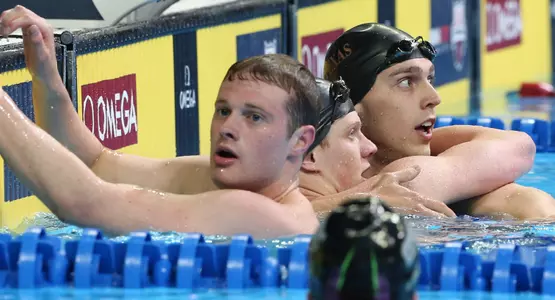
Long live the 200 freestyle
06.29.2016 | Men's Swimming and Diving
The 2015-16 Texas Longhorns have ensured that UT’s tradition of excellence in the 200 freestyle is going nowhere.
OMAHA, Neb. – Eddie Reese's dry humor. Friday night dinners. "Texas Tough." The Hook 'em Horns sign after every swim. The Eyes of Texas at the conclusion of a meet.
And, the 200 freestyle.
All of the above are givens with the Texas Swimming program. And none of the above appear to be going anywhere.
Reese and his associate head coach Kris Kubik rang in the 2016 U.S. Olympic Swimming Trials like they brought in the current millennium. The year 2000 was the last time they sent four men to the 200 freestyle finals at Trials. They headed to Omaha having sent at least one Longhorn to represent the United States in the 4x200m freestyle relay at seven straight Olympic Games.
The ensuing question was not whether the streak would stretch to eight Olympic Games; it was how many Texas guys would wind up on the relay.
The first three swimmers on the Longhorns' 800 freestyle relay at the NCAA Championships showed up for Tuesday's 200 freestyle final in Omaha. The only thing keeping the anchor from that relay out of the final was his nationality. Joseph Schooling is from Singapore and can't swim at the U.S. Trials. No matter. He's already on his way to Rio.
Texas rolled into Atlanta three months ago and blew the doors off the NCAA record in that relay at the NCAA Championships. The leadoff was do-it-all junior Jack Conger, who approaches his senior year with all the subtlety of a freight train. Business has been good.
The second leg was Townley Haas, a lanky Longhorn from Virginia who can't seem to slow down once he gets revved up. Haas dropped an extremely rare 1:30 split on the relay and then a never-been-done 1:30 in the 200 freestyle two nights later that imploded the American record held by two-time Olympian and former Longhorn Ricky Berens, who long ago took the record from another Longhorn, Dave Walters.
The relay's third leg was Clark Smith, a 6-9 Colorodoan with a seven-foot wingspan and former NCAA champion swimmers as parents. You sat there at the home pool of the 1996 Olympic swimming competition and figured something was going down in the 2016 Olympic swimming competition.
You can't do anything at the 2016 Olympics without going through the 2016 U.S. Trials first. Haas turned a head or two earlier this month when he edged Michael Phelps in the 200 free at the Longhorn Aquatics Elite Invite. The rest of the big boys – the likes of Olympic gold medalists Ryan Lochte, Conor Dwyer and Tyler Clary – waited for him in Tuesday's final before a national TV audience and a sellout crowd at CenturyLink Center Omaha. And he brought his cavalry with him – Conger, Smith and UT rising junior Jonathan Roberts, who made it all the way to the finals after entering the meet with the 38th seed.
Dwyer led Haas by two tenths at 50 meters, and with Dwyer and Lochte at the top of the field at 100 meters, most of America was ready to send those two to Rio to win the 200 free at the Olympics.
Haas, who sat third with Conger right behind him at 100 meters, passed Lochte for second at the 150 meters and made a mad dash for the top qualifying spot that Dwyer had held the whole way. Haas out-split Dwyer by nearly half of a second in the final 50 meters, won the race by one one-hundredth of a second and sent himself to the Rio Olympics. At 19, he's the youngest winner of the 200 freestyle at the U.S. Olympic Trials since 2004, when Phelps won at 19.
"Townley is a hard worker in practice everyday," Reese said. "He's the only swimmer I've got that never gave up on trying to beat Clark Smith in a workout. I don't know anyone that can do that. Townley never gave up. He kept trying, and it paid off."
Conger secured his place on the 4x200m freestyle relay by closing his final 50 meters even faster than Haas. The first-time Olympian took third in the final at 1:45.77. Clark Smith's sixth-place mark of 1:47.53 may well warrant an Olympic Team invite later this week as the U.S. Olympic Team selection procedures run their course.
"Clark has come a long way and has done a really great job," Reese said. "He worked hard at everything to get the strength to go that fast in a 200. With a body as big as his, you've got to be a hard worker. That's not even his (best) event."
Players Mentioned