10.02.2017 | Football
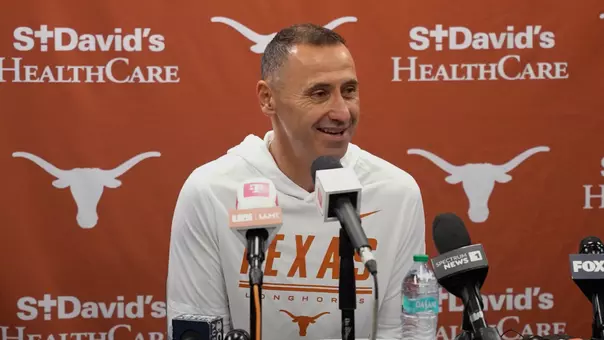
Tom Herman met with the media Monday afternoon to preview Saturday's game against Kansas State.
Opening statement: Not a thing to talk about other than happy to be back in the win column, after the Iowa State game. Happy to be back home this week in preparation for a home game. It feels like it's been quite some time with the loss at SC, and then the open date, it had felt like a long time since we had tasted a victory. So that felt good.
Really, really proud of the way that our defense has played the last three weeks. They're playing at a level that we can certainly win with. Continue to try to develop an identity offensively. Which, again, has become increasingly difficult, based on when you lose your two starting tackles and your starting tight end it's difficult to find ways to run the football.
And hats off, I said it post game, ton of credit to Matt Campbell and his defensive staff, and played literally two years of breaking them down, hadn't seen that front or coverage that they played pretty much the whole night against us. There was a lot of adjustment, and for an inexperienced offensive line that's difficult. And for the tailbacks, as well.
So it's back to the drawing board a little bit, but I think there will be some carry over this week in terms of the running game, which will enhance the way that we go about doing things, because it's carry over, and it's not a complete departure. I think those of you that were paying attention probably noticed quite a few differences in formations and run plays against Iowa State as compared to maybe the weeks prior, to try to get the best players in the right position to do their job in the run game.
So we've got to be able to do that, we've got talented receivers, but when a team is dropping eight guys into coverage every snap or almost every snap it's very difficult to throw the football, and you've got to be able to run it in those situations. We did sporadically, but not consistently enough.
Injury update, Connor Williams, after meeting with numerous different medical teams is going to proceed with a nonsurgical treatment of his medial collateral ligament and we'll evaluate it again in two to three weeks, and hopefully this conservative approach, going without surgery, will heal him up the best for the long-term, as well as allow him to get back into uniform here before season's end. So excited about that diagnosis.
And then lastly, just about the opponent coming in this week, there's probably not a coach in our profession right now that is more well respected than Bill Snyder. Unbelievable job in what he has done there, and it probably gets said every week of every year, but to take literally the worst college football team in the history of college football and turn it into what he's turned it into is remarkable. And this is going to be a physical, physical game. That's their deal. It has been for a long, long time. And that is exciting, because that's kind of a little bit what we like to think of ourselves, too.
So we understand that offensively. Probably not going to get a lot of possessions. I think last year Texas only ran 66 plays against Kansas State, so they're going to try to possess the football, and play really, really sound fundamental defense on that side of the ball. And obviously the guy that stands out is the quarterback, Ertz, kind of the do everything guy, can run it, can throw it, can get him out of bad plays, check him into good plays, improvise, he's a fantastic college football player.
On Shane Buechele's protective boot that he is wearing: Yeah, Shane -- yes, the boot is protective. So we went out yesterday in practice, pretty big brace on. We didn't put him in any situations where there was a defense, because he still wasn't moving really well. So he'll wear that boot unless he's training or practicing or whatever. We're going to get a PRP shot in that ankle to try to increase the healing time on that. We think that he'll be -- he won't be a hundred percent, but a quarterback with an ankle probably doesn't need to be a hundred percent to be serviceable.
On comparing the quarterbacks and their contrasting styles: Yeah, yeah, and Shane's had a couple of picks, and fumbled a couple of times, we just happened to recover a couple of his fumbles. He's got ball security issues, too, that's one of the things we've addressed offensively. We've had eight turnovers in four games, that's an average of two a game. That's too many. Thank goodness our defense is getting the ball. They're creating turnovers. And we're scoring off of their turnovers gained, and they're holding opponents quite regularly when we do turn the ball over. So we're playing good team football as far as that's concerned.
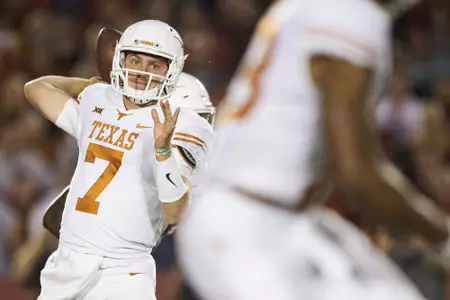
In regard to the quarterbacks, again, do I feel good? We've got to get better. Shane has got to be better, Sam has got to get better. We've got to get better everywhere, especially on offense. But we feel like you can win with either one of those guys at quarterback.
On finding ways to get Collin Johnson touches: Well, it's too hard to do. It's a cloud corner that sits there and recruits up the line of scrimmage and a safety right over the top of them with 12 yards. We're running them on corner routes. We were trying to find ways to get them. But to say we aren't going to throw the ball deep versus that coverage, it's an impossibility. But he does need to get touches, and we were trying to ever manufacture them, couldn't hit him a couple of different times when we tried them. I would imagine we're going to see more and more of that. One of my projects this week is to say let's figure out how to get him the football, because he's got a unique skill set. We'll just move him around. You don't just move around a 6-6, 220 pound receiver, you don't just put them in the slot. And then they find him in there and they double him in there. And it's a fish out of water. You've got to create opportunities, whether it's when they are leaving them one-on-one of being able to recognize it prior to snapping the football and get you into a Collin Johnson play, if you will, something of that nature. We've got to do a better job of getting him the football. But his skill set, it's a lot different than saying we've got to get Reggie the ball, great motion in the back field, run him on some jet sweeps, throw bubbles, where Collin's area of expertise is go routes and post routes. And when you take that a way, it's difficult to manufacture than other ways to get him the ball.
On things he's liked offensively: I think in the USC game we took advantage of one-on-one match ups and we made plays in the throw game, for sure. I liked the schemes that we had for the Iowa State game, although a lot of that got thrown out of the window early. So I feel like we're headed down the right path in terms of personnel and formations. We've got to do a much better job of coaching our guys and adjust to different things that you don't plan for.
So those are probably two of the biggest things, is that -- and then third down. I think on the season, which includes the first week, we're at 47 percent on third, and fourth down like 49 percent. We're staying on the field. I've never been a time of possession guy, but I look and I think two out of four games we've almost doubled our opponents time of possession. So we're keeping our defense off the field, keeping them fresh. And we've got a lot of work to do in the run game still.
On the running backs and their lack of missed tackles: The answer is yes and yes. To your observation, we're not making very many people miss. If it's blocked for four, we're going to make four, if it's blocked for six, we're going to make six. Where the great backs if it's blocked for four they give you eight and if it's blocked to one, they give you three or four. So and that's been addressed. Not hit the panic button yet. Chris and Kyle know that everybody wants to throw -- when you don't run the ball really well, everybody wants to throw the offensive line under the bus, but it's a collection of things. You'll see Toneil play more, he played more against Ohio State and he'll play more this week, too.
On patience offensively and if it gets easier the longer a player is in the program: I hadn't thought a lot about it. But we're still getting to know the players what they can do when the lights are on. And I think that's -- Cade Brewer is a prime example. That's a guy every time we've put him out there he's done well. So let's play him more. He's a true freshman. In over time in front of 95 thousand people in the Coliseum against the No. 4 ranked team in the country, down by 7, we had a true freshman throwing to a true freshman for the game tying touchdown. Not exactly where I would have hoped to be, but it's where we were and those guys came through. And the more they come through the more they're going to play.
But it's not -- I think it's more of knowing what our guys can do and less staff things, other than Tim Beck, I've worked with every one of the guys on the offensive staff, and Tim and I are very aligned in the things we believe in.
So communicating, adjusting, all that stuff is -- from that standpoint, it's not very difficult. It's, okay, what can these guys do, what can we do to put ourselves in a more advantageous position.
On making the offensive line work: I think you've got to change your expectations a little bit. Here's where there's a caveat to that, though. The caveat is if they're dropping eight into coverage and not supporting the run with their safeties and only playing a three-man front, you have to run the football. There's no other alternative. And so that was -- not disappointing, because we did it at time. 13 plays, seven and a half minute drives to end the game, I thought Tim and Derek did a great job, especially on the two third downs, calling quarterback draw. And thought everybody was going to get out of there and we could run the quarterback up in there.
There's nobody that's slept less and pulled more hair out than Derek Warehime at this point. But everything that we're doing or that he's doing I'm in full agreement with and we've got to do more of it in terms of repetitions at practice. And we've got to oftentimes, us being around each other for so long, I think there's a propensity on a day like day when you're game planning, and you say, hey, great, Kansas State is four down quarters, they play one up man 20 percent of the time. We used to do this, this, this, this, this and this and this, and then we're back in 2015 we did this. And then all of a sudden you look up and you've got 39 different run concepts up there and that's not fair to the in experience that we have at offensive line. So I think that's been the biggest thing is let's condense, let's make sure on Monday and Tuesday when we jog out on the practice field our focus is very, very narrowed in the run game, so our guys can get good at coming off the ball.
On coaching until he's 78 like K-State head coach Bill Snyder: I don't. I've got a 13 year old daughter that hasn't seen her dad very much. Ten year old son and an almost four year old son now that -- it will be a while. 36 more years? No. But if all goes according to plan we're going to be here quite some time. I would say 36 years might be a little bit long, though.
On his relationship with Tim Beck and learning to make adjustments: I didn't work with Major prior to (him) calling plays for me. And that was a very seamless transition, even though it came to adjustments. I think the biggest thing is that as a head coach, one, you've got to manage the game. That's why -- I mean I envy those guys that are head coaches and call plays. I don't know how they do it. They've got a different skill set than me, maybe.
I was always best calling plays from the box, too. And there were times in my career when a head coach would ask me to be on the field, whether it be a quarterback needs to be down there, the offense needs me. And I was a fish out of water. And so the biggest thing that we're learning, when I say we, myself and Tim Beck, is I can give you some really good input if you give me great communication of what you're seeing up there. Because I don't see the game really well down here, and I'm worried about getting the punt team on, are we going to fake a punt are go for it on the fourth down, I'm cheering up the defense, and doing all this, and hey, tell me what you see and I can help. And so that's where the very detailed communication of what's going on and what different down and distances is going on, when it's occurring and all of those things that I think has gone well. We can obviously still get better at it. But has gone well. And then, yeah, I mentioned on the call, you know, that it has nothing to do with talent. It's a trust issue and had some long, hard conversations with him and Coach Warehime that we've got to coach him to go to the right place with the right technique, with the right effort level because he's a talented guy that we need on the field. And I think even a guy like J.P. Urquidez is getting better week-by-week. Tope is not ready, but maybe by -- in a couple of weeks or towards the end of the year he would be. And then we've got Terrell Cuney, is a guy on the inside. The inside guys aren't playing awful right now. I mean outside guys aren't playing awful, either. But I think the inside guys are fairly solidified. We need to find some more consistency at tackle.
On special teams and the crazy third-quarter sequence at Iowa State: Yeah, you put the ball on the ground on a kickoff return, that's -- on kickoff return, I mean you think about that sequence now. Our Ray Guy punter finalist has a 17 yard punt, which sets them up in scoring position. They score to make it 14-7. Kick it off. That kickoff, we fumble it, and again the way we look at things around here, if the ball is out and you're not handing it to the official, then we consider that a fumble. We fumbled that. That gets overturned, rightfully so, his knee was down by rule. And then we throw the screen and it gets batted and there's no whistle. And things we've got to do a better job of reinforcing some things that you think are common sense, like, hey, there's penetration on a reverse, don't pitch it. If the ball is on the ground on a bubble, don't assume that it was a forward pass, fall on it. That's coaching. We've got to do a better job of reinforcing even the smallest of details that seem -- or you could assume as a coach would be common knowledge, but that we've got to cover all of those things.
Those plays could have been -- I don't hate to say, you should have won or could have won, could have done this or that, who knows? Our team -- our defense could have forced a turn over thereafter the fumble kickoff or whatever. There's a lot of different outcomes. But to answer your pointed question, I was really, really happy with the composure, especially offensively, where it could have been finger pointing, head hanging, moping around, the whole nine. And they were ready to go back out there time and time again to move the football.
On the defense and comparing it to defenses he's had in the past: Our defense in 2015 at Houston was pretty dominant. We were producing more offensively than we have been here through first quarter games. But we were pretty dominant. I don't know if it was dominant defense, but in 2012, we were not very good on offense. But we found ways to mix and match parts and took advantage of a down year in the Big 10 and went undefeated. But we were -- I think we were down to Miami and Ohio in the second quarter, we were only up two against AUB in the third quarter early in the season that year, but we got better. I think we beat Michigan State 17-16 that year.
On where Chris Warren needs to improve most: Making yards that he's getting tackled, still seeing to be some old habits kind of come back a little bit. Chris is running hard, make no mistake about it. And Chris's desire, effort and his accountability to his teammates is phenomenal. But again we've talked about it before, if I'm a six foot man, two yards long. So every time I get tackled, if I'm getting tackled going forward that means I'm going to gain a yard and a half to two yards getting tackled. And getting stood up or stood backwards or thrown sideways, that's a big difference. And it's pad level, it's lean, and it's finish on the point of contact.
On the keys to the secondary's success: The pressure on the quarterback. A lot of those picks are thrown right at him. And so that's -- and I think most secondary coaches will tell you that. You get good pressure on the quarterback and good things are going to happen on the back end.
On getting the defense to play at a high level: Belief. Of the biggest -- I think I told you guys the biggest mantra on that especially on defense, is cut it loose. Don't worry about the call. Don't worry is the back going to cut back, is the quarterback going to dodge me this way, just go. Just stick your foot in the ground and go as hard as you can go with your hair on fire and trust and believe that the other ten guys are doing the same thing right behind you. And then you can cut it loose and play with confidence. And I think -- I realize where San Jose State is in the pecking order of college football, but to shut a team out that had been scoring a lot of points and yards and all that stuff, and really do it in a much different way than what you saw in week one in terms of flying around and hitting people and being physical and not evaluating was a big step in the right direction that, okay, we're going to take this belief, which we thought we had through nine months of training, and a lot of old habits reared their ugly head in that opening week. But, again, I think for the first time our defensive players, rather than just say -- pointing fingers or say, well, we're just not good or lose confidence, they said, hey, let's try it this way. Let's try it this way, let's give it a shot. And they came out like gangbusters against San Jose State. 170 yards total offensive, and zero points, I don't care who you're playing, that's a pretty good day at the office. And they kind of realized, wow, this feels pretty good. And so then you is show up at USC and you're able to do the same thing and have similar results against one of the best offensers in the country, then it's okay, now we know. And I would imagine you'll continue to see them play that way.
On Kansas State and their toughness: Yeah, they recruit tough guys at that position. And they play tough guys at that position. And there's a lot of single wing principles to their offensive, the quarterback is the main ball carrier. There will be times when the quarterback and the fullback are the only people in the back field, not even a tailback in the back field. So I think it's toughness his probably the biggest thing. And when you're tough you don't go down easy and you turn what might be a four or five yard gain into a 12 yard gain, or you step through that last arm tackle and turn it into a 25 yard gain. But that's the thing to me that has stood out since I've been watching Coach Snyder's quarterbacks. They've all been tough dudes.
On his schedule and how much time he spends on game planning: Pretty much all of Monday, except from 11:30 to about 2:30, doing the conference call, this, and then the weekly rewind on Longhorn Network, so that's three hours I'd have to leave the room. But from 7 a.m. to 11:30, and then from 2:30 to 9:30, 10 p.m., you want to have 90 percent of your first and second down game plan in when you walk out of the building on Monday.
And Tuesday Morning we'll come back in, slept all night, maybe jotted some notes down in bed, watching film on your iPad in bed on Monday night. And so then Tuesday Morning will be what I like to call the cleanup of your first and second down game plan. And I'm in there the entire time. And then about 11:30, noon, we'll break for lunch. I go work out and Tim scripts practice. And then we have practice. I take a bunch of notes in practice and try to coach as much as I can on Tuesday in practice and then come in and watch the video of practice Tuesday night until about 10 p.m. Get done with watching practice, make the necessary corrections or deletions, a lot of times you've only got one more day, let's not invest in that anymore, we're not where we are where we thought we'd be on a certain play.
The next day you get up at 6:45, 7 a.m. Coach Mehringer had watched third down and red zone and he'll have in ideas. He'll present those ideas and Tim and I and the rest of the offensive staff will game plan and third down and red zone, and that will be the heavy emphasis of practice on Wednesday, will be third down and red zone. And Thursday no game planning going on, just a cleanup day, and narrowing your focus. So other than the three hours on Monday, I'm in there.
On the quarterbacks: I don't know. I don't know, because I've never been in a position where you only have two on scholarship. So that always makes me nervous, when the only other one you've got, you're going to throw them in there and run the risk of injury and now you're down to one. So we'll continue to Jerrod's practice -- the reason you didn't see Jerrod, he required 19 stitches. He got stepped on in practice on Wednesday, and cut his hand all the way into the meat, I guess, is the best way to put it. So, I don't know. It's something that we -- Tim and I talk about from time to time. And maybe as the season progresses you're more apt to do that.
On if you need a mobile quarterback for this offense to be successful: I don't think JT Barrett is much better runner or faster or anything than Shane or Sam. I mean did all right with him and Cardale (Jones). I think you need a guy that can improvise and make plays with his feet, but you don't need Braxton Miller or Greg Ward, Jr. As I said before, it helps. As you saw, we converted a third and short and a fourth and short running a quarterback sweep with Shane in there. And those always help because you add an extra blocker. But you don't need that kind of dynamic ability. You need a steady guy that's going to make a few yards when the yards present themselves.