The University of Texas at Austin Athletics
07.08.2016 | Baseball
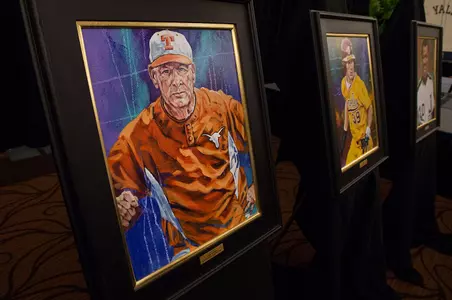
Former Texas Baseball head coach Augie Garrido was inducted into the National College Baseball Hall of Fame last weekend.
LUBBOCK, Texas – Given that Saturday night, July 2, had been billed as a "Night of Champions" for college baseball, it will come as no surprise that much of the web woven in the ballroom of the Overton Hotel was linked with threads connected to The University of Texas.
The finest piece, of course, was the induction of Augie Garrido into the National College Baseball Hall of Fame. Augie, who was a dual inductee from both Texas and Cal State Fullerton, became the tenth Longhorn to enter the Hall in its 11 short years of existence.
He is the fourth coach, joining Billy Disch (2008), Bibb Falk (2007) and Cliff Gustafson (2006). Longhorn players enshrined include Brooks Kieschnick (2006), Greg Swindell (2008), Burt Hooton (2008), Keith Moreland (2009), Kirk Dressendorfer (2009) and Richard Wortham (2010).
The 2016 class included retired coaches Robert Braddy of Jackson State and Tommy Thomas of Valdosta State. The players named were J. D. Drew of Florida State, Matt DeSalvo—who won a collegiate record 53 games at Marietta College—Rick Monday of Arizona State and Tom Paciorek of Houston.
Other award winners were Trinity's Tim Scannell (Skip Bertman National Coach of the Year), Clemson's Seth Beer (Dick Howser Player of the Year), Kent State's Eric Lauer (Pitcher of the Year), OU's Sheldon Neuse (Brooks Wallace Shortstop of the Year), Louisville's Brendan McKay (John Olerud Two-Way Player of the Year) and the late Gus Steiner (National Collegiate Umpire Award).
As each award winner spoke, there was an obvious theme permeating their thoughts about the game. Garrido—as usual—set the philosophical tone.
In an interview late in his life, Darrell Royal was asked the question about "What It Means To Be a Texas Longhorn."
"It is a chance," Darrell had said.
As he spoke on that Saturday, Augie noted that many people think of baseball as a game of failure. Often it has been said that the sport respects hitters who bat just over .300—which means you have made an out two-thirds of the time.
As each speaker was interviewed Saturday, their path to that night was illuminated. Jackson State's Bob Braddy spent 28 years at his alma mater and in 2003 became the first African-American coach to be inducted into the College Baseball Coaches Hall of Fame. He remembered working in the fields, picking cotton. Another coach recalled cropping tobacco leaves in the fields of North Carolina.
Augie remembered picking fruit in the valleys of California.
"It wasn't easy for any of us," Augie told the crowd of over 400. "But it helped us become who we are. Baseball coaches don't come from the country clubs."
"But I see the game as something different from a game of failure. It is a cruel game. It will break your heart," he said. "But it is like the cliché of the glass being half empty or half full. I choose to see baseball as an opportunity."
When asked about his decision to go to college rather than enter professional baseball out of high school, one of the honorees said, "I thought about it, and I decided it [going to college] was a piece of life I didn't want to miss."
And so with that, "opportunity" became the pervasive theme of the night.
The late Gus Steiner had become a superb collegiate umpire, despite losing an arm at a young age. Tom Paciorek turned out to be one of those threads connected to Texas. He had gone to the University of Houston as a football and baseball player. In 1966, he was part of history when his Cougars played Texas in the NCAA District playoffs in the Astrodome—the first indoor college games ever played. And then a year later, he was a part of another kind of Longhorn history, as UH came from behind to knock Texas out of the 1967 NCAA playoffs, defeating a favored Texas team in the final game Bibb Falk ever coached.
And then there was Augie.
When his 1995 Cal State Fullerton team won the College World Series, it was Garrido's third national championship in 17 seasons. That squad is still considered perhaps the best in the history of the game. By 1996, Augie had established the Titans as a national power, and taken a three-year swing in the Big Ten where he brought Illinois its first league title in years.
Texas had parted ways with Cliff Gustafson, who at the time was the winningest coach in the history of the game. The Longhorn job was open. Was it a glass half empty? Or half full? The answer, it turned out, came from his root. Augie's mom had been part of a west Texas family, growing up not far from Lubbock. The Dust Bowl had driven her family from the state, but the lure of the Lone Star was always a part of his DNA.
And so, following the 1996 season, he surveyed his life, and with his life partner Jeannie Grass, agreed with DeLoss Dodds and Butch Worley to become the coach of the Longhorns. What followed would be two more CWS titles, and two second-place finishes. And as television brought the college game into the bright lights, he became the winningest coach of all-time in 2003 in a series where the Longhorns eliminated No. 1 ranked Florida State in Tallahassee.
More than that, he taught kids about baseball, and about life. He told them how to conquer fear, saying the only way to do it was with confidence. He taught them that they had been given a gift; a chance to play a kid's game at the highest collegiate level.
And there, my friends, is that word again.
What was it Darrell said that it meant to be a Longhorn?
"It is a chance," he said. No more, no less. An opportunity.
And therein comes the final piece of the "Night of Champions" that connected the evening to the Longhorns.
In the period from 1968 through 1974, Cliff Gustafson's Longhorns were a fixture at the College World Series. Time after time, they and others would be thwarted because of a dynasty built by Rod Dedeaux at Southern Cal. In short, as teams came to Omaha, most teams came "hoping" to win. Southern Cal came "expecting" to win.
But when the Longhorns got to Omaha in 1975, Southern Cal was not there. That was because a young coach named Augie Garrido, whose small school had a budget of less than $5,000, had shocked the Trojans in a regional in their own park.
That was when Augie met Cliff, and a friendship ensued that would be a part of the fabric of Texas baseball. Texas won the 1975 title because of the heroics from players like Keith Moreland, Mickey Reichenbach, Jim Gideon and Richard Wortham.
But there was one other guy who made a difference.
In the Longhorns' win over South Carolina that led to an eventual championship game, a power-hitting outfielder was struggling at the plate. Gustafson called time out, and with a count of 0-2 on the batter, called on Mark Griffin, a little guy whose limited career had produced only a .263 batting average. And he sent him to the plate. With only one strike left, he laced a single that plated a run, and ignited a six-run rally.
In the program for College Baseball's "Night of Champions", page 14 is a full page ad with a collection of baseballs photographed in sepia tone, as if they are artifacts from the past. Centered in the middle of the page is this quote from the legendary Cleveland Indians pitcher Bob Feller:
"Every day is a new opportunity. You can build on yesterday's success or put its failures behind and start over again. That's the way life is, with a new game every day, and that's the way baseball is."
The page is sponsored by Mark Griffin, a former Texas Tech regent, and the head of his dad's oil empire which included Griffin Oil, Griffin Fuel and Transportation, Pro Petroleum and Rip Griffin Travel Centers.
It is, after all, about opportunity.